Product1 publisher3 min readPublished
A four-hour battery retrofitted into an operating solar farm is the template load planners must price
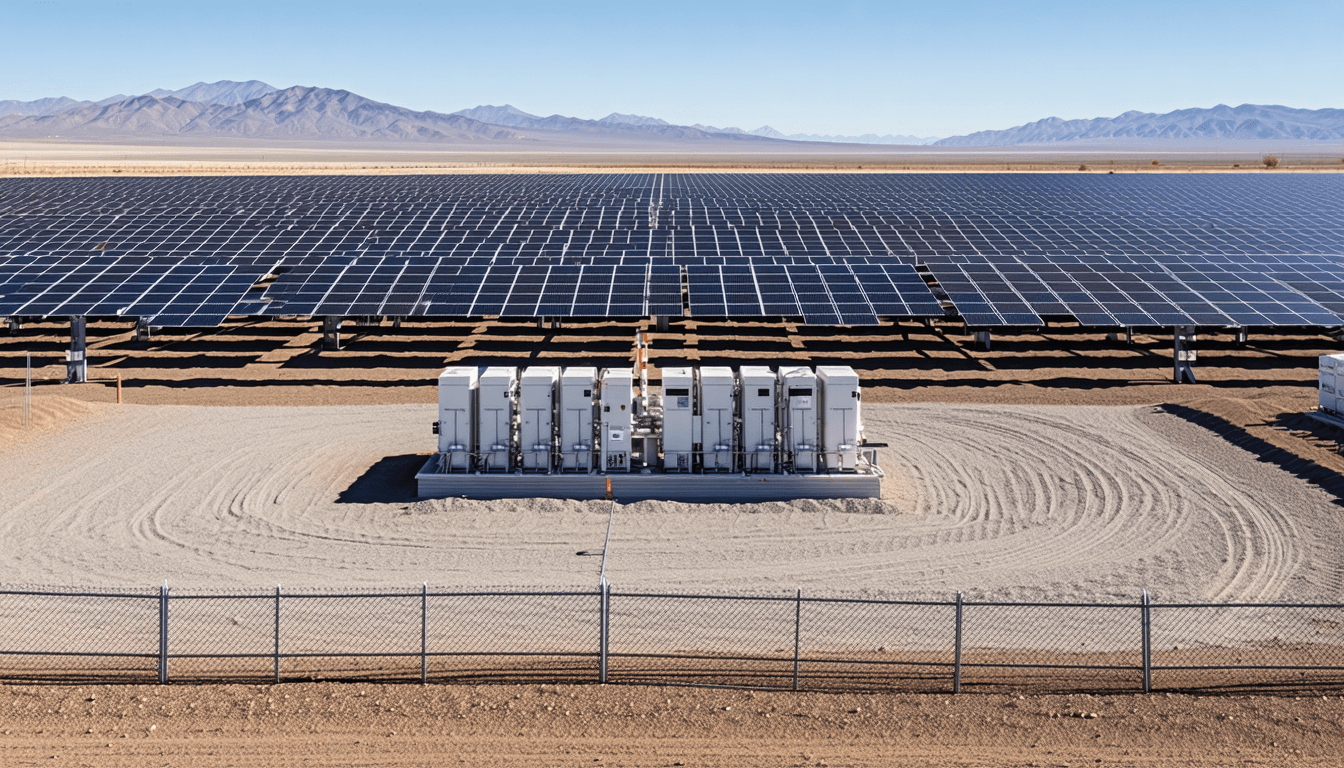
EDP Renewables North America and Redwood Coast Energy Authority put a 92 MW / 368 MWh battery inside the existing 300 MW Sandrini Solar site in Kern County. The structure matters more than the size.
The Product Desk · Product desk
Drafted by a language model from the sources cited here and checked against its claim ledger before publication. How we use AISend a correction
What happened
- Sandrini Energy Storage, a 368 MWh battery energy storage site in Kern County, California, has gone online.
- The project was launched by Houston-headquartered EDP Renewables North America (EDPR NA) and the Redwood Coast Energy Authority (RCEA).
- The project can deliver 92 MW of power and 368 MWh of energy storage capacity.
- The storage facility is located within the existing 300 MW Sandrini Solar energy site.
- Sandrini Energy Storage has a nominal duration of four hours.
Compiled by The Product DeskSomething wrong?How this is made
Why it matters
EDP Renewables North America and the Redwood Coast Energy Authority have brought Sandrini Energy Storage online in Kern County, California, a battery rated at 92 MW and 368 MWh that sits inside the existing 300 MW Sandrini Solar site [1][2][3][4]. The size is unremarkable; the structure is the part that data center and industrial load planners now have to model, because a retrofit into an already-built solar site is the cheapest form of new firm-ish capacity available in most western interconnection queues.
Divide the ratings and the asset is four hours long [5]. Its power rating is roughly 31 percent of the solar nameplate it was added to [6]. That is the shape of the product: not baseload, but enough to move a defined block of afternoon output into the evening peak. EDPR NA chief executive Sandhya Ganapathy described energy storage as transforming renewable power into "reliable, around-the-clock electricity" [7]. Four hours is not around the clock, and operators sizing load against a site like this should plan for the block, not the slogan.
The offtake is the more instructive detail. The solar site supplies RCEA with 100 MW [8], and RCEA also holds an energy storage service agreement covering 100 percent of the new project's storage capacity [9]. A single public buyer has taken the entire storage product, which is what a large private load would have to match or outbid to get comparable rights at a co-located site. RCEA executive director Beth Burks said the project adds clean capacity, boosts the generation from Sandrini Solar, and supports grid reliability [10].
Treat the marketing arithmetic carefully. EDP says the capacity is enough to power the equivalent of more than 22,000 homes [11]. Against 368 MWh, that works out to about 16.7 kWh per home [12], meaning one discharge cycle, not a day of supply.
The community-benefit numbers are worth reading side by side. EDP says the storage project will contribute more than USD 5 million for local public services and infrastructure including schools, roads, emergency services and parks [13], and that it created roughly 50 construction jobs [14]. The two projects together created about 250 jobs and are expected to generate more than USD 25 million in local tax revenue [15], which implies the solar phase carried roughly 200 of those jobs [16]. Storage is light on labour and comparatively heavy on tax base. Anyone negotiating a benefits package around a battery addition should price it that way.
EDPR NA now reports approximately 1,230 MW of gross operating wind, solar and storage in California, which it equates to more than 485,000 homes [17], and about USD 154 million in economic impact in the state, including over USD 41 million to local governments and over USD 33 million to landowners [18]. In June the company inaugurated Flatland Energy Storage in Coolidge, Arizona, at 200 MW and 800 MWh [19], also a four-hour configuration [20], making Sandrini about 46 percent of Flatland's energy capacity [21]. The reporting does not disclose a capital cost or contract price for Sandrini [22], so the per-MWh economics that would let a load planner benchmark it remain unavailable.
What to watch: whether full-capacity storage tolls to a single public offtaker become the default in California, whether EDPR NA and its peers repeat the retrofit-into-operating-solar pattern rather than greenfield hybrids, and whether the standard duration moves past four hours as evening peaks lengthen.