Product1 publisher2 min readPublished
Georgia regulators have approved more than five times the battery storage now running in the state
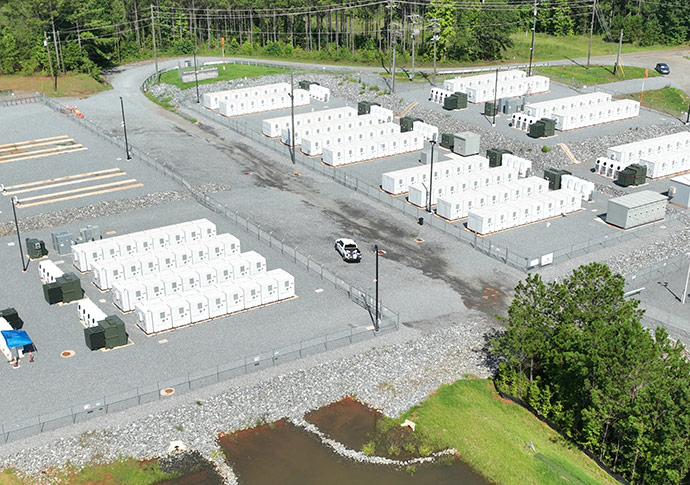
Georgia Power has put its 128 MW Robins battery into commercial operation next to a solar plant. The much larger queue of approved storage behind it sits mostly at existing power plant sites.
The Product Desk · Product desk
What happened
- The 128 MW Robins Battery Facility near Warner Robins has entered commercial operation, able to send up to four hours of stored power to the grid when demand rises.
- The battery sits beside the Robins Solar Facility and stores its output when demand is lower, releasing it later in the day when consumption is higher.
- With completed projects in Cherokee and Lowndes counties, Georgia Power puts its operational battery capacity at 579.5 MW, and a 57.5 MW facility in Floyd County is nearing completion.
- Georgia's Public Service Commission has approved nine more battery storage facilities across eight sites, together expected to add more than 3,000 MW of capacity.
- Burns & McDonnell built the Robins project and delivered it on schedule, according to Georgia Power.
Compiled by The Product DeskSomething wrong?How this is made
Why it matters
- constraint A load that runs continuously gets four hours of help from an asset like this and buys firm generation for the other 20, so storage moves the peak-period part of a bill and leaves the rest alone.
- decision Anyone modelling supply in middle Georgia has to model a cold winter morning, because that is one of the peaks Georgia Power says it dispatches this battery into.
- contradiction Robins is solar-paired; the queue approved behind it is described as storage only, so treating this project as proof that new Georgia storage arrives attached to new solar plans against the wrong pipeline.
- precedent Nine approvals granted at once make storage at existing plant sites the default next increment in Georgia resource planning. A developer pitching a pilot now has a working 128 MW comparison to answer.
The people who have to do something with this are the ones writing a load profile for a new site in middle Georgia. What Robins gives them is four hours of discharge [14]. At 128 MW, a full-power four-hour discharge is 512 MWh, and it covers four of the day's 24 hours [15][19].
Georgia Power's description of the dispatch window is more useful than the nameplate. The company says the battery holds energy when demand is lower and releases it during peak periods, including cold winter mornings [4]. A plant that runs around the clock spreads its demand across every hour. It buys supply in all 24 hours, and four of them are what this asset addresses [19].
Rick Anderson, senior vice president and senior production officer for Georgia Power, said: "By pairing battery storage with solar generation, we're creating a more flexible and resilient grid that can respond to customer needs during periods of peak demand while supporting Georgia's continued growth" [6].
Pairing is the part to test against what has actually been approved. Robins is one of four battery projects approved in Georgia Power's 2023 Integrated Resource Plan update [7]. The sites named in the newer round of approvals are facilities at Plants Bowen, Hammond, McIntosh, Wansley and Yates, plus standalone projects in Hall and McDuffie counties [10]. Solar pairing shows up in a separate set of approvals, two projects in Laurens and Mitchell counties for 350 MW of generating capacity between them [11]. All nine of the newly approved storage facilities are described as storage only [20].
The size is in the pipeline. What is approved is at least 5.2 times what is operating [16], and the operating number goes to 637 MW once the 57.5 MW Floyd County site finishes [17]. Robins by itself equals about a fifth of the fleet already in service [18]. Spread across the 2.8 million customers Georgia Power serves, that operating fleet is about 0.2 kW each [22].
The site is near Robins Air Force Base [13]. Georgia Power did not give a cost for the facility or an energy rating in megawatt-hours [21].
The sorting test runs on last year's meter data. The number that decides it is how many of a site's hundred highest-demand hours fell inside a single four-hour block; a high count means the approved storage can reach the demand charges on that bill, and a low count means the site is buying firm capacity for the other 20 hours whatever the commission approves next [9][19].
What to watch
- Whether the nine approved facilities are filed as plant-site storage or come back with solar attached.
- Whether Georgia Power's next resource filing specifies durations longer than four hours for any approved site.
- Whether the Floyd County project completes on the schedule Georgia Power has described for it.