Science1 distinct publisher3 min readPublished
A University of Virginia group turned an MRI scanner into a nanoparticle counter and found that delivery through an ultrasound-opened blood-brain barrier rose to 15 nm, held at 23 nm, then fell away at 45 nm.
The Scientist · Science desk

Compiled by The ScientistSomething wrong?How this is made
A bell shape is harder to account for than a straight decline, because it needs two things in tension rather than one filter. If the temporary gap that focused ultrasound pries open [4] simply acted as a sieve, delivery would fall as diameter rose. The 45 nm particle has 27 times the volume of the 15 nm one, by diameter cubed [3], and it did land at the bottom [12]. But the 2.3 nm gadolinium agent landed there too [12]. Being small appears to cost you something here as well, and the reported account does not identify what.
The arithmetic of the curve is internally consistent, which is worth checking before building on it. The two reported multipliers leave the largest particle at 2.6/2.5 = 1.04 times the smallest, roughly 4% apart [2], which is what "comparable" should mean. The stated 20-fold size range works out at 45/2.3 = 19.6 [1].
Then the control question. Three of the four particles were iron oxide, at 15, 23 and 45 nm [7]. The fourth was a gadolinium chelate at 2.3 nm [6]. Within the single chemistry, the pattern is level and then falling, which is roughly what the old size-exclusion rule of thumb would predict [2]. The finding that smaller is not automatically better therefore leans on a step between two materials as well as between two sizes, and diameter is not the only property that changes when you swap a small gadolinium chelate for an iron oxide nanoparticle.
That is not grounds to discard the result. It is the reason the measurement matters more than the curve does. Quantitative susceptibility mapping reads the phase shifts that magnetically distinct material imposes on the MRI signal and converts a 3D susceptibility map into concentration [13], with reported sensitivity down to fractions of a percent of the injected dose [14]. Against what was available before, that is the enabling part: fluorescence is semi-quantitative and PET is spatially coarse [15], and T1 mapping has been capped by commercial contrast agents that are small next to the immunotherapy and gene-delivery agents anyone actually wants to dose [16]. Whoever wants to re-run the size series with matched chemistry can now do it and get numbers back.
The thing this doesn't tell you is whether any of this works as medicine. All four particles are proxies for therapeutic candidates [6][7], not therapeutics, and a concentration in tissue is not the same as a drug reaching its target or doing anything once there. The quoted numbers are also the healthy-brain arm [9]; the study included glioma-bearing animals [8], and a tumour adds a blood-tumour barrier of its own [18], which is the barrier that matters for the indication most often invoked to justify opening the first one.
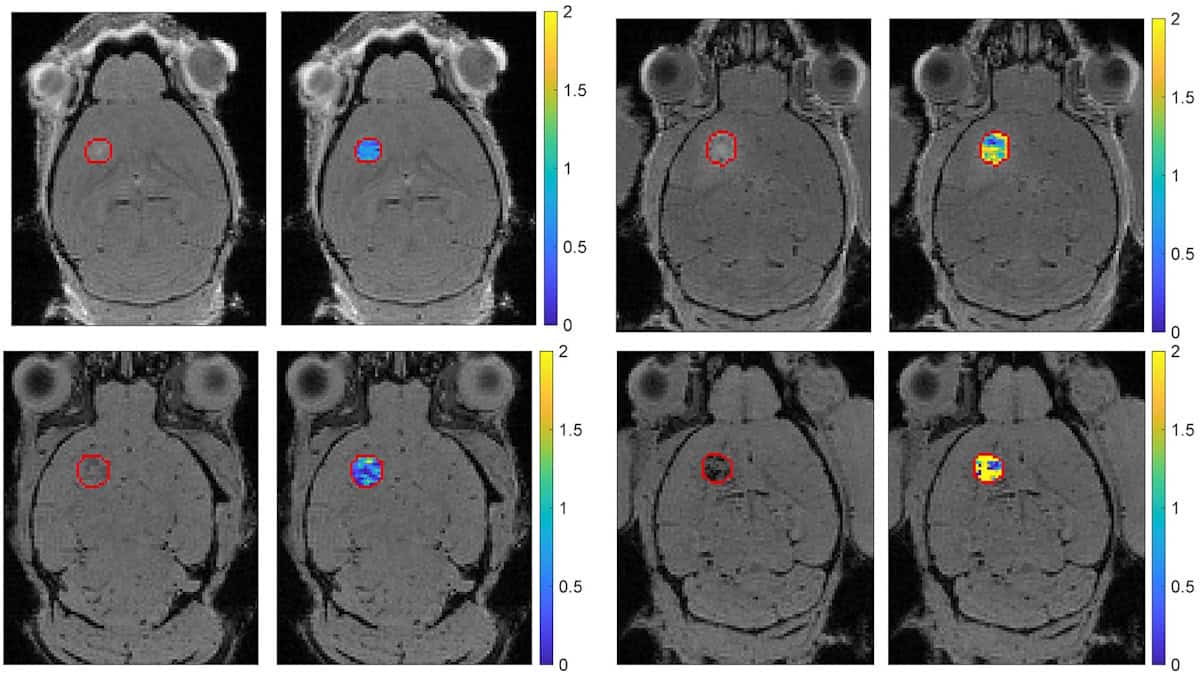
Ranked by verification strength, evidence, and original report placement.
Focused ultrasound (FUS) can safely disrupt the blood-brain barrier for drug delivery.
A long-standing assumption in the field is that delivery decreases as drug size increases.
Researcher Matthew Hoch and colleagues from the University of Virginia have shown that the assumption that 'the smaller the better' might not be entirely correct.
The delivery method begins with injection of gas-filled microbubbles into the bloodstream; focused ultrasound then expands and contracts the microbubbles, creating a temporary, localized gap that pries the barrier open long enough for drugs to pass.
The team tested the approach using four different particles spanning a 20-fold range in size.
The smallest agent was MultiHance, a gadolinium-based MRI contrast agent of around 2.3 nm, used as a proxy for small molecule therapeutics.
Distinct publishers with included, body-backed reporting in this cluster.
1 article · September 2, 2026
Follow any of these and your For You feed starts watching them — no settings page required.
science
The magnitude 9 nobody recorded: why simulated ground motions stay out of the codes1 distinct publisher
science
Graz group measures the geometry a single-molecule collision has to hit1 distinct publisher
science
Silicon's ceiling comes with numbers; its successors so far come with names1 distinct publisher
science
Earth's dragged spacetime is now measured to 0.1%, and quintessence models feel it1 distinct publisher
Evidence-backed comparisons of source perspectives and observed adoption signals. Read the methodology
Which Builder, Operator, and Investor concerns the observed source mix emphasized—not a truth score.
Evidence, demonstrated adoption, hype gap, incentives, and confidence are assessed independently, each on its own current evidence. How these are measured.
Precise numbers, one telling
The 2.6-fold rise, the plateau at 23 nm and the 2.5-fold fall all reach us through Physics World's write-up and nowhere else, and that write-up never names the journal, the dose, or how many mice were scanned. What is strong is the specificity: stated diameters, paired pre- and post-delivery scans, a described physical basis for converting phase shifts into tissue concentration. What is missing is anyone outside the University of Virginia group checking a first-of-its-kind readout that the same group is using to make its headline claim.
Mouse bench, with a trial-stage parent technique
The finding itself has no users: four agents, one mouse colony, and a quantification method whose only practitioner so far is the group that proposed it. The single real foothold is one level up — barrier opening by ultrasound is in Alzheimer's and glioblastoma trials, which is why the sizing question matters, not evidence that anyone has redesigned a therapeutic around a 15-23 nm window.
A sweet spot drawn through four points
"Smaller isn't always better" is fair to the data as reported, but a curve fitted to four particles in mice is a slimmer object than the phrase implies. The deflating detail sits inside Physics World's own figures: cancel the 2.6-fold rise against the 2.5-fold fall and the 45 nm particle lands within a few percent of the 2.3 nm agent, so the practical finding is a narrow mid-range advantage over both ends rather than a case for going big. The furthest reach in the piece is the press-statement suggestion that tumour delivery may even be enhanced.
The lab supplies the frame
Physics World has nothing riding on the outcome, but the shape of the story is the lab's: the novelty of the technique, the unexpectedness of the curve, and the one quote in the piece all come from a University of Virginia press statement attributed to senior author Richard J Price. No outside specialist appears to say whether a bell-shaped delivery curve upends the focused-ultrasound field or simply confirms what circulation-time arguments already predicted.
Confident about the account, not the conclusion
We can stand behind what was reported and much less behind what it means. The piece is internally consistent under the only test available to us — the stated 20-fold span does check out against 2.3 and 45 nm — and technically detailed enough to reason about. But with one publisher, no paper in hand, no statistics, and a novel readout validated only by its authors, our assessment is a careful reading of a single telling.