Science2 publishers3 min readPublished
JWST's best 'black hole star' candidate points to a shortcut for early supermassive black holes
MoM-BH*-1 shows the deepest Balmer break yet measured, which its discoverers read as a 100,000-solar-mass black hole inside a dense gas cocoon 660 million years after the Big Bang.
The Scientist · Science desk
Drafted by a language model from the sources cited here and checked against its claim ledger before publication. How we use AISend a correction
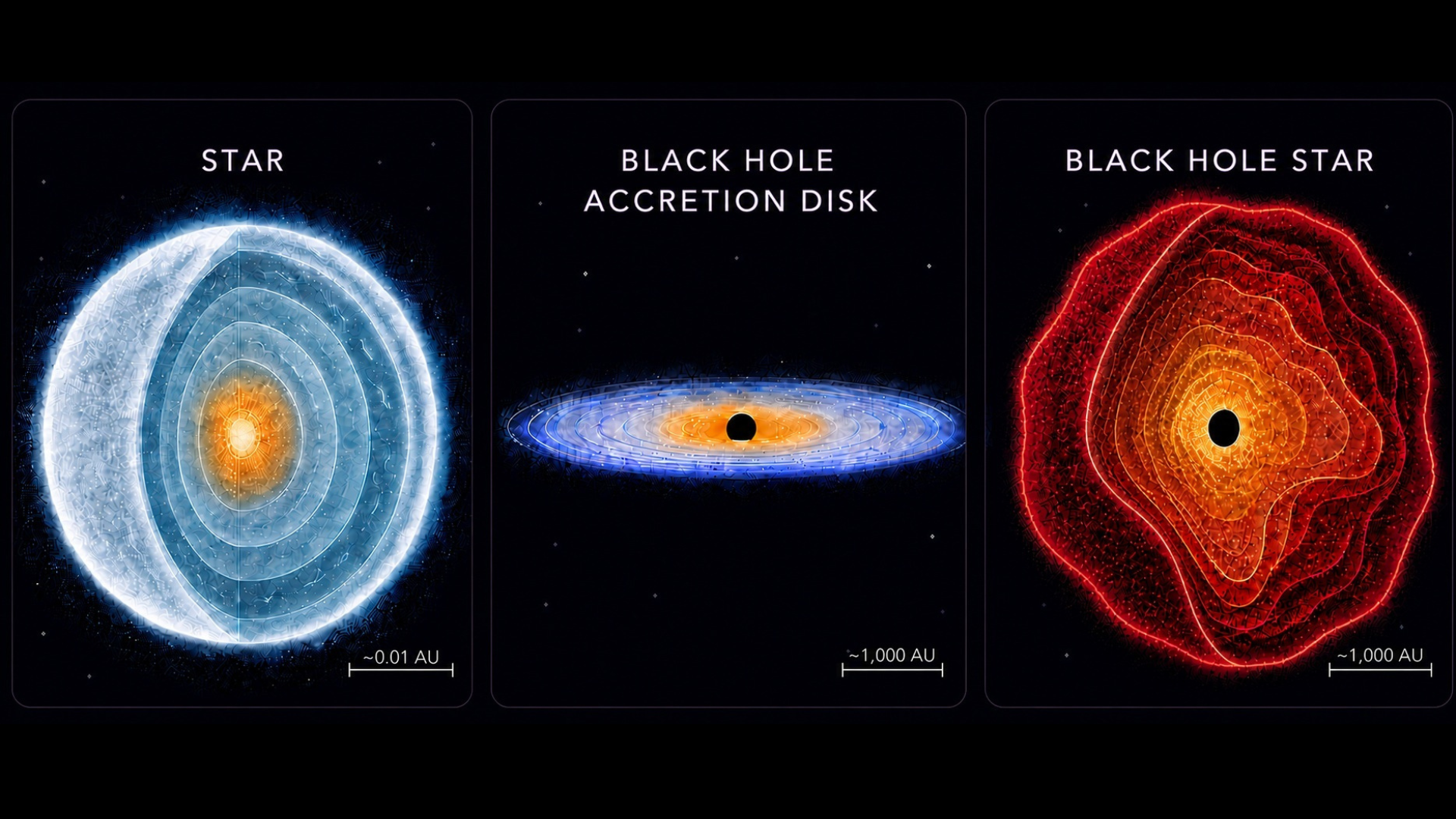
What happened
- Astronomers using JWST's Miracle or Mirage (MoM) survey found the most promising candidate yet for a "black hole star", named MoM-BH*-1.
- The reddish light from MoM-BH*-1 was emitted about 660 million years after the Big Bang, when the universe was approximately one-twentieth its current age.
- Little red dots are hundreds of distant crimson lights spotted by JWST that shine much brighter than stars but are too dim to be fully formed galaxies, making them one of the biggest puzzles in modern astronomy.
- When JWST began observing the distant universe in summer 2022, astronomers found many little red dots; they are highly luminous as an active black hole would be, but their spectra are odd, looking more like stars, with no X-ray emission.
- If confirmed, the findings could help unravel the mysterious origin of little red dots.
Compiled by The ScientistSomething wrong?How this is made
Why it matters
Astronomers using JWST's MoM survey have reported the strongest candidate yet for a "black hole star": a compact red source, catalogued MoM-BH*-1, whose light was emitted about 660 million years after the Big Bang, when the universe was roughly one-twentieth its present age [1][2]. If the interpretation holds, it converts the "little red dot" problem from a question about impossibly compact galaxies into a question about how quickly black holes got heavy [5][6][14].
The little red dots are hundreds of faint crimson sources JWST began turning up in 2022 [3][4]. They are far brighter than stars but too dim to read as fully formed galaxies, and their spectra are the awkward part: luminous like an active black hole, yet shaped more like a star, with no X-ray emission [3][4]. Part of the difficulty has been separation. In most cases the dot's light is mixed with light from an unresolved host galaxy, according to the MoM team [7].
MoM-BH*-1 is unusually clean in that respect. The object outshines its host galaxy by a wide margin and is about 100 billion times brighter than a typical star, the researchers reported on 12 August in Nature [8][2][9]. It is also redder than most little red dots [10]. The obvious explanation for redness is dust, as MIT's Robert Simcoe noted: dust absorbs shorter blue wavelengths and leaves the rest [11]. But the spectrum shows a Balmer break, an abrupt absence of light below the wavelength of the hydrogen Balmer series, which indicates light passing through an extremely dense shell of gas rather than a dusty screen [12]. First author Rohan Naidu of the University of Hawaii and MIT says the break here is three to four times stronger than any previously seen, deep enough in his account to rule out ordinary stars as the source [13][15][16].
The object is also badly short of heavy metals, implying gas that is close to pure hydrogen and helium [17]. Simulations that try to reproduce both the break and the luminosity converge, the team says, on a black hole of about 100,000 solar masses wrapped in a dense cocoon [18]. That mass is only just inside supermassive territory [19]. The proposed mechanism is that accretion energy from the black hole is absorbed by the surrounding gas and re-radiated, doing the job nuclear fusion does in an ordinary star [20][6].
This is not the first such candidate. Last year, an overlapping group of authors described an object called the Cliff with similar features; MoM-BH*-1 sits farther away and therefore earlier, which is why the team treats it as the more informative case [21][22].
The formation route is unsettled. Options on the table include direct gravitational collapse of a gas cloud and the merger of a cluster of massive stars [23]. Naidu favours a supermassive star forming roughly 150 million years after the Big Bang, thousands of times the Sun's mass, which sheds a gas shell in an outburst and then collapses [24][25]. His local analogue is Eta Carinae, a roughly 100-solar-mass star whose 1840s outburst briefly made it the second brightest star in the sky and left the Homunculus Nebula [26]. He describes this as the hypothesis now needing to be proved or disproved [27].
What to watch: whether other little red dots yield Balmer breaks of comparable depth once host-galaxy light is subtracted, and whether the claim that every supermassive black hole descends from a first-generation giant star survives contact with a larger sample [7][28].