Science1 publisher3 min readPublished Updated
JWST's brightest red dot looks like a star wrapped around a 100,000-sun black hole
An MIT-led team reports in Nature that the object radiates 100 billion times more than any star can, and argues the early universe's "little red dots" are their own class of object.
The Scientist · Science desk
Drafted by a language model from the sources cited here and checked against its claim ledger before publication. How we use AISend a correction
What happened
- Astronomers at MIT and elsewhere spotted an extremely bright red spot in the early universe using NASA's James Webb Space Telescope, and present their analysis in a paper in the journal Nature.
- The object is putting out 100 billion times more energy than any known star can physically produce, energies closer to what a black hole might generate.
- JWST spotted the bright red dot in the very early universe, just a few hundred million years after the Big Bang.
- The scientists conclude the most likely explanation is a mashup of a black hole and a star: a hugely dense cloud of gas powered not by standard nuclear fusion but by a central black hole. They call it a "black hole star."
- The object resembles an enormous star roughly the size of our solar system; Naidu describes a very extended envelope of gas around the black hole that looks like a star the size of the solar system.
Compiled by The ScientistSomething wrong?How this is made
Why it matters
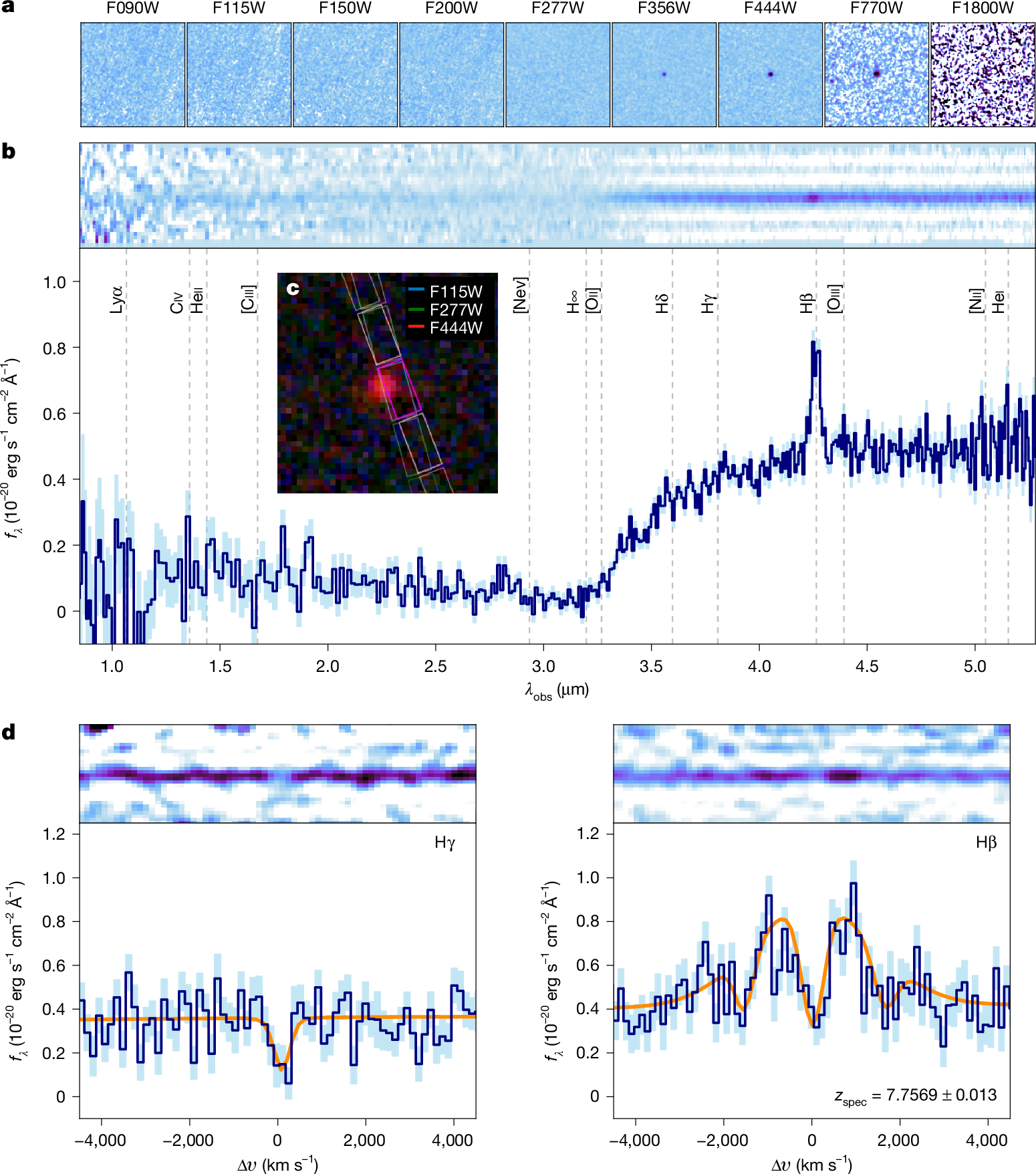
An MIT-led team reports in Nature that a very red, very bright point source found with the James Webb Space Telescope, a few hundred million years after the Big Bang, is putting out roughly 100 billion times more energy than any known star can physically produce [1][2][3]. Their preferred explanation is neither a star nor a galaxy: a hugely dense cloud of gas about the size of the solar system, powered by a central black hole of some 100,000 solar masses instead of by nuclear fusion [4][5][6]. The consequence is the interesting part. If the reading holds, the "little red dots" that turn up in nearly every deep JWST image are a distinct class of object rather than misread early galaxies [7].
The object was not what the team was hunting. Lead author Rohan Naidu, a NASA Hubble Fellow and Pappalardo Fellow at MIT's Kavli Institute, and colleagues were running a survey called "Mirage or Miracle" to find genuine galaxies in the first few hundred million years [8][9]. Naidu frames the problem as one of mistaken identity: many implausibly bright early galaxies have shown up, and some of those "miracles" may be "mirages" [10]. Co-authors include MKI director Robert Simcoe and Wendy Sun, with collaborators at other institutions [11].
The case against the boring answers is spectral. Red normally means dust, and Simcoe compares the effect to Canadian wildfire smoke reddening the sky over Boston [12], but other features of the light did not behave the way dust should [13]. The source is extremely bright and then, below a certain wavelength, its light vanishes entirely [14]. That drop is a Balmer break, conventionally produced by dense gas absorbing photons in the atmospheres of stars a few hundred million years old, the pattern seen in Vega [15]. Two things follow. Naidu says this is the deepest such break ever observed in any object, which rules out ordinary stars as the source [16]. And because the universe itself was only a few hundred million years old at the epoch observed, the textbook stellar reading would require a stellar population nearly as old as the universe containing it [1]. The light also carries almost no metals, essentially only hydrogen and helium [17].
For the black hole growth question, the load-bearing figure is a 100,000 solar mass black hole present a few hundred million years after the Big Bang [6][3]. The account of the work does not attach a growth rate, an accretion rate or a seed mass to that number [18], so any claim about how fast the first supermassive black holes assembled is downstream of assumptions this paper's summary does not supply. What it does supply is a mechanism in which a black hole's output is reprocessed through a vast gas envelope, which changes what a given brightness implies about the stellar mass behind it [4][5]. The team reached its conclusion by simulating competing scenarios [19], and Naidu says the picture of the object is evolving very rapidly [20].
Watch for whether other little red dots show comparably deep Balmer breaks and metal-free spectra when spectroscopy is pointed at them, whether independent groups reproduce the 100,000 solar mass estimate, and whether anyone can explain why these objects are everywhere early and essentially gone by the present day [7].