Science1 publisher2 min readPublished
The case for 'black hole stars' rests on two of Webb's little red dots
Webb picks up little red dots in nearly every image it takes, but two of them look like nothing in the ground-based archives, and the teams that found them say the pair hides a newborn supermassive black hole inside a bright hydrogen envelope.
The Scientist · Science desk
What happened
- Researchers began calling them little red dots in 2023: specks about a pixel across that shine as brightly as a whole galaxy, in red light with long wavelengths.
- After an early reading as galaxies, astronomers concluded the dots look more like supermassive black holes, whose infalling gas forms hot rings that outshine every star nearby.
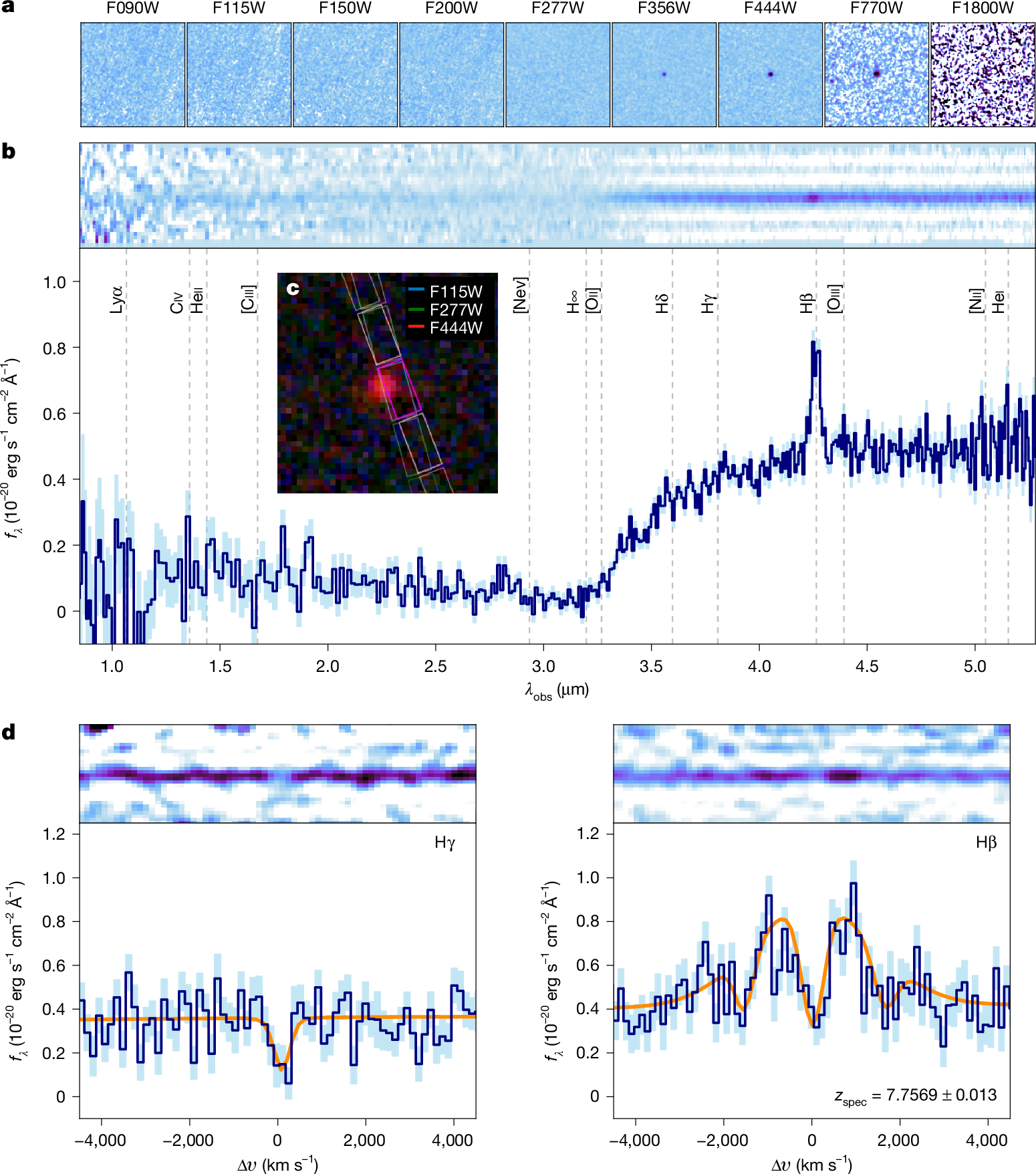
- In spring 2025 two teams simultaneously reported a pair of little red dots unlike all the rest, and unlike any object ever seen.
- The two teams propose a new kind of object, a hydrogen lump shining with the light of billions of suns around a black hole hidden in its core, which they call a black hole star.
- A paper posted last week goes further, arguing that Webb is watching supermassive black holes being born inside the cores of colossal stars.
Compiled by The ScientistSomething wrong?How this is made
Why it matters
- constraint Settling this costs telescope hours per target, since the surveys had to stare for hours at a time to get a usable spectrum, so the sample that could turn two odd objects into a class will grow slowly.
- decision Anyone estimating early black hole masses has to decide whether line width still measures what it is assumed to measure, because the same width supports both a bare black hole and a buried one.
- capability If the envelope picture survives scrutiny, astronomers would have an observational handle on supermassive black holes at the moment of formation, a stage no instrument has previously caught.
Line width is a mass estimate. Hydrogen clouds near a black hole move fast, each cloud emitting a slightly shifted shade. The net smear across many shades is what astronomers call a broad line. The wider the range, the faster the fastest clouds and the heavier the object they orbit [14]. Seeing that smear in a spectrum usually means you are looking straight at an exposed black hole [13]. The black hole star proposal puts the hole deep inside a hydrogen envelope that shines with the light of billions of suns [6]. In that picture, the gas making the light sits between the observer and the hole.
Anna de Graaff, of the Max Planck Institute for Astronomy in Heidelberg, heads one of the two groups. She said that in the millions of observations taken with ground-based telescopes, nothing looks like these sources [9]. Rohan Naidu, an astronomer at the University of Hawai'i, said of the newer analysis: "There is a fundamentally new phenomenon afoot." [8]
When the object spans a single pixel, its colour and its brightness are all you have [15]. That is why the surveys went spectroscopic: de Graaff led Rubies, Naidu co-led MOM, and both tabulated exactly which shades of light arrived and how bright each was. That gave astronomers a sense of what the particles in each object were doing [12].
A couple of little red dots appear in almost every image Webb takes [3], while the new object class is being argued from two of them [17]. The claim has set off a wave of follow-up work and disagreement [11]. Anna-Christina Eilers, an MIT astrophysicist who studies little red dots, said, "The field has gotten very polarized." [10]
Read as distant galaxies, the dots were bright enough to require enormous mass, and there was no known way for a galaxy to grow that big in a few hundred million years. Astronomers called them universe breakers [4]. The Quanta account of the dispute doesn't say how Webb observing time is being divided between the two pictures [18]. The black hole reading took over. Many astronomers concluded from the broad lines that big black holes were scattered through the early universe, the first billion years after the Big Bang that Webb was built to observe [16][1].
What to watch
- Spectra of more anomalous sources. They would show whether the two objects are a class or a coincidence.
- A published prediction that separates a buried black hole from an exposed one at the same line width.
- Revisions to black hole masses already inferred for the wider little red dot population.