Science1 distinct publisher2 min readPublished
A German-Swiss team images every magnon direction at once in as little as 30 seconds, at drive powers a thousand times below earlier X-ray methods. Their first result already outruns standard theory.
The Scientist · Science desk

Compiled by The ScientistSomething wrong?How this is made
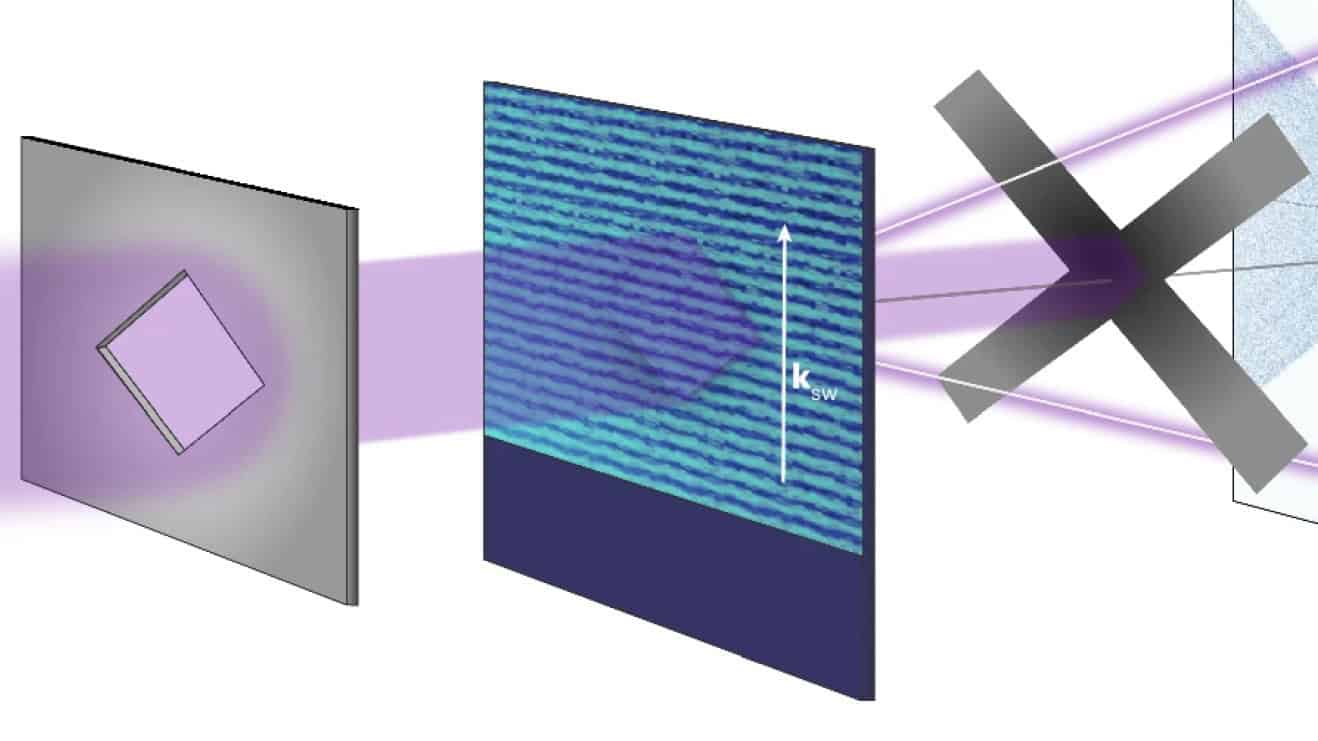
Scanning one direction at a time is not merely slow, it is the wrong shape of measurement for the process under study. When two high-amplitude spin waves scatter off each other they populate new waves heading off in every direction [10], so an instrument that samples a single direction per acquisition has to decide where to look before it has anything to look at [5]. The elliptical ring on the detector is therefore less the finding than the proof of method: its shape matches existing predictions of the spin-wave dispersion [12], so the instrument reproduces known physics in the same frame in which it reports unknown physics [11].
The acquisition time is the number worth running arithmetic on. At half a minute per map, 120 drive settings is an hour of measurement [15]. Nonlinear magnon work has consisted of individual demonstrations; one full momentum map per drive step makes it a sweep somebody can plot. That matters because the nonlinearity is intensity-gated: magnons collide, combine and split only when driven hard [10]. Methods needing more than a thousand times the power to register anything [8] were looking at that regime from well above its onset. Three orders of magnitude down, the onset itself sits inside the window.
What the window shows first is a hole in the theory. Waves appearing at simple fractions of the driving frequency fall outside standard theoretical descriptions [13], which puts the modelling behind the measurement for anyone proposing to carry information on magnons rather than electrons [14]. The regime below roughly 100 nm, where short-range exchange interactions dominate instead of longer-range forces [4], is precisely the regime magnonic logic proposals depend on, and it is now observable in a way it was not. Observable and designable are different states, and the gap between them is currently a theory problem, not an instrument problem.
One caution about the word device. The published account does not say what kind of X-ray source the technique requires, or whether it can be done away from a large facility [16]. Characterising exchange-dominated magnons in 30 s is a laboratory capability. It becomes a process capability only if the measurement can travel to where the material is being made.
Ranked by verification strength, evidence, and original report placement.
Magnon momentum microscopy uses soft X-rays tuned to a specific wavelength that scatter off the transient imprint a travelling magnon leaves on a material's magnetization; the scattering angle directly reveals the magnon's direction and wavelength.
The technique was developed by a team including Steffen Wittrock, Bastian Pfau and Daniel Schick, spanning Germany's Helmholtz Center Berlin for Materials and Energy, the Max Born Institute for Nonlinear Optics and Short Pulse Spectroscopy, and EPFL in Switzerland.
Magnon behaviour is most interesting at wavelengths shorter than about 100 nm, where dynamics are dominated by short-range quantum exchange interactions rather than the longer-range forces that govern longer-wavelength magnons.
Existing tools have consistently fallen short at probing the nonlinear regime; previous techniques could only probe short-wavelength magnons from one direction at a time, and researchers needed a way to probe all directions simultaneously with very high sensitivity.
A detector placed behind the sample records the full scattering pattern in one shot, producing a momentum-space map in which every magnon direction and wavelength appears at once rather than one at a time.
Follow any of these and your For You feed starts watching them — no settings page required.
Evidence-backed comparisons of source perspectives and observed adoption signals. Read the methodology
Which Builder, Operator, and Investor concerns the observed source mix emphasized—not a truth score.
Evidence, demonstrated adoption, hype gap, incentives, and confidence are assessed independently, each on its own current evidence. How these are measured.
Peer-reviewed result, single secondary account
The core mechanism, the YIG four-magnon observation and the agreement with spin-wave dispersion rest on work described in Nature Physics, which is a strong evidentiary base, and the article's own physics claims are internally consistent and specific. The discount is that the cluster contains only one trade-press retelling: no primary paper, DOI, figures or methods are in evidence, the headline capability numbers (30 s, >1000x) are unqualified as to conditions and baseline, and key methodological facts such as the X-ray source class are absent.
Single-lab first demonstration
Adoption is at the earliest possible stage: one collaboration, one instrument, one demonstration sample (YIG), reported at publication. There is no second group using the method, no instrument availability statement, no user-facility offering and no device or industrial application in evidence.
Slightly overstated at the payoff end, sober on the physics
The instrument claims are stated soberly and are anchored to a peer-reviewed result, and the article hedges the computing payoff as something physicists 'believe' magnons 'could one day' deliver. The mild positive gap comes from comparative superlatives carried without qualification — 'more than a thousand times weaker' with no named baseline, '30 s' as a best case — and from the gap between a single-sample laboratory measurement and the magnonics-in-computers framing that surrounds it.
Institutional publicity channel, no commercial stake disclosed
The single account is trade press serving the physics-research community, restating a result whose originating institutes have a clear reputational interest in the framing, and its comparative claims come from the developing team rather than an independent evaluator. Offsetting this, no vendor, product, funding round or commercial relationship is at stake in the story, the peer-reviewed venue is named, and the article volunteers that the fractional-harmonic findings exceed current theory rather than smoothing them over.
Moderate: peer-reviewed core, one publisher, material gaps
Confidence is limited chiefly by cluster breadth: one publisher, one article, no primary paper and no corroborating or contesting coverage, so nothing in the story is cross-checked. It is supported by the specificity and internal consistency of the account, the named peer-reviewed venue and named institutions, and the clear separation between what was measured on YIG and what is merely hoped for in magnonics. The unstated X-ray source requirements and the unsustainable derived throughput estimate mark where the record is thin.
science
The magnitude 9 nobody recorded: why simulated ground motions stay out of the codes1 distinct publisher
product
Canva's forecast cut turns model routing into a product line item1 distinct publisher
science
Graz group measures the geometry a single-molecule collision has to hit1 distinct publisher
science
Diamond crushed past Neptune's core pressure closes a 20-year gap in fusion capsule physics1 distinct publisher
Distinct publishers with included, body-backed reporting in this cluster.
1 article · August 27, 2026