Science1 publisher2 min readPublished
Hundreds of thousands of screened simulations point to net Antarctic ice loss even at 1.5C
Researchers screening hundreds of thousands of simulated futures in Nature Geoscience find Antarctica loses ice on net this century, even at 1.5C of warming. In the runs that survive, extra snowfall does not outweigh the loss, so Antarctica adds to sea-level rise this century.
The Scientist · Science desk
What happened
- Earlier projections disagreed on the sign because warmer air carries more snow, and in some runs that extra snowfall outweighed ocean-driven losses so the ice sheet grew.
- Of millions of combinations run, only futures that matched satellite gravity measurements of the ice sheet since 2002 were kept.
- Under very high emissions the surviving runs show a faster sequence of ice-shelf thinning, shelf breakup and accelerating glacier flow into the ocean.
Compiled by The ScientistSomething wrong?How this is made
Why it matters
- decision Coastal adaptation plans can carry Antarctica as a positive term in this century's sea-level budget at every warming level tested; the argument moves to how large that term is.
- capability A sub-second emulator checked against observations makes it practical to test assumption combinations that days-long supercomputer runs put out of reach, and the approach can be applied to other contested ice-sheet questions.
- constraint The result reaches only as far as the ISMIP6 archive spans real ice behaviour, and a gravity record starting in 2002 gives a limited test of how ice shelves collapse late in the century.
The most informative step in this study is what the team threw away. Satellites have weighed the Antarctic ice sheet since 2002 by sensing tiny changes in Earth's gravity, and every simulated future that failed to match that record was discarded [8]. Earlier projections include futures in which extra snowfall grows the ice sheet [4]. According to the study's authors, who described the work in a first-person account published by phys.org, the scenarios that survived all point toward net loss this century, including at 1.5C of warming [3].
The screen needed a fast model. Each ice-sheet simulation carries a single set of assumptions and can occupy a supercomputer for days [5]. The assumptions also compound. Ocean warming sets how fast ice shelves melt, thinner shelves let the glaciers behind them speed up, and a disagreement at one step, such as how shelves collapse, grows at the next [6]. The team of data scientists, glaciologists and oceanographers [12] trained a physics-informed machine learning model on ISMIP6, an international archive of Antarctic simulations. The authors wrote that it reproduces the original models' sea-level estimates with similar accuracy in a fraction of a second [7]. That let them run millions of combinations [8].
The thing this doesn't tell you is how much. The account does not report how many scenarios passed the satellite filter or how many centimetres of rise the survivors imply by the end of the century. Planners need that number. About 1 billion people live in coastal areas, and about 100 million of them, one in ten, live within 1 meter of sea level [1][1].
Two limits follow from the design. The emulator learned from the ISMIP6 runs [7], so its hundreds of thousands of futures recombine physical assumptions already present in that archive. Behaviour that none of those models contain cannot appear in the ensemble. The satellite record starts in 2002 [8]. I think a record that short is a weak test of assumptions about ice-shelf collapse, the step the authors name as unsettled [6], because the fastest shelf breakup in their own results comes under very high emissions [10].
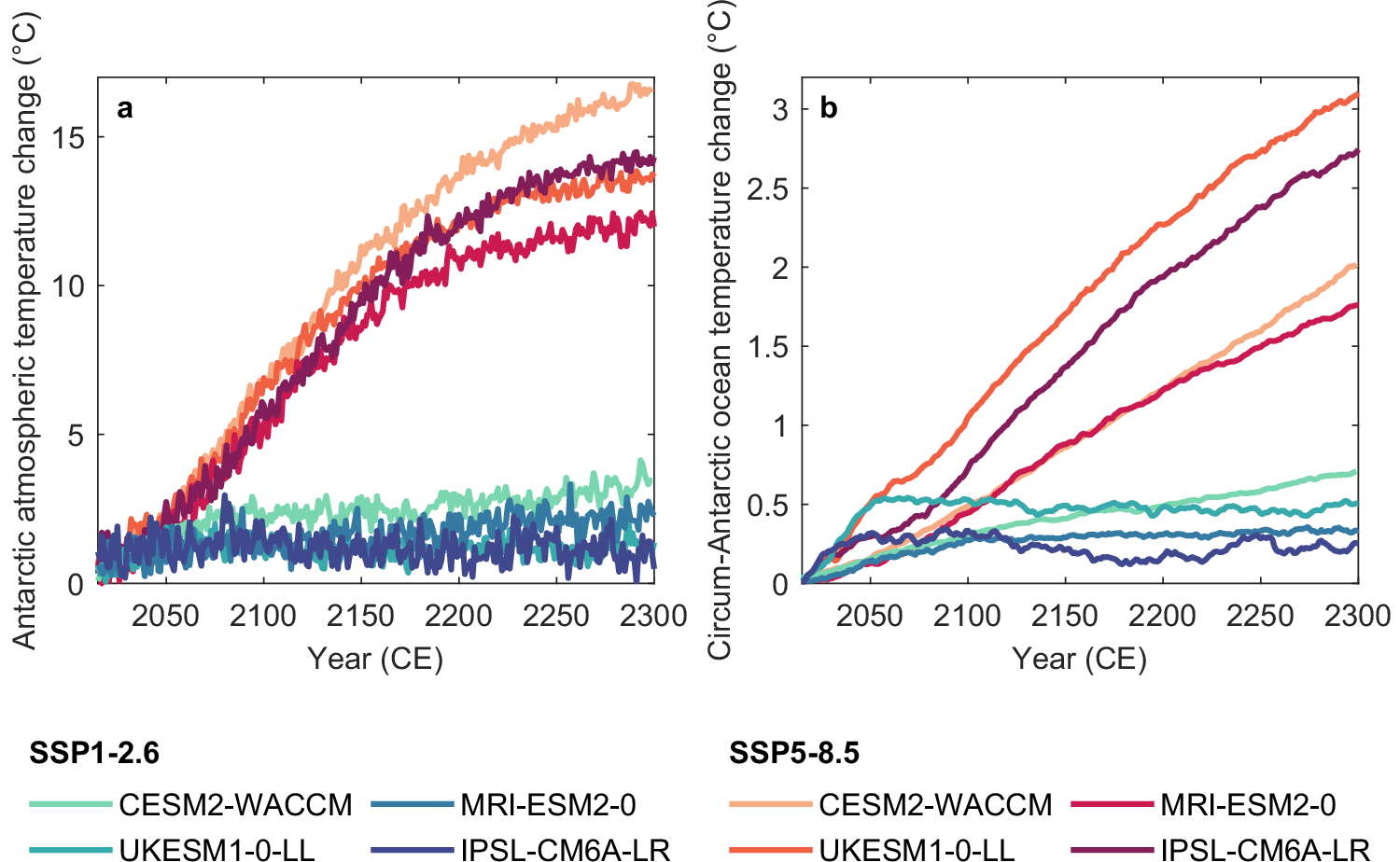
Within those limits, emissions still set the amount. The authors wrote that every ton of greenhouse gas avoided reduces Antarctic loss this century, with the benefit lasting hundreds of years [9]. Under very high emissions their runs show a faster chain: a warming ocean thins the shelves, weakened shelves break apart, and glacier ice reaches the sea faster [10]. That loss adds to rise already coming from Greenland, mountain glaciers and the expansion of warming seawater [11].
What to watch
- Whether groups running full ice-sheet models, without an emulator in between, reach the same net-loss result at 1.5C.
- Whether newer simulation archives with different ice-shelf collapse assumptions change what an emulator trained on them predicts.
- Whether additional years of satellite gravity data narrow the surviving scenarios enough to give coastal planners a tighter range.