Invest1 publisher3 min readPublished
American's 2028 seatback screens are a margin bet, not a passenger gift
American will put 4K screens at every seat on new narrowbodies from 2028 and add premium seats fleetwide. The driver is a profit gap CNBC puts at about $3bn to United and nearly $5bn to Delta.
The Investor · Invest desk
Drafted by a language model from the sources cited here and checked against its claim ledger before publication. How we use AISend a correction
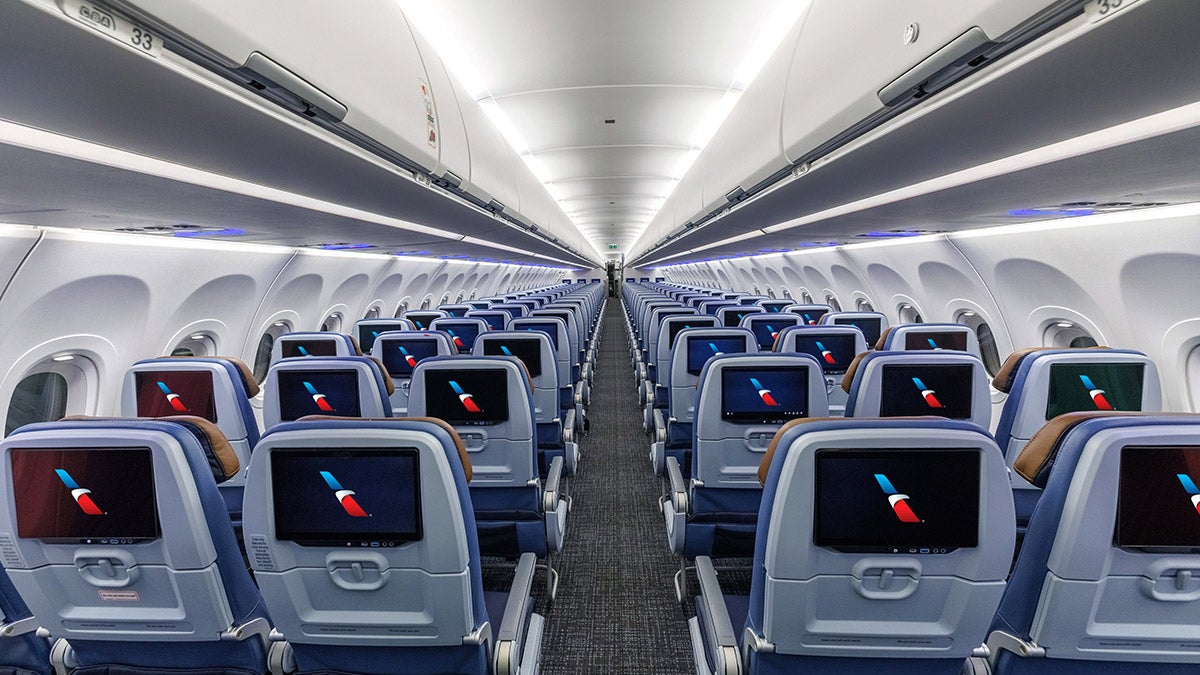
What happened
- American Airlines announced on a Tuesday that it will install 4K screens at every seat on all new narrow-body aircraft from Airbus and Boeing starting in 2028.
- The new screens will feature improved USB-C fast charging ports and Bluetooth audio connectivity.
- American said it is increasing premium seating across all aircraft to appeal to higher-spending travellers.
- Heather Garboden, American's chief customer officer, said in a statement that the enhancements, from next-generation seatback entertainment at every seat to substantially more premium seating options, will give customers more ways to relax, stay connected, and enjoy their journey.
- CEO Robert Isom told CNBC that American's long-range plan is certainly making up the margin gap with United and Delta.
Compiled by The InvestorSomething wrong?How this is made
Why it matters
American Airlines said Tuesday it will install 4K screens at every seat on all new narrowbody aircraft from Airbus and Boeing starting in 2028, with USB-C fast charging and Bluetooth audio, and that it will increase premium seating across all aircraft [1][2][3]. Chief customer officer Heather Garboden described the package as giving customers "more ways to relax, stay connected, and enjoy their journey" [4], but the number that explains the spend is a profit gap that chief executive Robert Isom has told CNBC his long-range plan is "certainly making up" [5].
The gap is large in absolute terms and small in margin terms, which is why it is expensive to fix. American booked more than $54bn of revenue last year [6]. United earned about $3bn more profit than American in 2025 and Delta nearly $5bn more, according to CNBC [7][8]. Against a $54bn revenue base, the Delta shortfall is on the order of nine points of revenue and the United shortfall about five and a half [1]. Closing that does not happen through amenity goodwill. It happens through seat mix, and premium seating is the line item American is actually buying.
The screens are the tell. American and its peers stripped seatback entertainment out of short-haul cabins on the argument that it saved weight, hardware maintenance and cost, moving passengers to their own devices [9]; the airline kept screens on more than 140 long-haul aircraft [10]. None of those cost objections have disappeared. What has changed is the assumed revenue on the other side of the ledger, which is to say American now believes a denser premium cabin will pay for hardware it once judged unpayable. CNBC reported the carrier had been seriously considering the narrowbody upgrade for months [11].
Note the scope and the clock. As announced, the commitment covers new narrowbody deliveries beginning in 2028, not a retrofit of the existing narrowbody fleet [2]. Fortune reported the announcement on Aug 19, 2026 [12], so first screen-equipped deliveries sit roughly two years out, and roughly a dozen years after the screens came out [3][4]. The nearer-term item is connectivity: Starlink goes into 500 American narrowbodies starting next year [13][5].
Meanwhile the differentiation window is closing before it opens. Delta debuted its Delta One suite on the A350-1000 in April, with a 180-degree flatbed and Missoni bedding, and aims to have sliding privacy doors on all suites by 2030 [14][15]; Ed Bastian's stated position is that Delta cannot win on cheapest and has to win on best [16]. Southwest ended open seating and added extra-legroom options, with chief executive Bob Jordan telling ABC News that 80% of its customers wanted assigned seating and 88% of those who would not fly Southwest wanted it [17][18]. A screen at every narrowbody seat in 2028 is parity, not advantage.
The cost side is moving faster than the cabins. IATA projected in June that jet fuel prices could rise 70% this year, a $100bn bill for the industry, and both United and American projected an extra $6bn of fuel cost this year [19][20]. American's own projected single-year fuel increase is larger than either of the profit gaps it is trying to close [6]. Isom told the Q2 call there has been "a tremendous amount of volatility in the fuel curve" [21]. Capex committed to 2028 hardware has to survive several more of those curves.