Invest1 publisher3 min readPublished
Etched's $10.3B mark prices a non-Nvidia inference bet at ten times booked orders
A $300 million Series C doubles Etched's valuation in seven months on $1 billion of orders and hardware almost nobody outside the cap table has run. Buyers now have a number to price against.
The Investor · Invest desk
Drafted by a language model from the sources cited here and checked against its claim ledger before publication. How we use AISend a correction
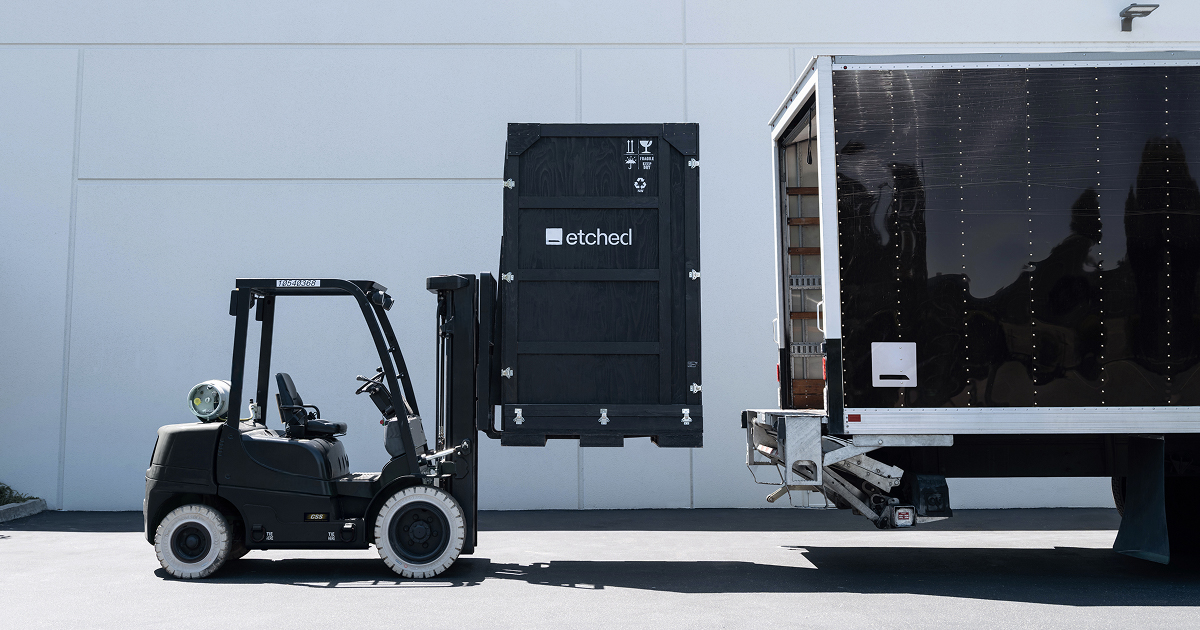
What happened
- Etched closed a $300 million Series C funding round at a $10.3 billion valuation, according to co-founder and COO Robert Wachen speaking to TechCrunch.
- The round was led by Sequoia, with Andreessen Horowitz, SK Hynix, Jane Street and Diffusion Capital also participating, along with other earlier investors.
- Etched was previously valued at $5 billion in December when it raised a $500 million round.
- The company says the round is the highest valuation ever for a Sequoia-led Series C.
- Last month Etched announced that it had successfully manufactured its homegrown chips, that its first full systems were being tested by clients, and that it had already booked $1 billion worth of orders.
Compiled by The InvestorSomething wrong?How this is made
Why it matters
Etched has closed a $300 million Series C at a $10.3 billion valuation, co-founder and chief operating officer Robert Wachen told TechCrunch, with Sequoia leading and Andreessen Horowitz, SK Hynix, Jane Street and Diffusion Capital joining alongside earlier backers [1][2]. The consequence for anyone budgeting inference capacity is not the headline number but what sits under it: last month the company said it had manufactured its own silicon, put first full systems in front of clients, and booked $1 billion of orders [6].
That order book is the part that changes a conversation. A transformer-specific accelerator was, on Etched's own account of its founding in 2022, treated as a wild idea [7][c8a]. It is now a line item that customers have committed money to, and Google is reportedly pursuing a version of the same idea with a Frozen v2 chip for Gemini [9]. Procurement teams do not need Etched to win to benefit from it; they need a credible second quote.
The financing arithmetic is worth reading carefully. Etched was valued at $5 billion in December on a $500 million round [3], so the valuation is up about 106 percent [20] while the round itself is 40 percent smaller [21], implying roughly 2.9 percent dilution at post-money [22]. Against $1 billion of booked orders, the mark is about 10.3 times bookings [19] on systems that, by the company's own admission, are not yet mass produced or delivered [17]. Etched says this is the highest valuation ever for a Sequoia-led Series C [5].
The technical claim is narrower than "transformer chip" implies. Wachen says the systems run any model, including mixture-of-experts designs such as DeepSeek and Qwen and non-transformer architectures such as Mamba, and are sold as full systems rather than loose chips [8]. The company built two components for the two halves of inference: a prefill chip that Wachen says runs at much lower voltage than other AI chips, which produces less heat and therefore allows more transistors, and for decode a new memory and interconnect design he calls cluster-scale memory, pooling shared memory across many chips at low latency [10][11][12]. All of that is the vendor's description, and the promised result is high speed at lower cost [12]. First silicon was manufactured by TSMC [13].
The verification problem is real and Etched does not hide it. Access to the systems has been limited to investors and early customers, and the famous names on the cap table were recruited through private demos in the office [14]. Wachen cites Andrej Karpathy, Noam Brown of OpenAI and Geoffrey Hinton as people who have actually run the hardware [15]; Karpathy is also listed among the company's backers [16]. Skeptics persisted even after the first successful fabrication was announced [23]. "We had no idea how hard it was going to be," Wachen said, adding that the team still has to be humbled by what reaching scale will take [18].
Two things to watch. First, whether the $1 billion in bookings converts into delivered, racked, revenue-recognised systems on a stated schedule, since bookings for undelivered hardware are a promise in both directions [6][17]. Second, SK Hynix's presence in the syndicate [2] next to a decode pitch built on a new memory and interconnect design [12]: the source describes an equity investment and no supply arrangement, so any read beyond that is speculation until one is announced.