Build3 publishers3 min readPublished
Apple's reported M8 Ultra server would pick up NVLink where UltraFusion stops
The Information reports Apple is weighing Nvidia's NVLink Fusion for an inference server built on two or four M8 Ultra chips in 2029. The engineering question is which part of that package would join the NVLink domain.
The Engineer · Build desk
What happened
- Apple is developing an enterprise AI server for AI developers, businesses and governments, in versions with either two or four of its planned M8 Ultra chips, The Information reported.
- Apple has discussed using Nvidia's NVLink Fusion to connect those chips, in a machine not expected before 2029 that could still be canceled or launched without Nvidia technology.
- Apple and Nvidia did not immediately respond to Reuters requests for comment, and Reuters said it could not independently verify the report.
Compiled by The EngineerSomething wrong?How this is made
Why it matters
- precedent Tom's Hardware argues the implications go well past one customer: an NVLink scale-up domain built around silicon Nvidia does not sell would make the fabric, its switches and its software stack the default for other in-house chip programs.
- constraint UltraFusion joins two SoCs and no more, so any Apple server larger than that has to buy someone else's scale-up fabric, and there are only two candidates in play.
- decision The timing of the choice decides it: pick before UALink switches are plentiful and the comparison is against a thin catalogue rather than the 2029 one.
- contradiction Tom's Hardware calls NVLink a strange pick for a UALink member while offering the explanation that Apple may want Spectrum-X, Quantum-X and co-packaged optics along with it, which are two different reads of the same decision.
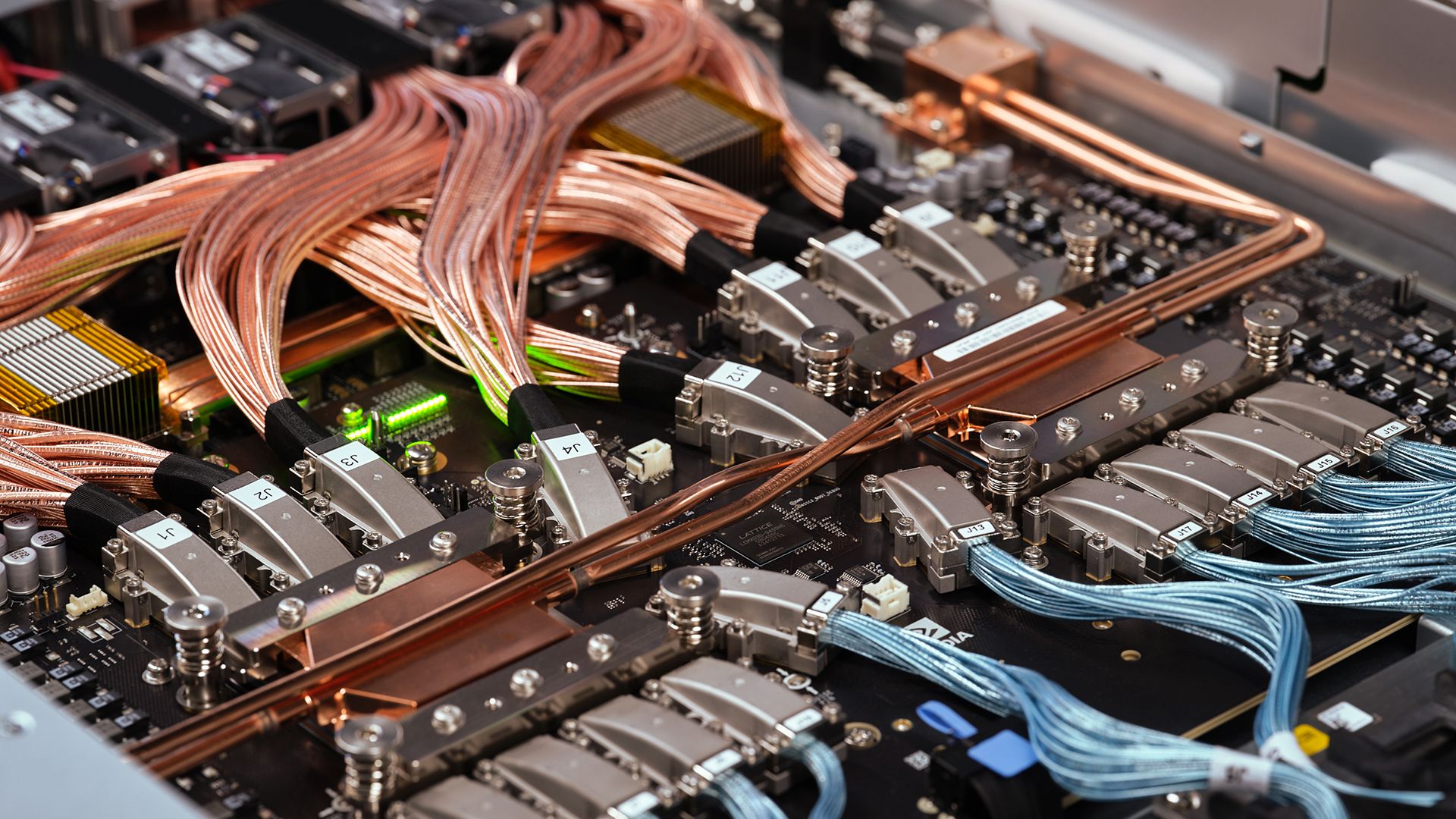
According to Tom's Hardware, the NVLink infrastructure Apple wants covers the interconnect protocol, switches, chiplets that add NVLink connectivity, and a software stack [6]. Nvidia built NVLink to scale up its own accelerators, so the fabric is tuned for accelerator-to-accelerator traffic and lets a rack of GPUs behave as one tightly coupled compute domain [9]. It has since been opened to third-party hardware [24].
That leaves an assembly question. An M Ultra is a system-in-package: a CPU chiplet and a GPU/neural engine chiplet joined with TSMC's SoIC-mH [11]. NVLink proper connects accelerators, and the coherent CPU-to-accelerator and CPU-to-CPU variant is a separate implementation called NVLink-C2C [10]. Tom's Hardware suggests Apple could expose the accelerator portion of an M8 Ultra through an NVLink Fusion chiplet, which would make the scale-up domain treat it as an accelerator [12]. The publication says there is currently no evidence for the alternative, moving the GPU/NPU chiplet onto its own substrate with its own memory [13].
Then there is the size of the thing. The largest configuration reported is four M8 Ultra sockets [1]. UALink, whose consortium Apple has joined, addresses up to 1,024 accelerators [14]. Four sockets is about 0.4 percent of that ceiling [25]. A four-socket box does not need a rack-scale fabric to talk to itself. Nvidia sells NVLink Fusion as one piece of a rack architecture that pairs scale-up NVLink with Spectrum-X Ethernet or Quantum-X InfiniBand scale-out, including switches with co-packaged optics [16].
Apple's own stitching stops at two dies. UltraFusion joins two high-end SoCs, and Tom's Hardware says the company does not have a proper solution for scale-up and scale-out connectivity between processors [7]. Its Private Cloud Compute machines already run mostly on Apple's internally developed connectivity, which The Information describes as too slow and too costly for large-scale commercial deployment [8].
The commercial pull shows up in the Mac line. OpenAI and Anthropic are buying Mac Minis and Mac Studios in bulk for AI workloads, and Apple's Mac revenue rose nearly 29 percent last quarter to $10.4 billion [20]. Apple last sold dedicated server hardware as Xserve, which it discontinued in 2011 [21]. Relations with Nvidia have been strained for nearly two decades after an alleged defect in Nvidia graphics chips caused widespread MacBook failures [22].
For the lock-in argument to hold, three things have to be true: the server ships in 2029, the scale-up decision is made while UALink switch choice is still limited [15], and an NVLink Fusion chiplet ends up on Apple's package [12]. None of it is settled. Tom's Hardware says the use of NVLink Fusion is not formalized [5], and the report allows for cancellation or a version without Nvidia technology [4]. The project was backed about a year ago by John Ternus while he headed Apple's hardware engineering organization [18], and the-decoder identifies Ternus as Apple's new CEO [19]. Tom's Hardware argues that if Apple picks NVLink Fusion over competing solutions, the implications run significantly wider than Apple buying Nvidia hardware [17].
What to watch
- Whether Apple's design exposes the GPU/NPU chiplet through an NVLink Fusion chiplet or keeps the accelerator inside the system-in-package.
- Whether UALink switches reach volume supply before Apple fixes its scale-up choice.
- Whether a configuration larger than four sockets appears, which would make this a rack product instead of a box.