Science1 publisherNot yet confirmed elsewhere2 min readPublished
Old manganese workings at Grandhome hold uranium at about 100 times Aberdeen granite levels
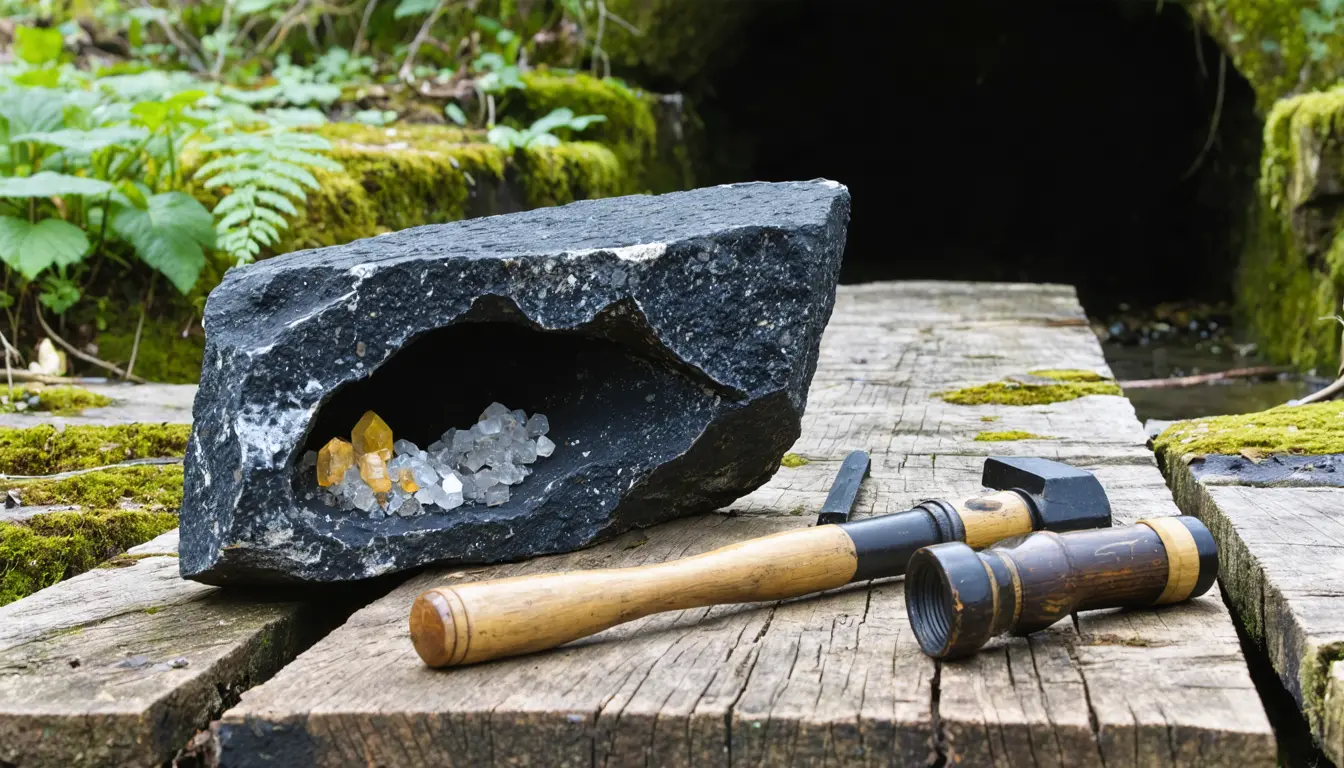
University of Aberdeen geologists found chernovite crystals at Grandhome in rock holding about 100 times the uranium of typical city granite. The authors say the amounts are not dangerous, and they tie the pocket to groundwater moving through exposed granite about 400 million years ago.
The Scientist · Science desk
Drafted by a language model from the sources cited here and checked against its claim ledger before publication. How we use AISend a correction
What happened
- Granite sampled elsewhere in Aberdeen, from Cults in the southwest to Dyce in the north, showed no comparable uranium enrichment.
- Grandhome, on the city's northern edge, was once quarried for manganese and has been known to geologists for more than 200 years.
- The mineralized rock also carries unusually high arsenic, which the study puts down to low-temperature chemistry near the Earth's surface, not deep underground.
- John Parnell and Joe Armstrong reported the work in Geochemistry: Exploration, Environment, Analysis, describing oxidative mineralization of an orogenic unconformity.
Compiled by The ScientistSomething wrong?How this is made
Why it matters
- constraint Because the 100-times ratio is not tied to absolute values or a dose reading, the no-risk verdict rests on the authors' judgement until the full paper's data are checked.
- capability Grandhome gives geologists an accessible place to study how an exposed ancient land surface moved uranium and rare earths into new minerals, a natural laboratory in the authors' description.
- precedent If the surface-groundwater account holds, other buried granite-sandstone contacts become reasonable places to look for similar uranium and rare-earth pockets.
"Hotspot" is a comparative word, so the first thing to check is what Grandhome was measured against. The University of Aberdeen team also sampled granite across the city, and none of it came close to the Grandhome enrichment [1][6]. Those samples are the control. Without them, one high reading at an old quarry could describe Aberdeen granite in general. With them, the uranium looks confined to a single place.
The ratio needs its denominator as well. Rocks from Grandhome contain around 100 times the uranium typically found in Aberdeen granite [5]. The published summary does not give either figure in absolute units, the number of samples, a radiation measurement, or how the mineralization was dated. The safety judgement is therefore the authors' own. "People sometimes hear the word uranium and immediately think of radioactivity or nuclear energy," Parnell said [7]. "But the amounts found at Grandhome are not dangerous, and the deposit is far too small and dispersed to have any economic value." [8]
The proposed origin is a surface process. The team thinks the uranium gathered while the granite lay exposed at the Earth's surface. Groundwater carried dissolved elements through the rock until newly formed minerals trapped them [9]. Chernovite, identified in samples from the old mine workings, is one of those minerals, and it also holds yttrium and other rare earth elements [2][9]. The setting is the boundary between the granite and the younger sandstone laid over it, where weathering and circulating water altered the rock around 400 million years ago, in the Devonian [10]. Parnell compared it to a tarte tatin. "At Grandhome, the really interesting chemistry happened at the interface between different rock layers," he said [11].
The arsenic is the detail that fits this account best. Its enrichment is put down to low-temperature chemistry near the surface [12], the same environment the groundwater model requires. The source presents that model as the team's belief, and the transport step as what is thought to have happened [9]. Parnell's reassurance concerns uranium. The arsenic appears in the summary as evidence about temperature and depth [8][12].
In my view the find adds to Aberdeen's geological history more than it rewrites it. It gives physical evidence of Devonian weathering and groundwater at the buried granite-sandstone contact [10]. "The rocks in and around Aberdeen are a remarkable record of the Earth's history," Armstrong said. "Discoveries like this help us understand the long and complex processes that have shaped the landscape beneath our feet." [14]
What to watch
- Absolute uranium concentrations and sample counts from the full paper, so the 100-times ratio can be set against granites elsewhere.
- Direct dating of the chernovite or its host minerals that confirms or moves the roughly 400-million-year Devonian timing.
- Sampling along other stretches of the granite-sandstone contact near Aberdeen to show whether Grandhome is a one-off.