Loading today’s stories
Science1 distinct publisher3 min readUpdated
A parameter-free tree replaces UMAP, and turns up an NK cell subtype from the myeloid lineage
Bonsai's authors argue that t-SNE and UMAP distort the structure they claim to show. Their alternative has no tunable parameters, and its first biological result is a myeloid-derived NK cell.
The Scientist · Science desk
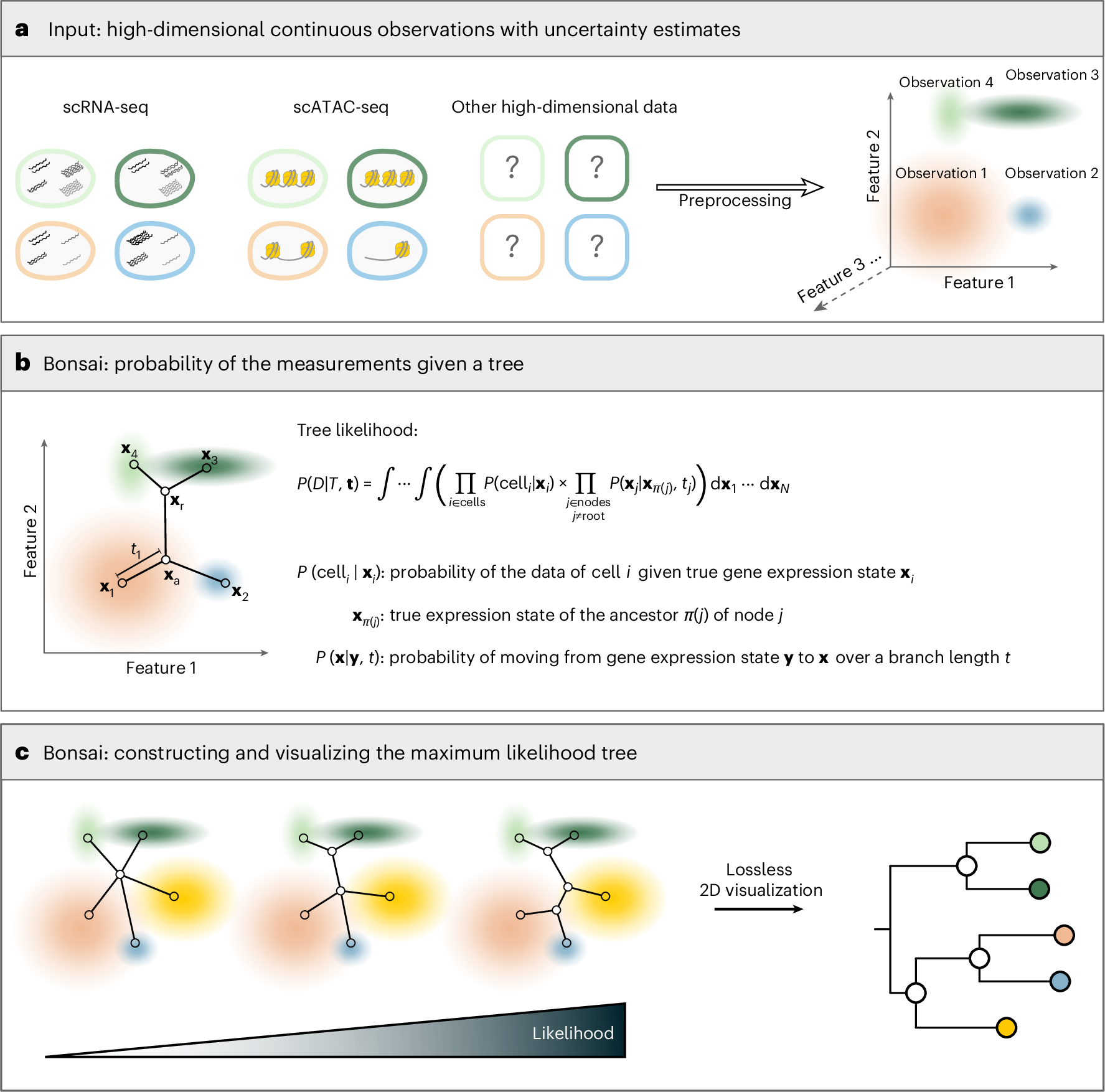
What happened
- Bonsai is a method that reconstructs the most likely tree relating any set of high-dimensional objects with arbitrary heterogeneous measurement noise; it has no tunable parameters, integrates downstream exploratory analysis methods with Bonsai-scout and scales to large datasets.
- Applied to blood cell data, Bonsai accurately recovered known lineage relationships and also discovered a subtype of natural killer (NK) cells deriving from the myeloid lineage, pinpointing genes distinguishing myeloid NK from lymphoid NK cells.
- The authors state that current single-cell exploratory analysis and visualization methods are ad hoc and uninterpretable, and that they distort the structure in the data.
- More than 1,750 scRNA-seq analysis tools were published in the last 8 years, almost as many as the total number of scRNA-seq papers.
- 1,750 tools over 8 years averages about 219 new scRNA-seq analysis tools per year.
Compiled by The ScientistSomething wrong?How this is made
Why it matters
A group publishing on nature.com has released Bonsai, a method that reconstructs the most likely tree relating a set of high-dimensional objects under arbitrary heterogeneous measurement noise, and reports that running it on blood cell data surfaced a subtype of natural killer cells deriving from the myeloid lineage [1][2]. The load-bearing claim is not the tree. It is the accompanying assertion that the visualization tools most single-cell labs already depend on are ad hoc, uninterpretable and actively distort the structure in the data [3].
The authors are blunt about the state of the field. More than 1,750 scRNA-seq analysis tools were published in the last eight years, almost as many as the total number of scRNA-seq papers [4], which works out to roughly 219 new tools a year [5]. Meanwhile the data itself resists interpretation: it is very high-dimensional and sparse, with noise levels that vary over several orders of magnitude across measurements [6]. Worse, the field does not know what structure to expect, including whether cells occur as discrete types or are distributed on a continuous manifold, and if so with what topology and dimensionality [7].
Into that gap goes practice the paper describes as near trial and error: tweaking the tunable parameters of t-SNE and UMAP until the picture matches prior biological knowledge or preconceived expectations [8]. The authors say both methods are well known to fail at representing local and global relationships without distortion [9], and that parameter-fitting to expectation hinders making genuinely novel observations or falsifying strongly held beliefs [8]. That is the argument operators should weigh: not that the embeddings are ugly, but that they cannot be used as evidence against what you already think.
The case for trees is partly biological and partly geometric. Cells from one organism are related through a lineage tree of cell divisions, so single-cell expression patterns have in fact diverged along branches [10]. The authors also invoke what they call the blessing of dimensionality: distances between objects in high-dimensional spaces can generically be represented accurately along tree branches [11]. Because a tree can always be drawn in two dimensions, the representation is distortion-free [12]. They acknowledge the approach is conceptually similar to hierarchical clustering [13].
On capability, the abstract claims Bonsai automatically regularizes noise, recovers differentiation trajectories, preserves high-dimensional distances and improves nearest-neighbor identification, with no tunable parameters, downstream analysis via a companion tool called Bonsai-scout, and scaling to large datasets [14][1]. On the blood data it recovered known lineage relationships as well as the myeloid NK population, and pinpointed genes distinguishing myeloid from lymphoid NK cells [2].
Two cautions. The myeloid NK result rests on the authors' own analysis in a single paper [2], and the material at hand reports the finding and the distinguishing genes rather than any orthogonal confirmation. And a tree is itself a prior. The paper's own framing concedes that nobody knows whether cell states are discrete or continuous [7], so choosing trees replaces a knob you tune with an assumption you cannot tune. Zero parameters is not zero commitments.
Loading topic controls
Loading related stories