Product1 publisher3 min readPublished
A cotton-pulp hydrogel kept sensing after a week at -13F because ice never formed
Researchers report a 3D-printable cellulose hydrogel that suppresses water crystallization, the specific failure that has kept hydrogel wearables out of cold rooms and outdoor use.
The Product Desk · Product desk
Drafted by a language model from the sources cited here and checked against its claim ledger before publication. How we use AISend a correction
What happened
- Researchers developed a flexible electrically conductive hydrogel from cotton pulp cellulose, an abundant renewable material.
- The study is published in the Journal of Bioresources and Bioproducts.
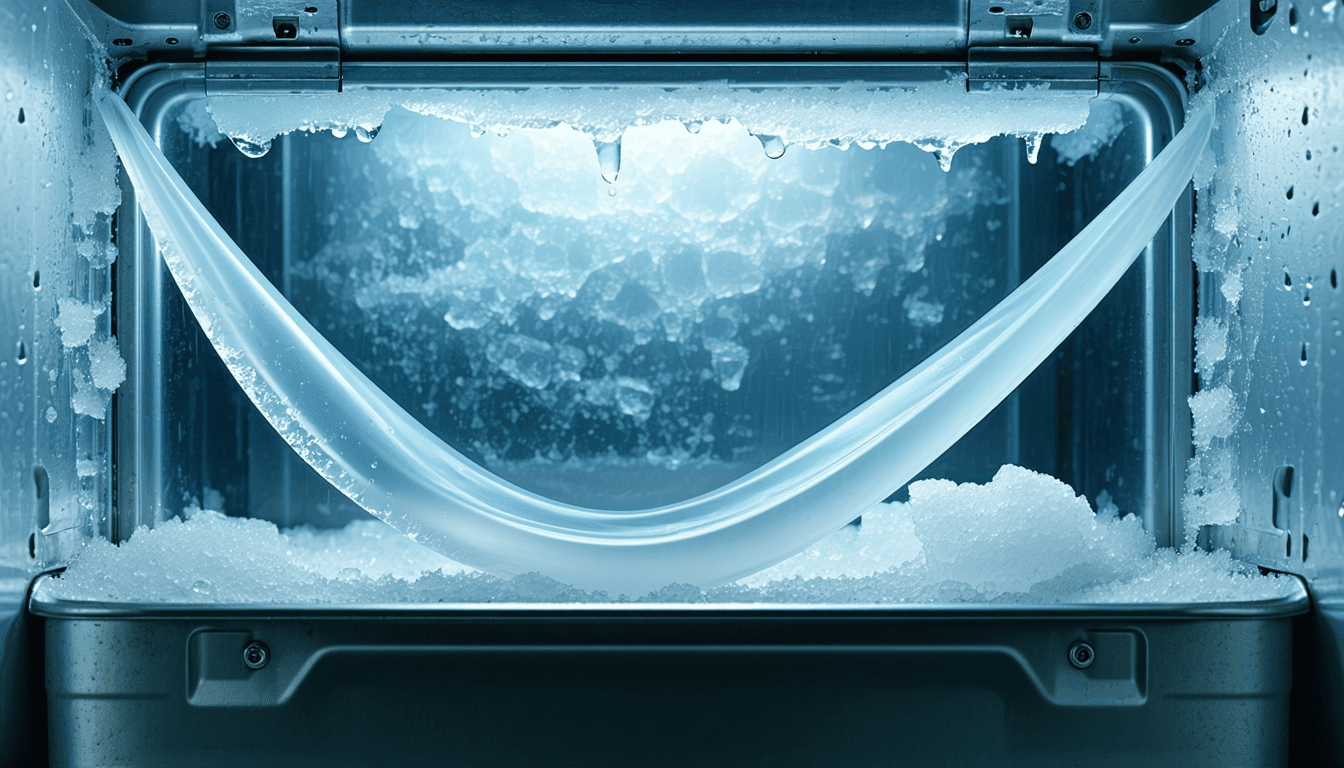
- Tests between -112F and 68F showed no exothermic peaks associated with water crystallization, indicating that ice formation was suppressed in the hydrogel.
- The approach addresses a basic problem with conventional hydrogel sensors: water inside them can freeze, making the material stiff and reducing its ability to carry ionic signals.
- The cold performance matters for wearable electronics that could operate outdoors, in refrigerated environments, or other applications where conventional water-rich hydrogels can lose flexibility and conductivity.
Compiled by The Product DeskSomething wrong?How this is made
Why it matters
A cotton pulp cellulose hydrogel kept producing repeatable electrical signals from finger bending and fingertip pressing after 168 hours at -13F, according to a study published in the Journal of Bioresources and Bioproducts [1][2][13]. The interesting number is not the temperature but the thermal scan behind it: across -112F to 68F the researchers report no exothermic peaks associated with water crystallization, which they read as ice formation being suppressed rather than merely tolerated [3].
That distinction is the whole point. Conventional hydrogel sensors carry signal through ions dissolved in water, so when that water freezes the material stiffens and its ability to carry ionic signals falls off [4]. It is the reason water-rich hydrogels have been a poor fit for outdoor wearables and refrigerated environments, where they lose both flexibility and conductivity [5]. Attacking the phase change directly is a different strategy from insulating a device or accepting degraded performance below freezing.
The route there is a solvent choice. The team dissolved cellulose in a mixture of zinc chloride and lithium bromide, which broke up the tightly packed crystalline structure of the cellulose while protecting the resulting molecular chains from damage, yielding a transparent hydrogel the paper calls HZ0.3L0.7-C3 [6][7]. The same salts supply the mobile ions for signal transmission, so the formulation does not depend on conventional conductive polymers [8]. Reported properties: ionic conductivity of 4.48 S/m and compressive stress up to 2.48 MPa [9].
As a sensor, the material responded in about 100 milliseconds and recovered in roughly 300 milliseconds [10], which works out to about 400 milliseconds per complete event, or roughly two and a half discrete gestures per second [11]. That is adequate for joint bending and throat movement and thin for anything faster. It held stable performance through 500 compression cycles at 30 percent strain [12]. A polydopamine coating was added for skin compatibility, and sensors were attached to fingers, wrists, elbows and the throat to pick up movement and pressure [14]. The team also built a data glove that translated hand movements onto a robotic model in real time [15].
The processing story is the part operators should note. The hydrogel is shear-thinning, so it flows under pressure and holds shape after printing, which let the researchers 3D print structures including five-pointed stars and maple leaves [16]. Geometry-on-demand matters more than the shapes chosen for the photographs: it is what turns a material into a sensor layout you can fit to a specific joint or tool.
What is not in the record yet is durability evidence at the scale a product needs. The week-long cold result as reported is qualitative, repeatable signals from two gestures, not a post-exposure conductivity figure [13]. Five hundred compression cycles is an early fatigue check, not a case for daily wear over months [12]. Nothing in the account addresses water loss or salt migration over long service, and the researchers themselves place the material at research and prototype stage, with further testing needed before commercial deployment [17].
Watch for whether the suppressed-crystallization behavior survives repeated freeze and thaw rather than one long soak at -13F, and whether conductivity is measured after cold exposure rather than inferred from signal repeatability. Watch, too, for a cycle count in the thousands and any data on how the zinc chloride and lithium bromide content behaves against skin over time, since that is where the polydopamine coating will be tested [14].