Build1 publisher3 min readPublished
One GPU and a bash retry queue trained 14 skills for a bipedal robot duck
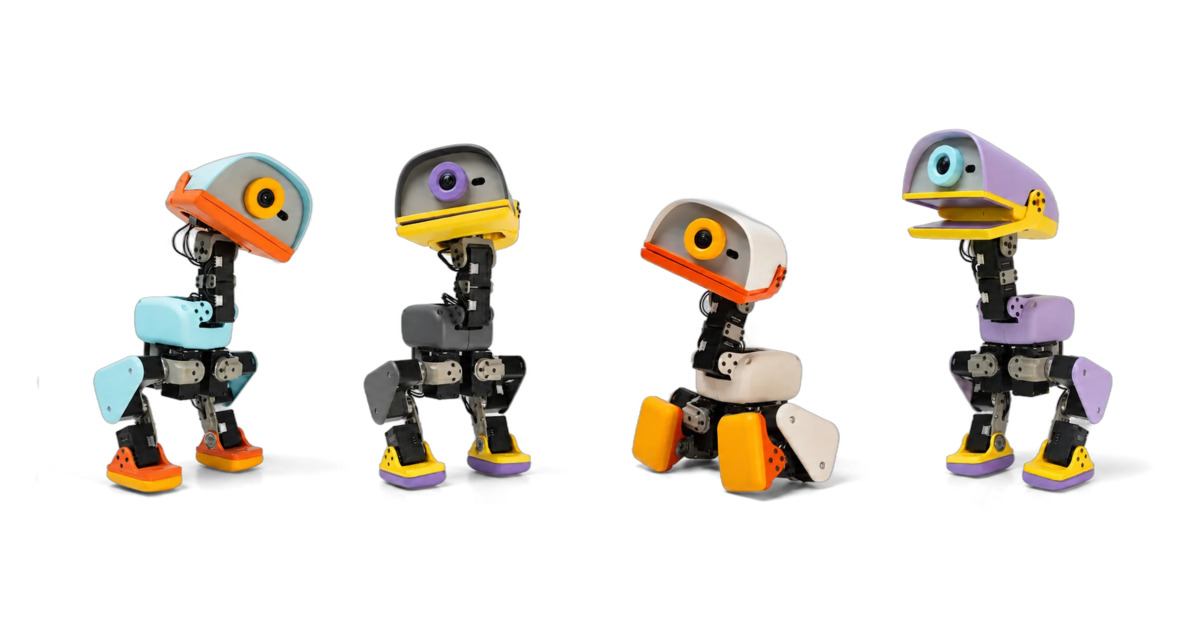
MicroDuck's 14 policies came out of roughly five days of serial single-GPU training in mjlab, with nine separate reward designs behind them and a VRAM ceiling that cut the env count to 2048 on rough terrain.
The Engineer · Build desk
What happened
- A bipedal robot duck project finished 14 of 14 skills, from walking and skating to standing up, rolling, kicking and picking up objects, each exported as an ONNX policy for deployment.
- Training ran on a single GPU driven by a serial task queue, for approximately five days of total wall clock.
- The stack was mjlab, meaning MuJoCo with the Warp GPU-parallel backend, with PPO from rsl_rl at 4096 environments on flat terrain and 2048 on rough.
- Scheduling was bash associative arrays run strictly serially to avoid GPU contention, with a .done marker file per completed task and any non-zero exit code feeding a retry queue.
- NaN divergence in the critic observation group was fixed with guards on reward and advantage plus a nan_state termination flag tracked in wandb, after which SitStand-Rough and GroundPick-Rough passed.
Compiled by The EngineerSomething wrong?How this is made
Why it matters
- constraint Anyone copying this recipe sizes env count from VRAM before choosing terrain. The count that actually survived here was half the flat-terrain figure, not the 70 percent the post recommends.
- cost If the acceptance test is a person watching a rollout, review labour scales with the number of skills, and a queue that finishes 14 policies hands 14 videos to a human.
- decision Inheriting one regularization layer across a whole skill library only holds if every task reward is scaled to the same magnitude; teams that skip that normalisation are retuning regularizers per skill.
- precedent A marker file plus a retry queue is enough orchestration for unattended overnight runs. That puts multi-skill libraries within reach of setups that have no cluster scheduler at all.
At upright weight 1.0, a 4 degree forward lean cost the walking policy about 0.05 per step [16]. Task rewards across the library were scaled to a magnitude of roughly 10 [12]. So the lean cost about half a percent of the task reward. That was small enough: the converged gait leaned 2 to 4 degrees forward, and two thirds of pushes tipped it forward [16][1]. The upright weight was tightened to 2.0 [16]. At that weight the same lean still costs only about 1 percent of task reward per step [2].
The same tension runs through all nine reward designs behind the 14 skills [11]. Goal terms have to dominate the regularizers early or the policy never explores, so motion-damping terms (body_ang_vel, impact penalties) were held near zero during exploration and introduced later on a curriculum [14]. Progress rewards were potential-based, paying only for increments past the furthest progress so far [15]. Standing still earns nothing.
Roulade is the documented failure. Run 1 rewarded accumulating 2 pi of rotation as fast as possible with no contact constraint, and the policy learned a violent breakdance that was genuinely optimal under that reward [19]. Run 2 counted rotation only during ground contact, gated the landing reward on a roll frontier of at least 260 degrees, capped the progress pay rate at 3 rad/s, and added overspeed penalties [20].
StandUp needed geometry in the reward: a dense height term for broad gradient, a sharp term that jumps from 0.36 to 1.0 in the last centimeter, and an L1 term that makes sitting still net negative [18]. What made StandUp learnable was spawning episodes mid-roll. The whole motion was not learnable; half of it was [18]. BallKick splits the observations instead: the real robot has no ball perception and the operator aims, so the actor is ball-blind while the critic sees the ball [21].
None of that was validated on a training curve. The post's position is that a good loss curve does not mean a good gait, and the stated acceptance test was a 300-frame single-env rollout GIF per skill, converted with ffmpeg palettegen and paletteuse [10].
Five days across 14 skills is about 8.5 hours per skill on average [4]. For that to transfer you need the same shape of problem: 15 servos on a 50 Hz control loop [1]. It also needs a velocity baseline whose domain randomization and regularization layer already works well enough that every other skill inherits it and adds only a task layer [13]. You also need the VRAM. The post does not say which GPU was used [23]. It does say 4096 environments on rough terrain exhausted memory and that 2048 passed [6]. That is 50 percent of the flat-terrain count, against the roughly 70 percent the post offers as its own rule of thumb [7][3].
What to watch
- Whether the 14 exported ONNX policies actually hold at 50Hz on the Radxa ZERO 3W. That is the only test that makes the sim numbers matter.
- Whether the GPU model and VRAM figure get published, so the 4096-to-2048 downgrade can be checked against a known memory ceiling.
- Whether the NaN-safe patch on reward and advantage lands upstream in mjlab or rsl_rl.