Loading today’s stories
Product1 distinct publisher3 min readPublished
Pollen ships Microduck's open software months before the $399 robot itself
The stack for Pollen's 25cm bipedal duck is on GitHub now, first units are due before Christmas 2026, and the mechanical files are staying shut, so the purchase is a bet on the policy code rather than on the body.
The Product Desk · Product desk
What happened
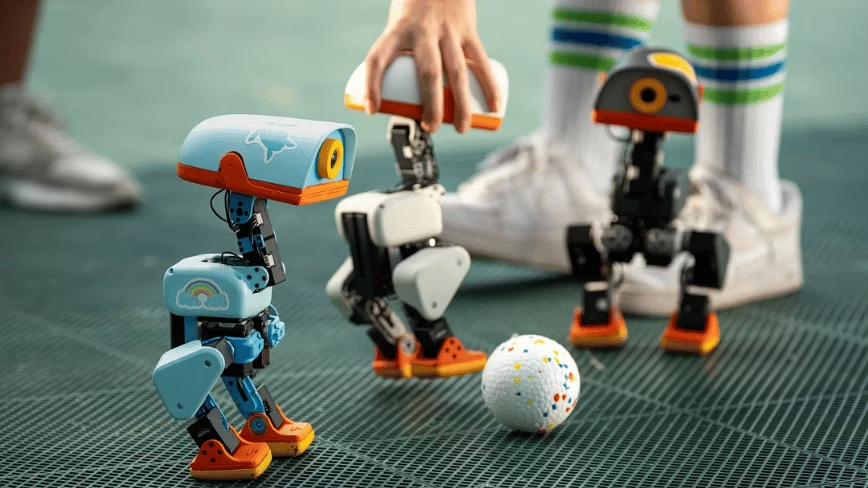
- Pollen Robotics, the Bordeaux company owned by Hugging Face, opened preorders on Thursday for Microduck, a 25cm bipedal robot with 15 motors at an introductory $399 before taxes and shipping.
- The robot runs a Rockchip RK3566 with an AI accelerator, 1GB of RAM and 32GB of storage, and senses through a front camera, an 8x8 time-of-flight LiDAR matrix and two inertial measurement units.
- The full software stack is already published, with the SDK and robot software in one GitHub repository and the reinforcement learning and sim-to-real tools in another, months ahead of any hardware.
- Santiago Pavon of Pollen put the beak's lifting capacity at roughly 100 grams and accepted that grasping will stay limited on a robot of this size.
Compiled by The Product DeskSomething wrong?How this is made
Why it matters
- capability Multi-robot behaviour work stops needing a room full of hardware: five bodies come to $1,995 before taxes and shipping, which is a purchase order rather than a capital request.
- constraint A payload of about an eighth of the robot's own weight and roughly an hour of battery bound what this platform can honestly measure, so manipulation and long-horizon autonomy testing still needs other hardware.
- decision With the mechanical and electronic files shut, the buy is a judgement about whether the open policy code will port to other bodies later, not about owning a repairable machine.
- exposure Anyone budgeting around navigation or SLAM is depending on unpaid contributors, because Pollen has said out loud that it expects the community to supply the autonomy work.
The first thing a team does with a robot this cheap is buy more than one, and Pollen has pre-answered the question of what to do with it by saying Microduck is about ten times more fun in groups, with races and robots reacting to each other as the internal favourites [21].
The price supports that. Divide $399 by 15 motors and you get about $27 an actuator, and that $27 also has to carry the RK3566, the time-of-flight matrix, the two IMUs and the battery [23]. It works because nothing in the parts list is asked to lift anything: Santiago Pavon's figure of roughly 100 grams is about an eighth of the robot's own sub-800g mass [24], and TechCrunch had to correct its launch story after overstating what the beak could carry [18].
What the money does buy is a control loop running at 50Hz, a decision every 20 milliseconds [9][25], and a sim-to-real repository that is public now, so a skill trained in simulation can be pushed onto the machine when one arrives [11][12]. That is a locomotion policy bench with a camera on it.
The gap worth naming, before anyone writes the internal memo, sits between the pitch and the delivery. Teams will put voice recognition, navigation and SLAM on the slide as things the platform does. Pollen has written those same words down as things it hopes owners will do, and Pavon says adding purpose and autonomy is still being worked on and is expected to come from the community [20]. What is being pitched is a platform, but what will actually ship late next year is a walking, self-righting testbed with about an hour of runtime on a removable NP-F550 camera battery [5][10].
The chassis is where the rollout gets awkward. Pollen's press kit tells journalists that the open-source claim covers the software stack only, and asks reporters not to describe the machine as open-source hardware [13]; a representative told The Register the company has no plans to open the design files [14]. The split is deliberate policy rather than a paperwork oversight, and Pollen already runs the same approach on Reachy Mini, which it says has passed 10,000 units since launching last year [15]. In practice, a snapped hinge or a beak with different geometry is Pollen's decision to support, not something a buyer can print.
The purchase comes down to two questions: whether the experiment lives in the policy or in the body, and whether the calendar tolerates first deliveries before Christmas 2026 [4]. Policy work travels, because it is code in a public repository that outlives any one chassis [11]. Body work does not travel, because the files are shut [13]. For a patient buyer betting on policy, this is a bench worth several units; for someone in a hurry betting on the body, it is a toy with a good SDK, which is close to what The Register called it: a cheap way to teach hardware AI and modern robotics, not an in-home butler [19]. Clement Delangue's launch post drew 4.4 million views [16], and none of those views is a grasp test.
What to watch
- Whether first deliveries hold to before Christmas 2026 and whether the $399 introductory price survives the preorder window.
- Whether community repositories produce working navigation or SLAM before the hardware lands, given Pavon put autonomy on the community.
- Whether any third party publishes replacement part geometry for a chassis whose design files Pollen says it will not open.
Loading claim ledger
Loading source directory links
Loading share composer
Loading topic controls
Loading related stories