Product1 distinct publisher3 min readPublished
The Information reports a price that works out to 86 times Hugging Face's revenue, which means what Nvidia bought is the host of three million open-weight models, and every pipeline that fetches at build time has a new upstream owner.
The Product Desk · Product desk

Compiled by The Product DeskSomething wrong?How this is made
A line in the repo you own resolves a model name against a remote host, and it runs on every build with nobody watching it. That host carries more than three million open-weight models [2], which is how it became the default and why nobody has re-litigated it in years. The story teams tell themselves is that open weights make them portable. What the pipeline does is fetch bytes at build time from one address, under a name only that address resolves.
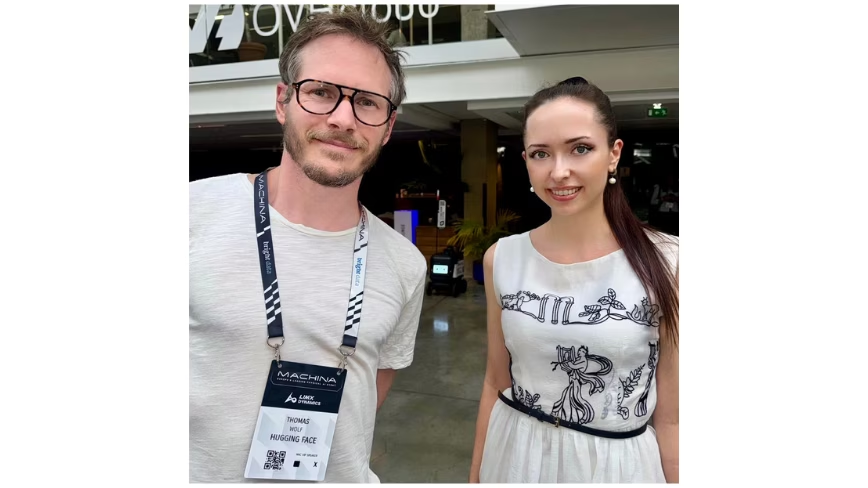
Divide $12.9 billion by $150 million of annualized revenue and you get 86 times [1]. Divide it by the 250 people who work there [8] and you get about $51.6 million a head [2]. Neither number is about robots. Robots is what the founder interview was about. Thomas Wolf's kit line includes a roughly $100 arm that has passed 10,000 units, and a Reachy Mini quoted at $300 to $500, with 20,000 units on track this year [10][9]. (The same write-up elsewhere gives the Reachy Mini as $399 to $499 [9].) Twenty thousand units at the middle of that range is around $8 million of hardware revenue [3], which is not what a $12.9 billion check is chasing. The check is chasing the place developers land by default.
On the buyer's side the sum barely registers. It is 13.4 percent of a single quarter's revenue [5], which the write-up renders as about thirteen days of sales [6], and roughly 72 percent of the $18 billion Nvidia says it has committed to equity investments through 2027 [5][6]. Against the $7 billion valuation attached to the investment Hugging Face turned down, per the Financial Times, the sale price works out to about 1.8 times that mark [4], the figure that had been attached to staying independent.
So far, only a price has been reported. The account covers the multiple and the earlier valuations and says nothing about post-close hosting terms or storage pricing [14]. Wolf describes the enterprise storage line as gaining traction faster than almost anything else the company has built [12], which makes it the part of the business an owner with different incentives can reprice first.
Two axes sort your own exposure. One is whether the artifact reaches production or stops in a notebook. The other is whether you can rebuild last month's image with the registry unreachable. Production plus rebuildable is where you want to be, and the running cost is keeping the mirror fresh. Production plus not rebuildable is the work item: pin by digest and copy the bytes into storage you control, with the license text you were served saved next to them. Notebook plus not rebuildable can wait, provided somebody has written down that it is only a notebook. Notebook plus rebuildable means you have already paid for a mirror and the production jobs should point at it.
The cheap version of the test is one build with the registry blocked at the firewall, run on a quiet Tuesday when nothing is shipping. Whatever fails in that build is the part of the stack you were sourcing from a company whose new owner sells accelerators [1].
Ranked by verification strength, evidence, and original report placement.
Nvidia agreed to buy Hugging Face for $12.9 billion, reported on August 27, 2026, in one of Nvidia's largest acquisitions to date.
The $12.9 billion price values the ten-year-old startup at roughly 86 times its $150 million in annualized revenue and nearly triple the $4.5 billion valuation it fetched in 2023.
The deal leaked the same day Nvidia reported $96.2 billion in quarterly revenue and forecast a 70 percent jump in revenue next fiscal year.
Nvidia disclosed it has $18 billion committed to equity investments through 2027.
At Nvidia's current pace, $12.9 billion is about thirteen days of sales.
In January the Financial Times reported that Hugging Face had turned down a $500 million investment from Nvidia at a $7 billion valuation.
Distinct publishers with included, body-backed reporting in this cluster.
Follow any of these and your For You feed starts watching them — no settings page required.
build
Unsloth's 10% quant claim is really about which machines can run a 27B model1 distinct publisher
build
Hugging Face's $13B process puts most teams' model pipeline under a single owner2 distinct publishers
invest
Nvidia's Perplexity talks move its money one layer further from its own chips1 distinct publisher
product
Nvidia circles Rebellions because the low-power inference tier is not optional2 distinct publishers
Evidence-backed comparisons of source perspectives and observed adoption signals. Read the methodology
Which Builder, Operator, and Investor concerns the observed source mix emphasized—not a truth score.
Evidence, demonstrated adoption, hype gap, incentives, and confidence are assessed independently, each on its own current evidence. How these are measured.
One relayed scoop wrapped in one interview
The transaction at the centre of this — price, multiple, timing — reaches us only through The Next Web relaying The Information, with the January backstory relayed in turn from the Financial Times. Nobody from Nvidia or Hugging Face is quoted on the deal. What is firsthand is the softer material: Wolf on robot kits, actuator counts, and which open-weight models he likes. The piece also contradicts itself on two verifiable numbers, the Hub's model count and the Reachy Mini's price, which is not fatal but tells you how much settling this reporting still needs.
The platform is enormous; the deal has changed nothing yet
Two very different adoption stories are stacked here. The Hub's usage is genuine and large — millions of hosted models, a trending list developers treat as a starting point. The hardware business is real but small: 10,000 kits sold, 20,000 targeted, $2.6 million of Microduck orders. And the thing the headline is about, Nvidia owning the open-weight distribution layer, has produced no observable change to anyone's workflow, because as of this reporting it is an agreement, not a closed transaction with published terms.
An 86x headline resting on an unconfirmed price
The framing runs ahead of what has been established. '86 times revenue' and 'a chip vendor in every open-weight build' are strong conclusions drawn from a price nobody in the deal has confirmed and a revenue base nobody has audited. Meanwhile the disclosed businesses being valued are a roughly $8 million hardware line and a storage product whose only evidence is the co-founder calling it fast-growing. The gap is not invention — it is a well-sourced-sounding valuation story built on a single relay.
The seller narrates his own sale
Thomas Wolf is the only person speaking on the record, and he is a co-founder being valued at $12.9 billion while describing his own storage traction, his own robot launch, and the ecosystem mission that makes the price look like vindication rather than an exit. The Information's scoop and the interview access both benefit from the other's existence. None of that makes the numbers wrong; it does mean every soft claim in this story arrives from the party with the most to gain from how it reads.
Single outlet, two internal contradictions
One publisher, no confirmation from either party, and a report that disagrees with itself about a model count and a product price. Confidence would rise quickly on an Nvidia or Hugging Face statement, a filing, or any second newsroom putting its own name to the $12.9 billion figure. Until then, treat the arithmetic as internally consistent and the premise as unverified.