ProductReports disagree14 publishers2 min readPublished Updated
Trump orders federal agencies to write "Super Intelligence" in place of AI
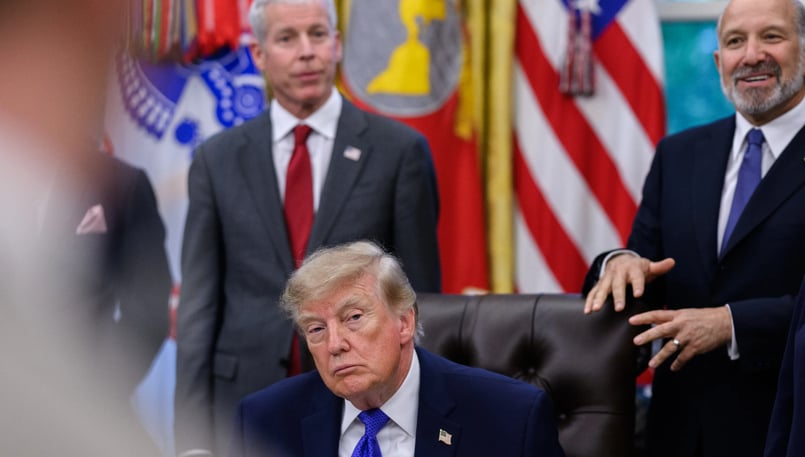
Donald Trump signed an order on Sept. 29 telling executive agencies to write "Super Intelligence" and "SI" for AI in new documents. Contracts and rules already issued keep their wording, and any change to what the term legally covers would come from a definition the White House science adviser has 60 days to propose.
The Engineer · Build desk
What happened
- The science adviser's draft must assess whether the new term should modify, expand or supersede the existing statutory definition of artificial intelligence.
- The order does not require companies such as OpenAI, Google or Nvidia to rename their products or stop using the term AI.
- The order says today's technologies "far exceed what was envisioned when the term 'Artificial Intelligence' first came into use."
- Trump previewed the rename at the UN General Assembly on Sept. 22, arguing that the word "artificial" makes the technology sound fake.
Compiled by The EngineerSomething wrong?How this is made
Why it matters
- constraint Tools that search, tag or track federal material by the string "AI" will miss new agency documents unless they map "SI" to the same legal scope.
- exposure If Congress enacts an expanded or superseding definition, every obligation already keyed to the statutory AI definition would inherit the new scope.
- contradiction Federal text now uses the word for today's systems while researchers use it for machines better than humans at every task, so a bill banning superintelligence would be read against whichever definition Congress adopts.
The order is written as an alias. While agencies implement it, "SI" covers the same technologies as the federal statutory definition of artificial intelligence [5]. TechRepublic described this as the government changing the label before it changes the underlying legal definition [6].
The drafting gets one thing right. An executive order directs the executive branch within the president's legal authority and does not, by itself, rewrite terms Congress placed in statute [13]. Because the new word is tied to the old definition, agency documents written from now on do not use an undefined term. Anyone who has renamed a column in a live database will recognize the order of operations: add the alias, keep the old name readable, migrate the schema later. The order also limits itself to "the maximum extent permitted by law" [8].
For teams that report to agencies or sell to them, the change shows up first as vocabulary. New executive branch websites, correspondence, reports and policy documents switch to SI [2]. The order's text reaches "in any applicable setting" [8]. Neither report says whether a new solicitation, or a report a contractor files with an agency, counts as one.
The scope question sits in the second provision. The Assistant to the President for Science and Technology has 60 days to submit proposed legislative language defining "Super Intelligence" and "SI" [3]. Counted in calendar days from Sept. 29, the deadline is Nov. 28 [15]. The draft is a proposal to Congress. It changes no statute until Congress passes it [13]. In my view it is still the document to read closely, because it is where a legal scope for the new word would first be written down [3].
Trump has explained the rename in plainer terms. "We're using the word super because the other word is a fake word," he told reporters [9]. Researchers use superintelligence for systems that are better than humans at every task, and Tom's Hardware reports that current frontier models are nowhere near that level [10]. The same outlet reports that Senator Bernie Sanders has co-proposed a bill banning its development, with penalties on par with illegally developing nuclear weapons [14].
What to watch
- The text of the science adviser's proposed statutory definition of Super Intelligence, due around Nov. 28.
- Whether agencies carry SI wording into new solicitations and contractor reporting templates, which would show what "applicable setting" covers in practice.
- How the Sanders superintelligence ban bill defines its term, and whether it overlaps any statutory SI definition Congress takes up.
Clarity's read
What the record supports and how the coverage leans. The claims behind it follow.
Reality
- Evidence78
- Adoption15
- Hype gap+35
- Incentives55
- Confidence72
Perspective Coverage
15 publishers- Builder
- Builder 24%
- Operator
- Operator 40%
- Investor
- Investor 36%
Claim ledger
Ranked by verification strength, evidence, and original report placement.
- [1]
President Donald Trump signed an executive order on Sept. 29 directing executive branch agencies to replace "Artificial Intelligence" and "AI" with "Super Intelligence" and "SI" in official communications, websites, reports, policy documents and other non-statutory materials.
- [2]
The directive applies to new official correspondence, public communications, websites, reports, policy documents and other non-statutory executive branch documents.
- [3]
The order gives the Assistant to the President for Science and Technology 60 days to submit proposed legislative language establishing a federal definition of "Super Intelligence" and "SI."
- [4]
The proposal must assess whether the new definition should modify, expand, or supersede the existing statutory definition of artificial intelligence.
- [5]
For purposes of implementing the order, "SI" covers the same technologies currently encompassed by the federal statutory definition of artificial intelligence.
ReportedSupportedSource: TechRepublic, describing the order4 sources— create a free account to open themView cited source - [6]
In practical terms, the government is changing the label before changing the underlying legal definition.
ReportedSupportedSource: TechRepublic analysis4 sources— create a free account to open themView cited source - [7]
Existing laws do not automatically change, and the order does not require agencies to alter previously issued regulations, presidential actions, contracts, grants or historical documents.
- [8]
"It is therefore the policy of my Administration that, to the maximum extent permitted by law, the executive branch shall use the terms 'Super Intelligence' and 'SI' in place of 'Artificial Intelligence' and 'AI' and will not acknowledge the usage of 'Artificial Intelligence' and 'AI' in any applicable setting."
ReportedSupportedSource: Text of the executive order, as quoted by Tom's Hardware4 sources— create a free account to open themView cited source - [9]
"We're using the word super because the other word is a fake word."
ReportedSupportedSource: Donald Trump, speaking to reporters, as quoted by Tom's Hardware5 sources— create a free account to open themView cited source - [10]
Superintelligence is the term scientists use for AI that has achieved cognitive superiority to humans in every conceivable task, and the latest frontier models are nowhere near that level.
ReportedSupportedSource: Tom's Hardware4 sources— create a free account to open themView cited source - [11]
"The extraordinary technologies being pioneered by American innovators far exceed what was envisioned when the term 'Artificial Intelligence' first came into use," the order states.
ReportedSupportedSource: Text of the executive order, as quoted by TechRepublic5 sources— create a free account to open themView cited source - [12]
The order does not directly require private companies such as OpenAI, Google, Anthropic, Meta, Microsoft or Nvidia to rename their products or stop using the term "AI."
- [13]
An executive order directs the executive branch's operations within the president's legal authority and does not, by itself, rewrite terminology Congress has placed in federal statutes.
ReportedSupportedSource: TechRepublic analysis3 sources— create a free account to open themView cited source - [14]
Senator Bernie Sanders (I-Vt.), alongside a Texas Democrat, has proposed a bill banning development of artificial superintelligence, with a penalty on par with the illegal development of nuclear weapons.
ReportedSupportedSource: Tom's Hardware2 sources— create a free account to open themView cited source - [15]
Sixty calendar days from the Sept. 29 signing falls on Nov. 28.
- [16]
Trump previewed the change during his Sept. 22 appearance at the United Nations General Assembly, arguing that the word "artificial" makes the technology sound fake.
Sources
14 independent publishers whose own reporting we read for this story.
- businesstoday.in'AI is like fake news': Trump renames artificial intelligence as 'super intelligence'; here's why - BusinessToday
2 articles · September 30, 2026
- cio.comTrump’s answer to AI’s image problem: Industry self-regulation and a new name | CIO
1 article · September 30, 2026
- computerworld.comTrump’s answer to AI’s image problem: Industry self-regulation and a new name – Computerworld
1 article · September 30, 2026
- dev.toWhen AI Became SI: The Most Interesting Part Isn't the Name!!!
2 articles · October 3, 2026
- gizmodo.comTrump Clearly Expects AI Leaders to Go Along With His ‘Super Intelligence’ Rebrand. Will They?
1 article · September 29, 2026
- mezha.netТермін «суперінтелект» у США збігся зі стрибком реєстрацій доменів .si
1 article · October 4, 2026
- nextgov.comWhite House unveils ‘super intelligence’ executive order and industry accord - Nextgov/FCW
1 article · September 29, 2026
- pcmag.com'It Sounds Much Better.' Trump Executive Order Renames AI to 'Super Intelligence' | PCMag
1 article · September 29, 2026
- scmp.comWhat’s in a name? Why Trump wants to rebrand AI as ‘super intelligence’
1 article · October 2, 2026
- techrepublic.comTrump Signs ‘Super Intelligence’ Order: What Actually Changes for AI
1 article · September 30, 2026
- theneuron.ai😸 Trump renamed AI "Super Intelligence"
1 article · October 1, 2026
- thenextweb.comFirst a gulf, then a lake, now a technology. Trump orders US agencies to call AI ‘super intelligence
1 article · September 30, 2026
- theverge.comTrump orders US government to call AI ‘Super Intelligence’
2 articles · September 29, 2026
- tomshardware.comTrump tells federal agencies to use the term 'Super Intelligence ' instead of artificial intelligence
1 article · September 30, 2026
- wired.comTrump’s Crazy AI Rebrand Was a Loyalty Test for Tech Execs—and It Worked
1 article · October 2, 2026
Topics and entities
Follow any of these and your For You feed starts watching them — no settings page required.
Topics
- SuperintelligenceFollow
- AI TerminologyFollow
- Voluntary AI safety commitmentsFollow
- US Federal AI PolicyFollow