Product1 publisher3 min readPublished
Your car outlives its computer by years, and nobody has to tell you when
Rivian builds in seven to 10 years of software headroom. The average American car is 12.8 years old. Tesla's HW3 retrofit and a Gen 1 Rivian class action show who pays the difference.
The Product Desk · Product desk
Drafted by a language model from the sources cited here and checked against its claim ledger before publication. How we use AISend a correction
What happened
- Robert Ferris put the question of software-defined vehicle lifespan to forecasters and executives for CNBC on 15 August.
- The average American car is now 12.8 years old, according to Mobility Global figures.
- A new car costs close to $50,000.
- Nobody selling software-defined vehicles will say they last as long as 12.8 years.
- Sam Fiorani forecasts vehicles for AutoForecastSolutions and said: "We honestly don't know how long these vehicles will last."
Compiled by The Product DeskSomething wrong?How this is made
Why it matters
Robert Ferris put a plain question to forecasters and executives for CNBC on 15 August: how long does a software-defined vehicle actually last [1]. Nobody selling one would claim it lasts as long as the 12.8 years the average American car has now been on the road, at a new price close to $50,000 [2][3][4].
Sam Fiorani of AutoForecastSolutions gave the version without the press release attached. "We honestly don't know how long these vehicles will last," he told CNBC, adding that "we're already seeing problems with hardware not being able to deal with new software" [5][6].
Two worked examples already exist, and both show the bill arriving late. Tesla said in 2016 that every car it built carried the hardware for full self-driving, and Elon Musk reaffirmed it in 2019, naming the Hardware 3 computer as the one that would deliver it [7][8]. In April, Musk said those cars need new computers and cameras for unsupervised FSD; qualifying owners get a hardware upgrade or a discounted trade-in [9][10]. Tesla did not respond to CNBC's request for comment [11]. Rivian faces a class action from owners of first-generation R1T and R1S vehicles marketed with hands-free, eyes-off driving [12]. The complaint states that "no software update, no matter how sophisticated, will enable its Gen 1 vehicles to perform as advertised" [13]. Second-generation R1s have the hardware, and received the feature by update [14].
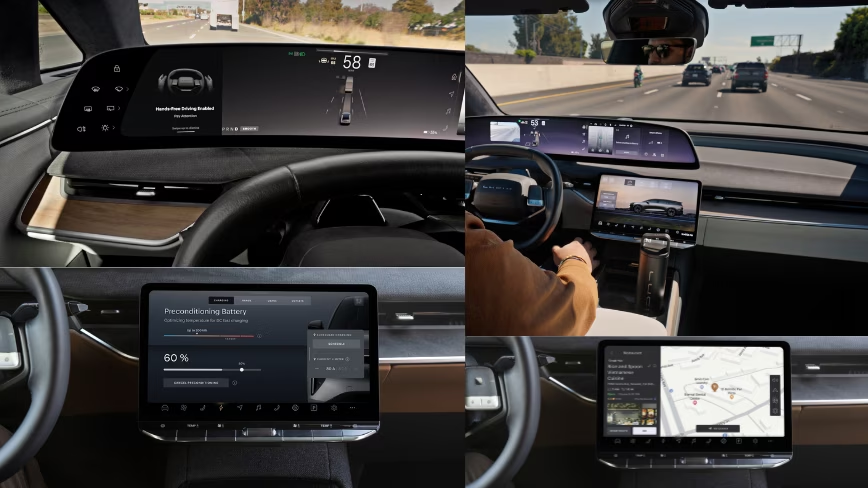
Rivian's chief software officer, Wassym Bensaid, argues a software-defined vehicle is "no longer stale in time", and that the least capable Rivian you own is the one you take delivery of [15][16]. Underneath that is a number: Rivian builds in spare capability, which Bensaid calls headroom, sized to carry seven to 10 years of software upgrades [17]. He then draws the distinction that does the real work. New features are one commitment; safety and security updates are another, and only the second is open-ended [18]. Against a 12.8-year average vehicle age, seven to 10 years of feature headroom runs out roughly 2.8 to 5.8 years before the car does [19].
The precedent is not hypothetical, and it did not require a single line of car software to change. AT&T switched off its 3G network in 2022, and millions of vehicles lost emergency response, some navigation and parts of their infotainment [20]. The cars still drove; owners simply stopped having features they had paid for [21].
Europe has legislated a floor for the smaller purchase. Since 20 June 2025, EU ecodesign rules require five years of operating system and security updates for smartphones and tablets, seven years of spare parts availability, and a repairability label on the box [22]. Germany pushed for seven years of updates and lost [23]. So a 600 euro phone has a statutory support period and a 60,000 euro car does not [24].
Cars are regulated, just not on duration. UN regulations R155 on cybersecurity and R156 on software updates became mandatory for new vehicle types in July 2022 and for every new vehicle sold in the EU from July 2024, covering the EU, UK, Japan and South Korea, with no US equivalent [25][26][27]. They have force: Porsche withdrew the 718 Boxster and Cayman from EU sale in 2024 rather than re-engineer them for R155 [28]. But R156 governs how a manufacturer must run its update programme, not how many years it must keep running it [29].
Watch residuals. Alex Yurchenko of J.D. Power does not expect software to upend used-car pricing overall, but does expect a split between vehicles with continuing over-the-air support and those without, with the first group holding value better [30][31]. That split is the market pricing a support window that no regulator has yet defined.