Build1 publisher3 min readPublished
xTool's M2 cuts the entry price and the toolset, then bills you back in ink
The M1's blade and pen are gone, cameras and air assist are now standard, and a $99 non-refillable cartridge sits in the middle of the running cost.
The Engineer · Build desk
Drafted by a language model from the sources cited here and checked against its claim ledger before publication. How we use AISend a correction
What happened
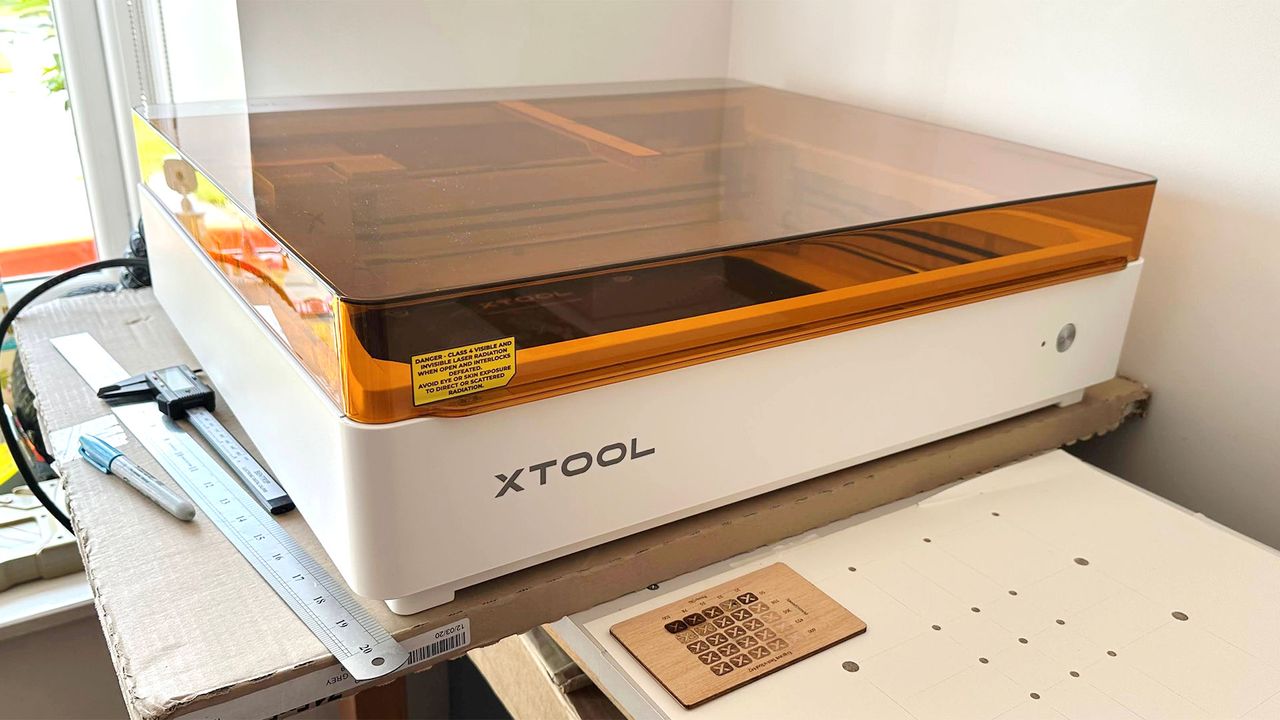
- The xTool M2 color craft laser and engraver is xTool's second take on an all-in-one craft tool in a box, and is not just an iterative update to the xTool M1 Ultra but a thorough remix.
- The M2 throws out the previous model's cutting blade and pen options.
- The M2 offers 10W diode, 20W diode, CMYK, and 2W IR laser head options, covering cut, print and engrave.
- The review's pros list cites a "New $549 entry price" for the M2.
- The review body states the xTool M2 10W base model is available for $599.
Compiled by The EngineerSomething wrong?How this is made
Why it matters
xTool's M2 color craft laser and engraver is the company's second all-in-one craft box, and Tom's Hardware describes it as a remix rather than an iteration: the M1's cutting blade and pen options are deleted, replaced by a choice of 10W diode, 20W diode, CMYK print, and IR laser heads [1][2][3]. What matters for anyone budgeting is that the advertised entry price is the least stable number on the page.
The review's own pros list leads with a "New $549 entry price" [4], while the body of the same review states the 10W base model is available for $599 [5]. That $50 discrepancy is unreconciled in the source [6]. Either way, the entry figure buys a bundle described as machine plus 10W diode head and nothing else [7], and Tom's Hardware puts it at roughly half the price of last year's M1 Ultra [8].
From there the ladder climbs quickly. The 10W Color Print and Cut bundle, which adds the CMYK print head and one cartridge, is listed at $699, usually $749 [9]. The 10W Deluxe bundle is $939, usually $989 [10]. Each 20W diode tier costs $400 more than its 10W equivalent [11]. Bought separately, the CMYK printing module with a cartridge is $169 and the RA3 Lite rotary accessory is $259 [12][13]. Bundling the print head therefore prices it at about $100 inside the Color Print and Cut kit against $169 a la carte [14].
The consumable is where the arithmetic gets awkward. Replacement cartridges are $99 and are not refillable [15], which is roughly 59 percent of the $169 list price of the entire print module with a cartridge included [16]. Tom's Hardware warns that extras can push the price beyond $1,000 [17]; the specific paths confirm it. A 10W Deluxe bundle plus the RA3 Lite is $1,198 [18], and even the base machine with the print module and the rotary reaches $1,027 [19].
What the lower entry price does not cost you is hardware that used to be optional. Twin positioning and monitoring cameras are standard, alongside a separate camera for fire hazard monitoring and alerts [20][21]. Air assist is integrated, extraction is fan-powered with a flexible pipe, and the enclosure lid is laser-safe tinted [22][23][24]. The print head now runs CMYK rather than the previous CMY, which the reviewer characterises as washed-out [25]. xTool claims the 20W head raises single-pass basswood depth from 8mm to 10mm and single-pass acrylic from 3mm to 8mm [26].
The complaints are unglamorous and physical: the cutting base is a flat metal tray, the supplied magnetic standoff clamps are flimsy, and the reviewer reports a few operational wrinkles plus a couple of software bugs in an otherwise good xTool Studio [27][28][29][30].
Two pricing gaps are worth tracking. Tom's Hardware could not find a price for the 20W diode head sold on its own, which makes buying 10W now and upgrading later an open-ended commitment [31]. And the IR head is described as a 2W option in the pros list while the promotional pages show a 3W unit with no price given [32][33]. Until those are published, and until someone establishes whether the $99 cartridge has any third-party alternative, treat the $549 or $599 figure as a deposit rather than a cost.