Science1 publisher3 min readPublished
No country is on track to cut food system emissions by 2030, first goal-referenced audit finds
The Food Systems Countdown Initiative scored 197 countries against 44 indicators in Nature Food. On most targets, most countries miss; on food system emissions, every country misses.
The Scientist · Science desk
Drafted by a language model from the sources cited here and checked against its claim ledger before publication. How we use AISend a correction
What happened
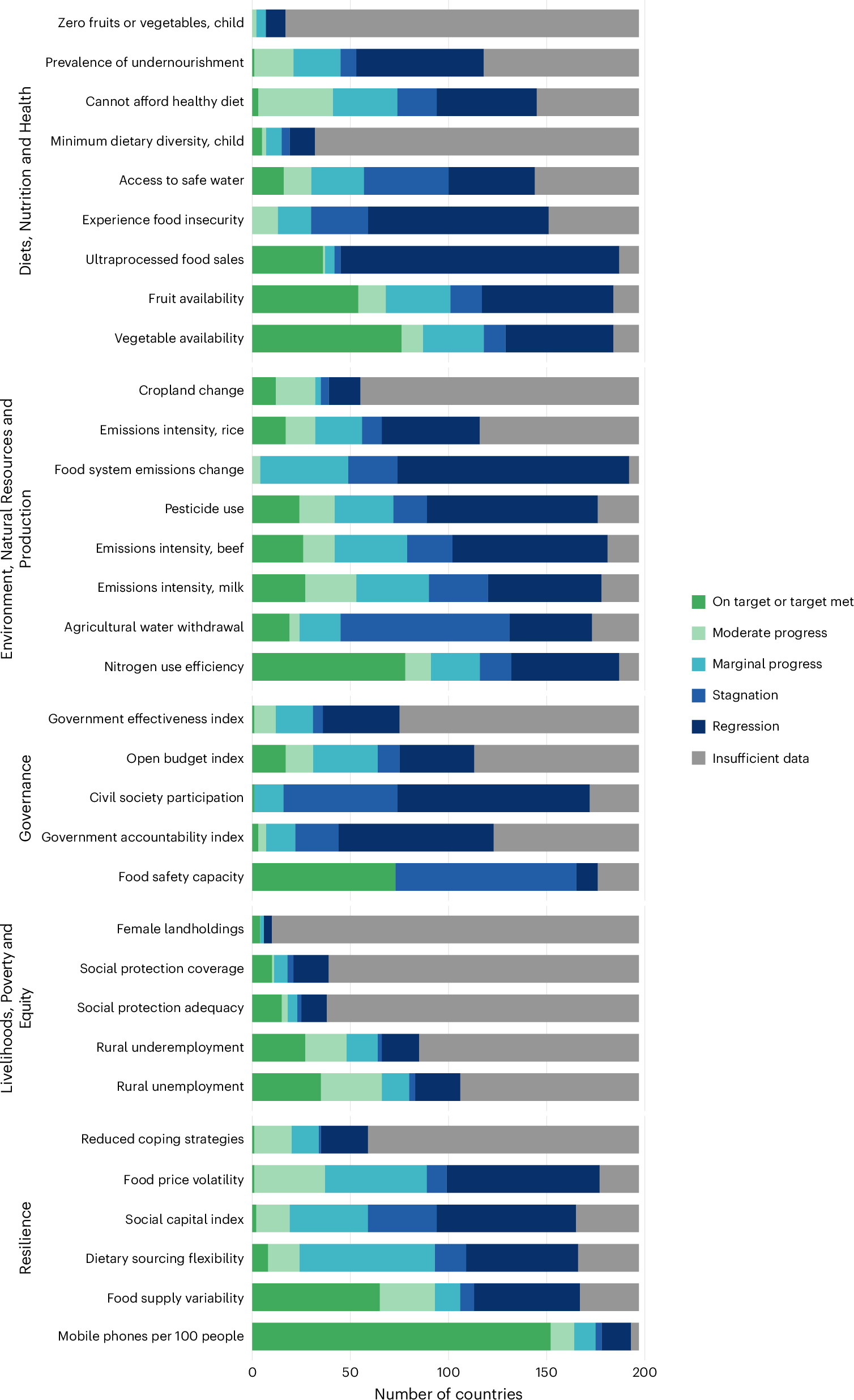
- A study published in Nature Food by the Food Systems Countdown Initiative is described as the most comprehensive performance assessment of food systems to date, covering 197 countries and 44 indicators across five themes: diets, nutrition and health; environment, natural resources and production; livelihoods, poverty and equity; governance; and resilience.
- For most indicators on health, environment, livelihoods, governance and resilience, a vast majority of countries will not meet the internationally agreed 2030 goals.
- The indicator 'greenhouse gas emissions from food systems' has one of the largest gaps, with the global average 75% away from the target, and no country in the world will meet the target at its current pace.
- For the first time, the study goes beyond tracking trends to assess progress and measure how food systems are performing and how much more they need to improve to meet globally set targets.
- The Food Systems Countdown Initiative is a global interdisciplinary research collaboration co-led by Johns Hopkins University, Cornell University, the Food and Agriculture Organization of the United Nations and the Global Alliance for Improved Nutrition.
Compiled by The ScientistSomething wrong?How this is made
Why it matters
A research collaboration co-led by Johns Hopkins University, Cornell University, the UN Food and Agriculture Organization and the Global Alliance for Improved Nutrition has published in Nature Food what it describes as the most comprehensive performance assessment of food systems to date: 197 countries scored against 44 indicators across diets and health, environment and production, livelihoods and equity, governance, and resilience [1][5]. The finding that matters commercially is not that progress is slow but that it is now measured against a distance: for greenhouse gas emissions from food systems, no country in the world is projected to meet the 2030 target at its current pace, and the global average sits 75% away from it [3].
The methodological shift is the point. Previous Countdown work tracked direction of travel; this paper assesses how far countries still have to go against a benchmark [4]. Lead author Bianca Carducci said the distinction between tracking trends and measuring performance "is what turns a monitoring exercise into a tool for accountability" [6].
The scoreboard is unflattering. Of 30 indicators, exactly one has been met by most countries: mobile phone subscriptions, used as a proxy for connectedness and resilience [7]. For 22 indicators, fewer than a third of countries will hit their global target or benchmark by 2030 [8], which is roughly 73% of that 30-indicator set [18]. Note that the reported denominators move around, 30 in one finding and 33 in another, against a headline count of 44 indicators, so the fractions are not directly comparable [20].
Required rates of change are the part operators should read twice. Africa would need at least 15% to 20% annual improvement across 23 indicators [9]. Asia would have to cut food insecurity by more than 63% every year [10]. Europe is not exempt: 19 indicators are described as unattainable by 2030 [11]. And several indicators are moving backwards, including ultra-processed food sales, agricultural water withdrawal, pesticide use, civil society participation, government accountability and change in food system emissions [12]. Mario Herrero of Cornell said that without accelerated progress, "efforts risk becoming performative rather than transformative" [13].
There are functioning parts. For seven of 33 indicators, at least a third of countries are already on track for 2030, about 21% of that set [14][19], and half the indicators are moving in a desirable direction globally [14]. The authors also publish the pace of change needed to hit targets by 2050 rather than 2030 [15]. Benchmark choice changes the apparent gap substantially: African countries are on average 58.7% away from the global benchmark for affordability of a healthy diet, but 32.2% away from a regional benchmark set by the average of the top fifth of African countries, a difference of 26.5 percentage points in the measured shortfall [16][21]. Jessica Fanzo of Johns Hopkins argued that bold global targets inspire ambition but "can become a source of inertia if they seem permanently out of reach" [17].
For anyone making food-sector sustainability claims, the practical consequence is that a country-level counterfactual now exists. A firm reporting emissions progress in a market where no country is on trajectory [3] is reporting against a failing baseline, and the paper supplies the required annual rate to check whether a stated plan is arithmetically capable of closing the gap.