Science1 publisher3 min readPublished
Automated feeders turn wild chickadee memory into a survival statistic
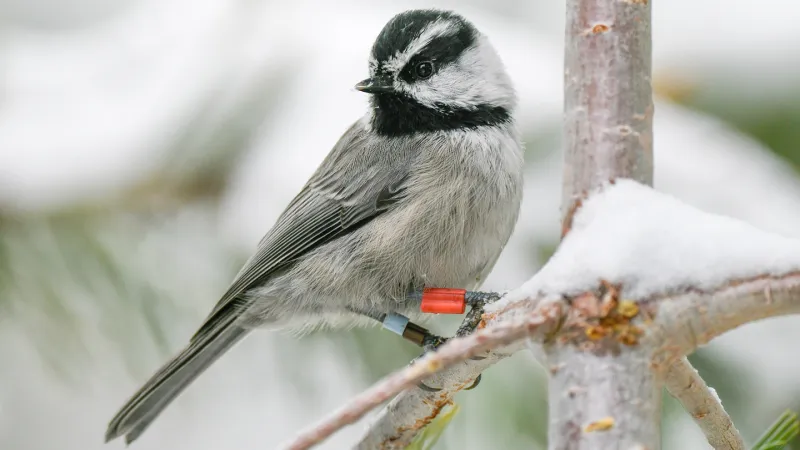
At a Sierra Nevada field station, feeders that open for a single banded bird have tested up to 250 mountain chickadees a winter since 2013, which lets a memory score be matched against which birds actually survive.
The Scientist · Science desk
What happened
- Battery-powered feeders that read a leg microchip and open for one banded bird let a University of Nevada, Reno team memory-test up to 250 wild mountain chickadees a year.
- The work runs at Sagehen Creek Field Station, about 16 kilometers north of Truckee, California, which Science News describes as one of the longest running studies of animal cognition in the wild.
- Each bird is scored on how fast it learns which feeder opens for it, then scored again after the researchers switch its assigned feeder, giving separate measures of spatial memory and cognitive flexibility.
- In Science in 2024 the researchers reported that the smartest birds live the longest.
- About two-thirds of these chickadees never survive their first winter, while the ones that do can live a decade or more.
Compiled by The ScientistSomething wrong?How this is made
Why it matters
- capability A cognitive score attached to a named individual across years can be regressed on lifespan, which is the measurement captivity cannot produce, since a cage removes the winter mortality that does the selecting.
- constraint The skill the species is known for is pulling single seeds out of crevices under meters of snow, and that recovery is not what the feeders score, so reading box-learning as cache-finding is extrapolation.
- cost Automation buys sample size rather than fewer people, so this method only travels to sites where someone will make a 30-kilometer snowmobile run in winter carrying seed, batteries and a chainsaw.
- precedent With longevity already tied to memory scores, the group's stated next target is reproductive success, which is where a claim about fitness rather than survival would actually be completed.
The leverage in this design is that the test travels to the bird and then stays for the bird's whole life. Because each feeder admits exactly one chipped individual and timestamps the visit [6], a wild population becomes a repeated-measures cohort, with scores accruing to named birds rather than to a group average. Line those up against the nesting, mating, genetic and survival records the team keeps on the same individuals [8], and a memory score can sit on the same row as a date of death. A captive cohort could not produce this, because the cage removes the agent doing the selecting [17].
Roughly one bird in three survives into a second year of testing [20], and the ones that get through can keep going for a decade or more [9]. Vladimir Pravosudov began work on mountain chickadees in 1999, 25 years before the Science paper [12][18]; the eight-feeder arrays arrived in 2013 [5], so the published result rested on about 11 winters of automated testing [19]. At up to 250 birds a winter, that is an upper bound near 2,750 bird-winters of tests, and rather fewer distinct birds, since a ten-year-old chickadee turns up in the sample ten times [19][4].
Whether the memory is doing the work is not something this shows. Nobody assigns the scores at random. Whatever makes a chickadee quick at the feeder task (early nutrition, body condition, rank, territory quality) could independently make it likelier to see April, so the data document selection acting on a trait in the wild without isolating the trait as the cause. The team's finding that genetics account for about 80 percent of cognitive differences among these birds [11] narrows the alternatives, though it is a variance decomposition inside one population under one set of conditions, not a statement that memory explains 80 percent of survival.
What the array scores is how fast a bird learns an assigned box. The behavior the species is famous for is prising single seeds out of tree crevices, sometimes under more than four meters of snow [15], on mornings when a bird weighing about as much as a pencil has minutes to find one [1]. The figure of a hundred thousand caches per bird comes from Richmond's account of that natural behavior [2], not from the feeders. And the Science result reaches this account as a direction rather than a magnitude [10]: smarter lives longer, with no effect size attached.
Lauryn Benedict, an animal behaviorist at the University of Northern Colorado who is not involved in the work, calls it a very clever experimental setup [13]. So the defensible statement stays narrow: in one Sierra Nevada population, birds that learn a feeder faster tend to live longer, and most of the variation in that learning is inherited. Katherine Johnson's next questions, about how those abilities alter reproductive success [14], are where a claim about fitness rather than longevity would close.
What to watch
- An effect size and interval for the memory-lifespan relationship, which the 2024 Science result reaches this account as a direction only.
- Results tying feeder scores to reproductive success rather than survival, the line of questions Johnson describes as next.
- A second population running the same arrays, which would test whether faster learners outlive slower ones outside this Sierra Nevada site.