Science1 publisher3 min readPublished
Simulated tides near Sagittarius A* destroy enough binaries to match the S cluster's count
Rodrigo Silva's team at Coimbra counted 43% of the S-cluster stars as binaries, then ran 100,000 simulated pairs through the black hole's tides for a million years and finished at 38%, close enough to argue the stars were born where they orbit.
The Scientist · Science desk
What happened
- The S-cluster stars circling Sagittarius A* are B-type and only a few million years old, in a place where the black hole's gravity should tear a gas cloud apart before it can collapse into stars.
- A team led by Rodrigo P. Silva of the University of Coimbra refined the count of pairs among those stars and put the binary fraction at 43 percent, plus or minus 9 points.
- Their simulation followed 100,000 binaries for a million years and ended with 62 percent intact, 18 percent merged and 20 percent disrupted, for a predicted binary fraction of about 38 percent.
- The predicted fraction stayed consistent with observations at different distances from the black hole, and the authors take that as one formation route operating throughout the region.
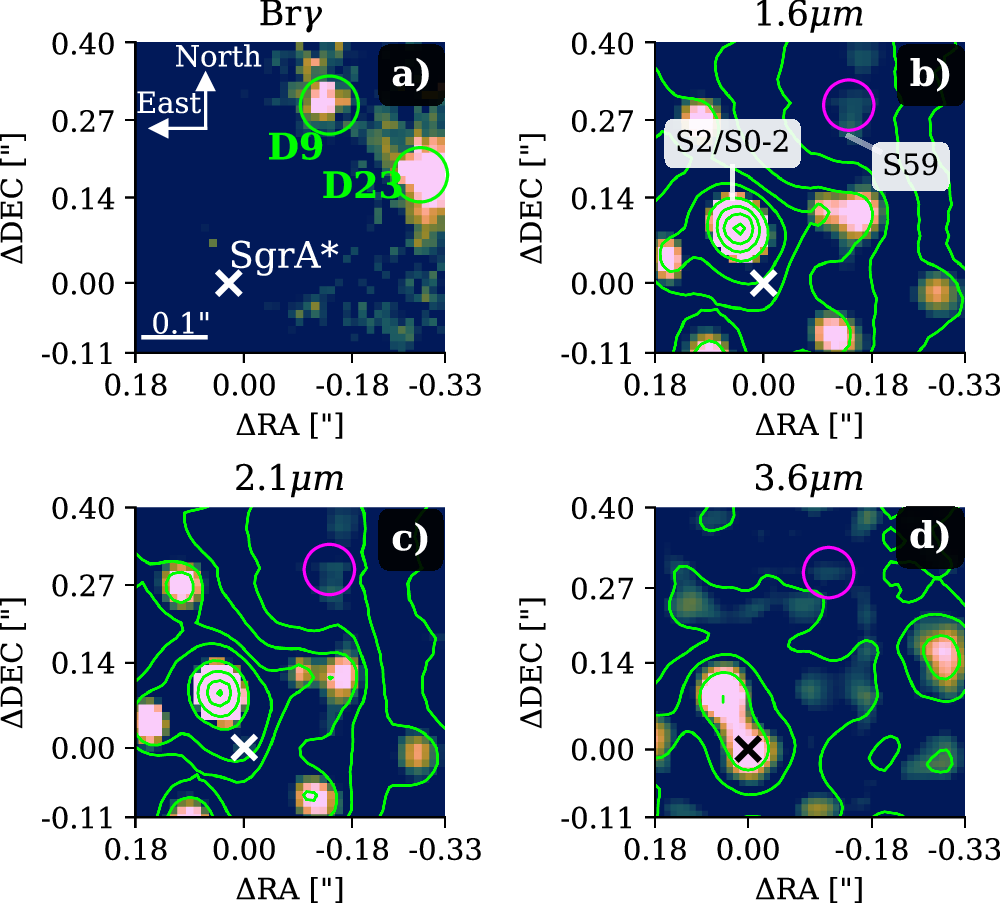
- The competing account, in which the black hole captures one member of an infalling binary and ejects the other, would leave the cluster nearly pairless, and the cluster already holds the binary D9.
Compiled by The ScientistSomething wrong?How this is made
Why it matters
- constraint Any origin story that needs the black hole to have broken up almost every pair now has to survive a measured 43 percent pairing rate, which puts capture-and-ejection under more pressure than the local-birth picture.
- decision The question turns on observing time rather than more computing: spectra and motions precise enough to find companions among a few dozen faint stars in a crowded field are what would move the number.
- capability If tides really set the pairing rate, the way the binary fraction falls toward Sagittarius A* becomes a way to measure the tidal field itself, using ordinary stars as the instrument.
The comparison rests on a small sample. Silva's group reports an observed pairing rate of 43% with a 9-point uncertainty [9], and if that uncertainty is counting statistics, the census holds roughly thirty stars: 0.43 x 0.57 divided by 0.09 squared gives 30 [1]. Thirty B-type stars tracked within 0.04 parsecs of a black hole of about 4 million solar masses is a substantial sample [2][3]. It also sets the resolution of the test, because a fraction known to plus or minus 9 points cannot separate 38% from 43% [4].
The deficit to be explained is 26 percentage points against the field rate for massive stars [3]. The simulation started 100,000 binaries at that field rate of 69% and ran for a million years on orbits matched to the cluster's observed structure [10][8]. Of those pairs, 62% survived intact, 18% merged and 20% were pulled apart [11]. Multiply the starting fraction by the survival rate and the answer is 42.8% [2]. The paper's prediction is 38% plus or minus 10% [11]. The difference lies in how single stars are counted after a merger or a disruption, and the write-up does not spell out that bookkeeping.
The work constrains the rival channel more sharply than it confirms its own. Hills capture, in which Sagittarius A* shreds an infalling binary and flings one member away at high speed, should leave the S cluster with almost no pairs at all, and the cluster contains the binary D9 [7]. The disk-migration route has its own trouble: it does not explain the nearly random orbital eccentricities of the S stars, or why B stars would have migrated inward while O and Wolf-Rayet stars stayed put [6]. In situ formation, in this paper, wins partly by elimination.
In the Astronomy & Astrophysics paper, published Aug. 11 [1], the team wrote: "This indicates a common formation mechanism throughout this region, with the decline toward Sgr A* driven primarily by increasing tidal disruption" [13]. They also wrote: "Our findings support an in situ formation scenario, such as gas-shell fragmentation" [14]. I would put more weight on the radial trend than on the single number, since a fraction that declines the right way toward the black hole across the whole cluster is harder to produce by tuning one initial condition [12].
Two conditions bound the match. The integration covers a million years while the S stars average a few million years old [5], so it does not run the length of their lives. And the 69% it starts from is measured for massive stars in the Galactic field, not near Sagittarius A* [8]. Silva's team says sharper measurements of stellar motions and spectra would settle how many binaries are actually there [15].
What to watch
- A tighter binary census from radial-velocity monitoring: a fraction near zero would revive capture-and-ejection.
- Whether a second system like D9 turns up in the S cluster, or whether none does.
- Whether the same simulation, integrated out to the stars' full few-million-year ages, still lands near 38 percent.