Invest1 distinct publisher3 min readPublished
PCE is running at 3.7% and the 30-year sat near 5.18%, which pays 148 basis points over inflation for thirty years of duration risk while the chair declines to say what would make him move. Banks have to model that gap.
The Investor · Invest desk

Compiled by The InvestorSomething wrong?How this is made
A reaction function is a conditional, and conditionals are what the long end trades: tell me what moves you and I will price the distribution around it. Thursday's arithmetic was a 30-year near 5.18% against PCE running 3.7% over the year [3][2], which is 148 basis points of real compensation for thirty years of duration risk [1]. If instead you take seriously the 2% target Warsh has reaffirmed consistently since becoming chair [8], the same coupon is 318 basis points real [2]. Those are two different worlds, one where the market has quietly stopped underwriting convergence and one where it demands an unusually fat real term premium to hold the tail of the curve, and Friday's speech does not settle which. A stated rule would at least narrow it.
The 52 basis points between the 10-year and the 30-year [3] is where Bessent's expanded debt buybacks land [5], and that is the part bankers should be chewing on rather than the next quarter-point. Derek Tang of Monetary Policy Analytics reads the buyback expansion, alongside Treasury's dollar-yen intervention, as evidence of anxiety inside Treasury that yields could go up too much [6], and says the Treasury market's signal on inflation and growth is now muddled by Treasury's own actions [7]. Or rather, the more interesting version of the problem: the Fed cannot tell whether 5.18% is a fiscal price or an inflation price when one of the bidders is the fiscal authority.
Which makes the credibility question a resource-allocation question. Isaac Wheeler of Derivative Path thinks continuing to beat the drum on the price-stability mandate may be sufficient to restore some credibility [10]; Mark Zandi of Moody's Analytics wants the logic of the guidance refusal itself, because that is what goes to credibility [9]. Those are not the same purchase. Spending the speech on the mandate leaves the communication strategy unexplained, and an unexplained strategy is exactly what a bank cannot put in a shock scenario.
This is probably wrong, but the tail worth pricing is not the next cut. Three ways it runs: Wheeler is right and the drumbeat holds the long end; Zandi is right and silence reads as the absence of a rule, so term premium widens into a market where Treasury is already leaning against yields [5]; or the underemployment that may be hiding behind low jobless claims [11] binds first, and the Fed eases with PCE 1.7 points above target [4]. That third one is the scenario American Banker's sources are gesturing at when they say banks need to consider extreme shocks [12]. What would prove me wrong is dull and plausible: two more PCE prints continuing the improvement Zandi already sees [8], the 30-year drifting in without a word of guidance, and the reaction function turning out never to have been the binding variable at all.
Ranked by verification strength, evidence, and original report placement.
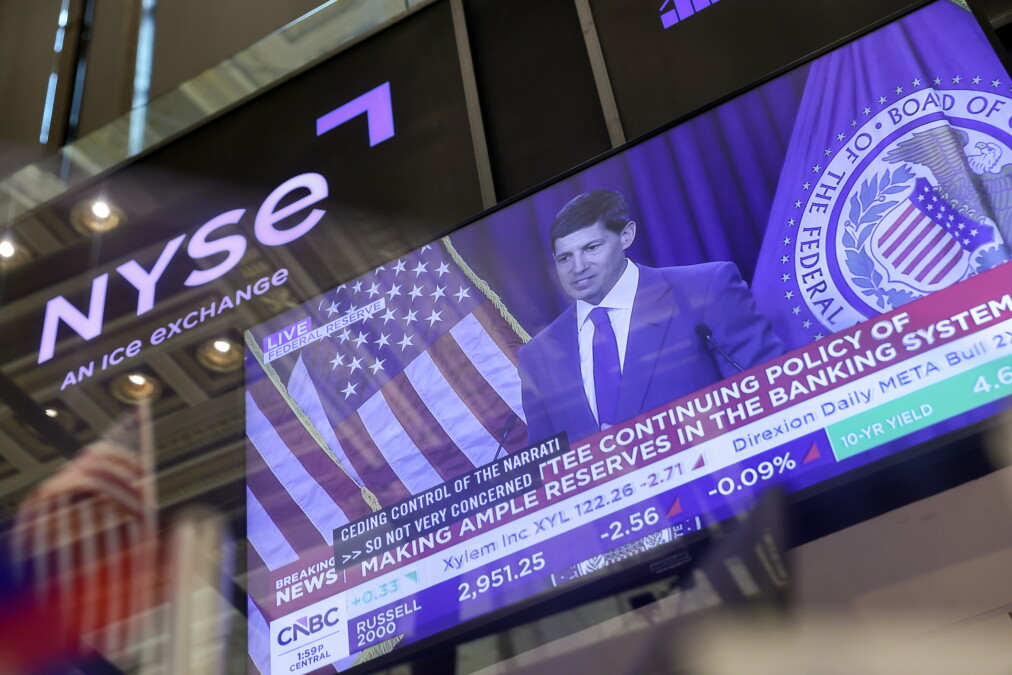
Federal Reserve Chair Kevin Warsh is slated to give a keynote speech Friday morning at the Jackson Hole Economic Symposium in Wyoming, which experts expect he will use to reestablish credibility with markets by explaining how the Fed will respond to changing conditions, though they expect few specific commitments.
The 10-year Treasury yield held around 4.66% and the 30-year around 5.18% on Thursday.
The yield on long-dated Treasury bonds has spiked in recent weeks amid concerns about government borrowing and fiscal policy.
Treasury Secretary Scott Bessent announced a move to expand government debt buybacks last week, which some observers say blurs the boundary between the Fed's monetary policy mandate and Treasury's debt management responsibilities.
Derek Tang, CEO of Monetary Policy Analytics, said Treasury's intervention in the dollar-yen market and its planned increase in buybacks are a series of events that clearly reveal anxiety in the U.S. Treasury that Treasury yields could go up too much.
Distinct publishers with included, body-backed reporting in this cluster.
1 article · August 27, 2026
Follow any of these and your For You feed starts watching them — no settings page required.
invest
Fed disunity, not the Fed's path, is the risk in duration before Warsh speaks1 distinct publisher
invest
"An inadvertent error is not fraud": Cook turns removal attempt two into a test of "for cause"1 distinct publisher
invest
The bond market is doing the tightening, and Warsh is not coming to relieve it1 distinct publisher
invest
Two-to-one on a hold: the dollar's three-month low reprices every July forecast1 distinct publisher
Evidence-backed comparisons of source perspectives and observed adoption signals. Read the methodology
Which Builder, Operator, and Investor concerns the observed source mix emphasized—not a truth score.
Evidence, demonstrated adoption, hype gap, incentives, and confidence are assessed independently, each on its own current evidence. How these are measured.
Specific figures and named sources, but one publisher and a speech that has not happened
The cluster supplies precise, checkable levels (PCE 3.7%, 10-year 4.66%, 30-year 5.18%) and three on-the-record experts with disclosed affiliations, which lifts evidence above anonymous commentary. It is capped by having exactly one publisher, by the core subject being a forward-looking event rather than an observed outcome, and by the underemployment strand being asserted with its supporting figure truncated out of the supplied body.
No adoption-type events in scope
This is a monetary policy and rates story. The supplied source reports no release, deployment, benchmark, pricing or license change, or usage disclosure, so there is nothing to measure and no adoption facts may be inferred.
Mildly overstated: framing outruns an event that has not occurred
The headline and dek assert that Warsh owes the market a reaction function and that banks have to model the gap, but the sourced material supports only that a speech is scheduled, that analysts expect a target reaffirmation with little or no forward guidance, and that the publisher itself recommends extreme-shock modeling. The underlying numbers are accurately stated and the mandate-blurring concern is carried by named quotes, so the overstatement is modest rather than severe — it sits in the imperative framing and the unquantified bank-modeling directive.
Disclosed commercial affiliations on all quoted voices; trade-press audience alignment
Every expert view is attributed with an affiliation that has a commercial interest in Fed and rates interpretation: a ratings-affiliated economics shop, a Fed-analysis firm, and a balance-sheet strategy provider serving banks. The publisher is a banking trade outlet whose forward look advises its bank audience to run extreme shock scenarios, which aligns with reader demand. Disclosure is clean and no undisclosed stake is reported, so distortion pressure is moderate rather than high.
Moderate: verifiable data, but single publisher and anticipatory core
Confidence is limited by the single-publisher cluster and by the fact that the story's central subject is a speech that had not yet been delivered when the piece ran. The quantitative claims and the derived spreads are internally consistent and checkable, and the expert attributions are explicit, which supports a middling rather than low score.