Invest1 publisher3 min readPublished
Warsh ties part of the yield rise to hyperscalers' funding competition
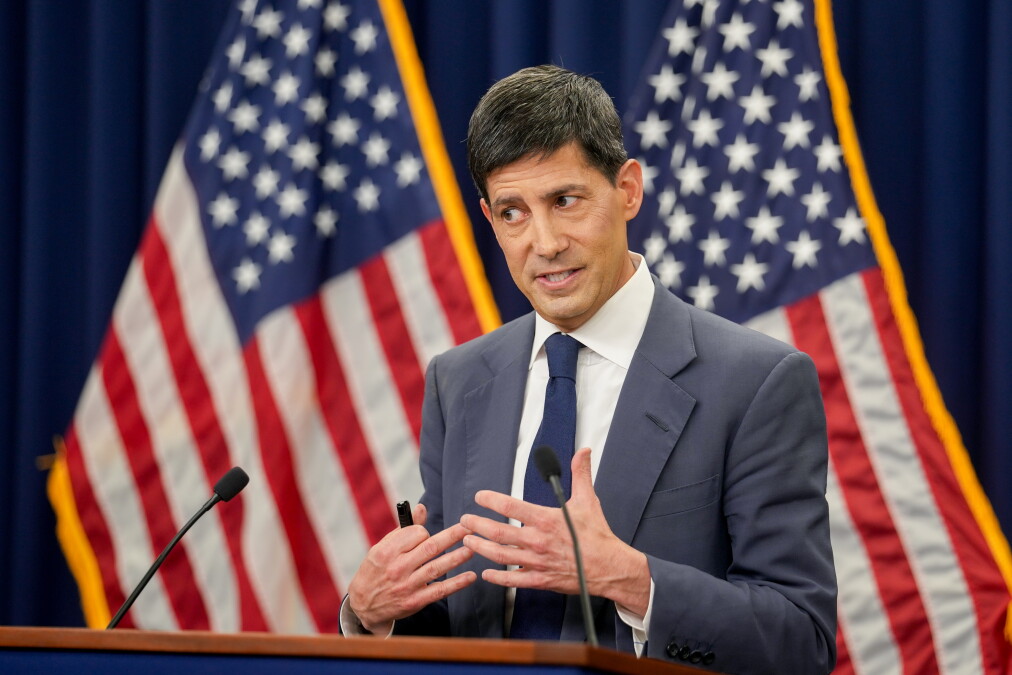
Fed Chair Kevin Warsh said hyperscaler fundraising partly explains rising yields, as companies add about six times the Treasury's increase in bond supply. Pension funds and insurers that buy 30-year paper are being asked to fund both borrowers from a pool Employ America's Skanda Amarnath calls finite.
The Investor · Invest desk
What happened
- Treasury sold nearly $3.3 trillion of notes and bonds through August and is on track for more than $4.9 trillion this year, about 2% above last year, per SIFMA.
- Corporate bond sales reached nearly $1.9 trillion through August and are on pace to pass $2.8 trillion, up 28% from 2025.
- Employ America's Skanda Amarnath said pension funds and insurers matching long liabilities have swapped some government securities for higher-yielding tech corporate debt.
- Tech firms took 28.7% of corporate bond proceeds in the first half of this year, up from 20% in 2025, according to SEC data.
Compiled by The InvestorSomething wrong?How this is made
Why it matters
- cost If long-dated buyers want more yield to hold government bonds while hyperscaler paper is on offer, the Treasury pays part of the AI buildout's financing bill through its long-end borrowing costs.
- constraint With a finite pool of liability-matching buyers, each hyperscaler 30-year deal that pension funds and insurers take down leaves less of their duration budget for Treasury long-bond auctions.
- exposure Treasury long-bond yields now depend partly on hyperscaler capex guidance, so a cut in tech spending plans becomes a rates event as well as an earnings one.
Worked backward, the pace figures show where this year's extra supply comes from. A corporate year of more than $2.8 trillion that is 28% above 2025 implies roughly $2.19 trillion last year, or about $610 billion of added corporate bonds [4][1]. A Treasury year of more than $4.9 trillion that is about 2% higher implies roughly $4.8 trillion last year, or about $100 billion added [3][2]. Companies are supplying about six times as much of the increase as the government [3].
At the long end, the headline comparison overstates the overlap. Treasury's 20- and 30-year bonds have totalled about $344 billion this year, 12% of its medium- and long-term issuance [5]. Corporate bonds of 10 years or longer have reached $752 billion [6], about 2.2 times as much [4]. A 10-year corporate bond competes with the 10-year Treasury note, and that note sits in the government's $3.3 trillion total, not in the $344 billion [3][5]. The reported figures do not separate out corporate bonds of 20 years and longer, the bucket where hyperscaler 30-year deals would land.
The conventional worry runs the other way, with government borrowing pulling savings away from private investment [8]. Warsh put the reverse on the record after the Federal Open Market Committee meeting. "The surge in capital expenditures ... is real, and the so-called hyperscalers are out in the market raising funding, and so the competition for capital is real and I think it partly explains the increase in yields," he said [1].
The buyers in question are specific. "A lot of the hyperscalers are issuing long term debt, 30-year debt, which is in direct competition with Treasuries," said Skanda Amarnath, executive director of Employ America. "There's a finite number of investors who are willing to invest in really long-dated fixed income products. It's a deep market, but it's not infinite." [2] John Velis, Americas macro strategist at BNY, said competition for Treasury bonds has reached a level not seen since the dotcom boom of the 1990s [11]. "Long-term investors would prefer AAA or investment grade sexy bonds that are of the current investment theme, which is now AI," Velis said [10].
Inflation and expected rate hikes are the main reasons American Banker gives for yields at 20-year highs [13]. If they account for nearly all of the move, the hyperscaler effect is a small share inside Warsh's "partly". A sharp tech slowdown is the one exception American Banker names to its view that long rates could stay high while annual AI capital spending tops $1 trillion next year [14]. Absent either, the same long-dated buyers have to absorb both borrowers at once.
I think that last case is the likeliest over the next year. The added supply is mostly corporate, and the buyers Amarnath names are the ones who also hold the long bond. The counter-case is Velis's own caveat that supply-side shocks are also lifting yields [12]. The thesis is wrong if hyperscaler long bonds keep arriving while 30-year Treasury yields fall relative to shorter maturities.
What to watch
- Bid demand at the next Treasury 20- and 30-year auctions, set against the calendar of hyperscaler long-dated bond deals.
- Whether corporate issuance keeps its pace through year-end, and whether a breakout of corporate bonds of 20 years and longer appears.
- Warsh's next post-meeting remarks, for any attempt to size how much of the yield rise he attributes to private borrowing.