Science1 publisher3 min readPublished
Ariel's giant fractures point to a past ocean more than 170 km deep
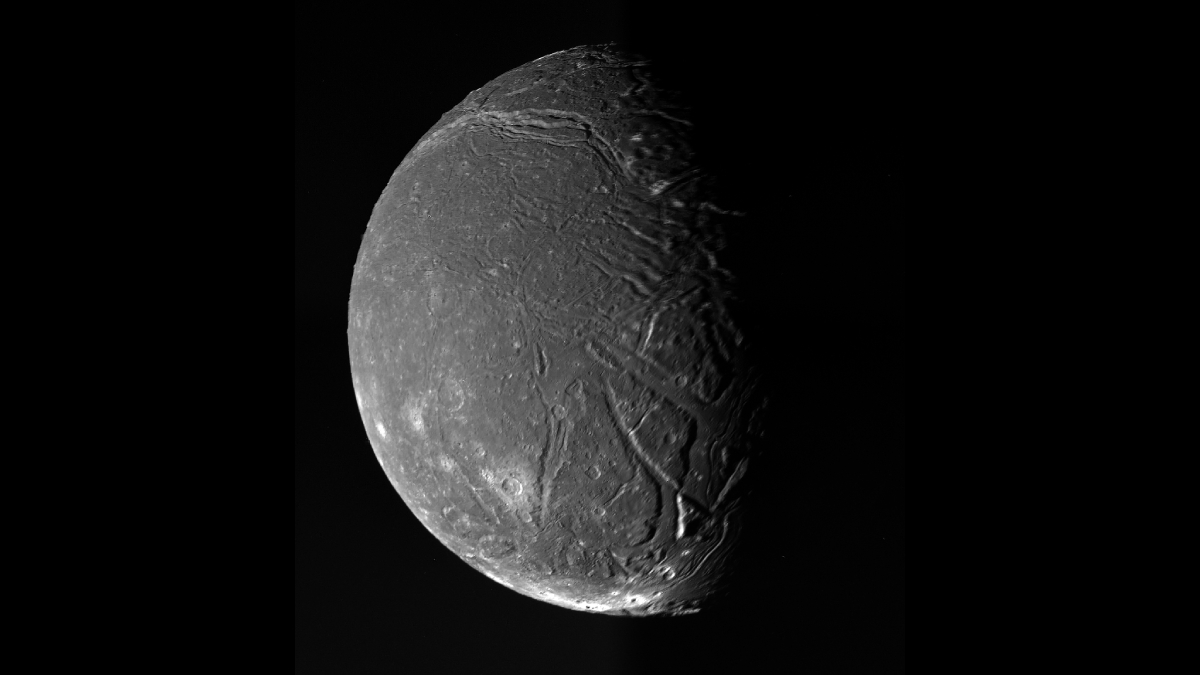
Tidal modelling published in Icarus says Uranus's moon Ariel needed a past ocean, possibly more than 170 km deep, to form its giant fractures. How deep depends on how eccentric Ariel's orbit once was, and surface maps alone cannot tell the two apart.
The Scientist · Science desk
What happened
- A study in Icarus concludes that Uranus's moon Ariel may once have held a subsurface ocean that could have been more than 170 km deep.
- The work started from Ariel's fractures, ridges and grabens, some of which are larger than similar features almost anywhere else in the Solar System.
- Fitting a tidal-stress model to those features puts Ariel's past orbital eccentricity at about 0.04, roughly 40 times its present value.
Compiled by The ScientistSomething wrong?How this is made
Why it matters
- constraint The same fractures fit either a thin shell over a large ocean or a more eccentric orbit over a smaller one, so Ariel's ocean depth cannot be fixed until someone has data on its interior.
- decision Anyone planning a return to Uranus now has two moons whose surfaces, on this team's model, required past oceans, and a specific interior measurement to aim for at Ariel.
- precedent Later moons in the series will share the team's method and assumptions, so matching results would widen the pattern without confirming it; a fit by an outside group would count for more.
The 170 km figure is one end of a trade-off. Fractures as large as Ariel's need strong tidal stress, and the model can supply that stress in two ways. "In order to create those fractures, you have to have either a really thin ice on a really big ocean, or a higher eccentricity and a smaller ocean," said Alex Patthoff, a Planetary Science Institute senior scientist and co-author of the paper [10][14]. "But either way, we need an ocean to be able to create the fractures that we are seeing on Ariel's surface." [10]
I would give Patthoff's second sentence the most weight, because within this model the requirement for an ocean holds whichever orbit is assumed, even though the ocean's depth changes with it.
The analysis fits a simulation to a map. The team charted Ariel's largest structures. It then computed the stresses produced as the moon distorts "from soccer ball-shaped to slight football-shaped and back as it moves closer and farther from Uranus during its orbit," Patthoff said [7]. The paper's first author, Caleb Strom, a recent University of North Dakota graduate, describes ancient impact craters sitting beside much younger terrain, with some smooth regions that may have formed through cryovolcanism [5].
An eccentricity of 0.04 still describes an orbit that would look nearly circular [9]. Divide it by the team's factor of 40 and today's value comes out near 0.001 [3]. The older orbit would also have been about four times as eccentric as Europa's, and Europa's icy shell is heavily fractured by the same kind of tidal stretching and squeezing [9].
For scale, 170 km is about 42 times the Pacific's average depth of roughly 4 km [1][2]. Ariel is 1,159 km across [4], so an ocean that deep would be a layer about 29 percent as thick as the moon's radius [2].
On the case for going back to Uranus, I think the paper helps in a narrow and specific way. It turns Ariel's outsized fractures [6] into a stated relationship between ocean depth and past eccentricity. Only measurements of Ariel's interior could pick a point on that curve.
The study does not say whether any of that water survives. The researchers set out to reconstruct what Ariel's interior and orbit looked like when the fractures formed [15], and the release says only that the moon "may once have contained" an ocean [1]. Miranda does not provide an independent check either. The Ariel paper is the second in a series, and the same team reported similar results for Miranda last year [12]. "We are finding evidence that the Uranus system may harbor twin ocean worlds," said Tom Nordheim of the Johns Hopkins University Applied Physics Laboratory, another co-author [13].
What to watch
- An independent group refitting Ariel's and Miranda's fractures with a different tidal-stress model, and getting the same need for an ocean.
- Whether the team's series extends to other Uranian moons, and whether those surfaces also require past oceans.
- Any Uranus mission plan that includes interior measurements at Ariel able to tell the thin-shell history from the high-eccentricity one.