Product1 publisher3 min readPublished
Anthropic commits to one of the three steps in Amodei's pacing plan
At Dreamforce, Dario Amodei set out a three-step plan for slowing the AI frontier and said his company has done the first step. Jensen Huang told the same stage that market forces already handle it and no new laws are needed.
The Product Desk · Product desk
What happened
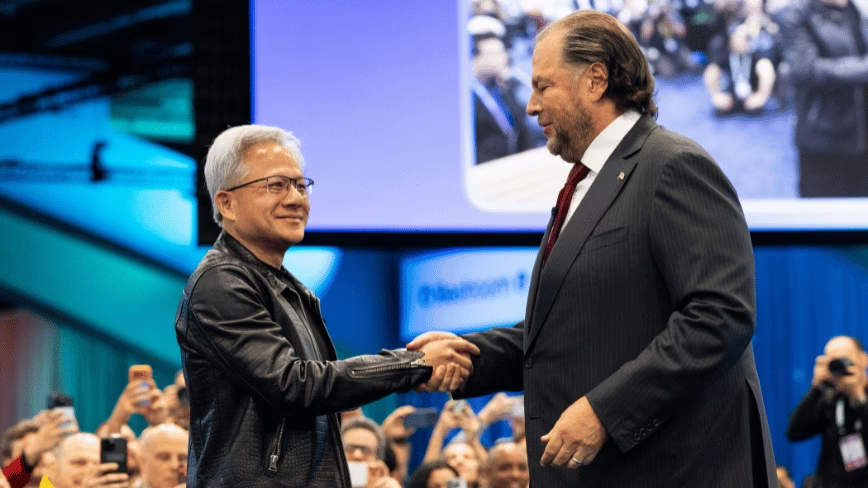
- Nvidia chief executive Jensen Huang told the main stage of Salesforce's Dreamforce conference in San Francisco on Tuesday that the industry needs no new laws and no new regulations.
- Anthropic chief executive Dario Amodei, interviewed earlier in the same keynote, laid out the three steps from his weekend essay: transparency and safety investment, then industry-wide standards, then an international component.
- Hours later, on CNBC's Mad Money, Huang called antitrust exemptions for safety coordination "completely unnecessary" and told Jim Cramer, "We have plenty of laws."
- Off the main stage, Marc Benioff told reporters the labs should slow down or speed up as they see fit and then be held accountable, according to CNBC.
Compiled by The Product DeskSomething wrong?How this is made
Why it matters
- constraint Procurement cannot cite an industry-wide safety standard in an RFP, because that standard is step two of a plan whose author says the conversation about it has not happened yet.
- contradiction One supplier says pacing coordination needs government cover to be legal and the other says no exemption is needed at all, so "we follow industry practice" cannot be read as meaning the same thing from each.
- exposure If release timing stays a matter of internal confidence and market feedback, the customer's own evaluation is the first outside check the model meets.
- decision A team assembling a model roster now has to write per-vendor diligence questions and decide what counts as an acceptable answer, since the suppliers are not converging on a common one.
A vendor review form usually asks which safety standards a supplier follows and who verifies them. Anyone filling that in for a model supplier this week can watch the whole argument, since Salesforce published the full keynote on YouTube [18]. Marc Benioff told the audience there were 10,000 people in the room and 10 million watching online [3].
Sort Amodei's plan by who has to sign it. Recommitting to transparency and investing more in safety is something one company does alone. Agreeing standards for everyone, and adding an international component, needs other companies and governments to come along [5]. Two of the three steps therefore depend on agreement that has not been reached [1]. The framing Amodei gave for the first step was about self-examination: "let's look at our own record. We may not have had this big high-profile incident, but I'm sure we're not perfect," he said [4].
Huang put the check inside the company that ships. "If you build a product or a service and you're not confident in its functionality, capability, or safety, then don't release it," he said [10]. He described the discipline as market-supplied: "You pace yourself until you are confident you're releasing something that the market would appreciate. The market forces are already there" [11]. He also said that "safety is paramount. In a lot of ways, it's job one. However, safety is an engineering problem" [9].
The sharpest disagreement is about whether law is in the way. In his essay, Amodei wrote that some forms of coordination on pacing are legally difficult and would need government support, and CNBC noted that US antitrust law generally bars rivals from agreeing to limit competition [13]. Anthropic did not respond to CNBC's request for comment [14].
Even if the technology were frozen in place, Amodei said, people would be using only about 5% or 10% of its possible value [7]. By those figures, 90 to 95 percent of the value in today's models is still unclaimed [2]. He added: "Pacing the Frontier is not doing that at all" [8].
For a review board on Monday, two things separate the three commitments: whether the promise depends on the vendor alone or on other companies agreeing to it, and whether it is written down somewhere a customer can attach to a contract or is only a statement of intent. Anthropic's transparency step is unilateral and, on Amodei's account, already made. The standards step is multilateral and unmade. Huang's release test is unilateral and internal, resting on the confidence of the team that ships. Only the first of those three gives procurement a sentence to quote back.
The split on that stage was about regulation, and neither executive was asked what a customer could hold him to. On the evidence from the keynote, the only commitment already made by one party without waiting for another is Anthropic's transparency step [6].
What to watch
- Whether Anthropic's promised dialogue with the rest of the industry produces a named counterparty or a published standard.
- Whether any lab formally asks Congress for the antitrust cover Amodei's essay says pacing coordination would need.
- Whether Nvidia or Anthropic publishes release-confidence criteria a customer can cite in a contract.