Product1 publisher3 min readPublished
Quest games run on Meta's 100-gram VR glasses with a narrower 70-degree view
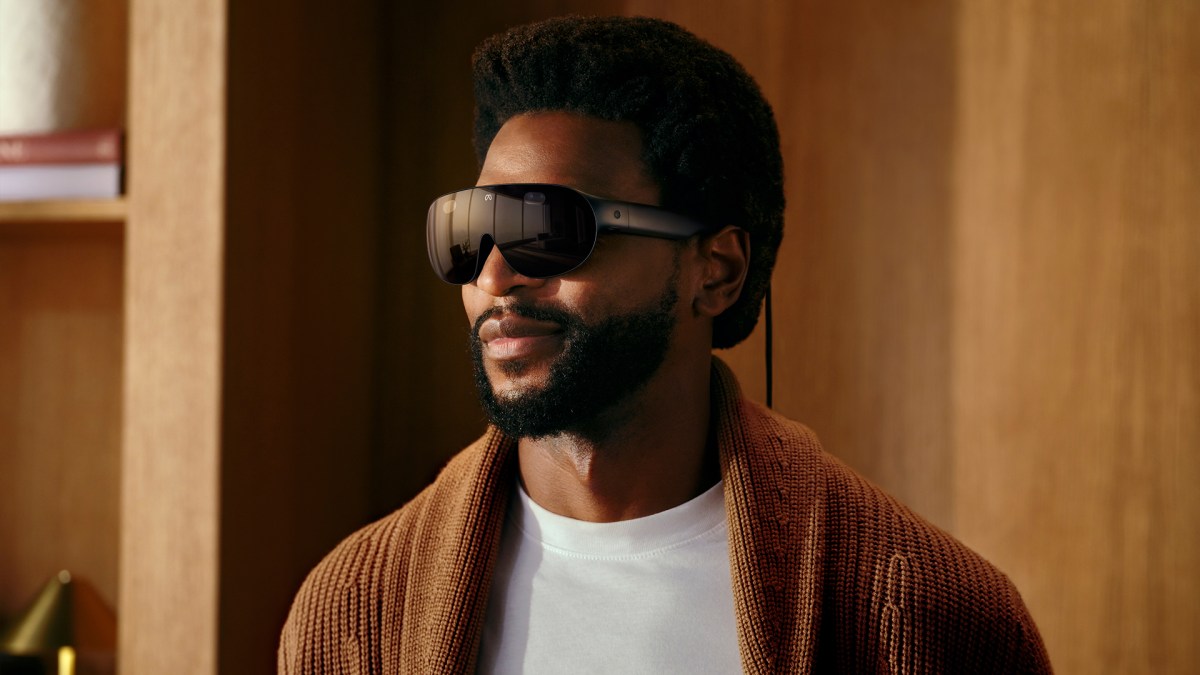
Meta's VR glasses weigh 100 grams to the Quest 3's 515 and run the full Quest catalog off a phone-sized compute puck, Gizmodo reports. XR teams keep their Quest apps but now have to design for a 70-degree field of view and for input by hand and eye.
The Product Desk · Product desk
What happened
- At its Connect keynote, Meta showed VR glasses that connect by cable to a separate compute puck about the size of a phone.
- The glasses weigh 100 grams, against 515 grams for the Quest 3 and 750 to 800 grams for Apple's Vision Pro.
- They can play the entire Quest catalog, though some titles require connecting Quest controllers.
- Their field of view is 70 degrees, compared with 110 degrees on the Quest 3.
- Meta says the puck delivers three hours of battery life, while the Quest gets a little more than two hours.
Compiled by The Product DeskSomething wrong?How this is made
Why it matters
- decision Existing Quest builds reach the glasses as they stand, so the roadmap choice narrows to which apps get a hands-and-gaze mode.
- capability Developers targeting the Quest 3 and 3S gain a gaze input their current hardware lacks, on a device that runs the same software.
- constraint Layouts that rely on peripheral space lose 40 degrees on the glasses, so edge-placed menus and cues need a redesign pass.
- exposure A team that moves its roadmap now is betting on one reviewer's short demo in a dim room, with performance and bright-light use still untested.
Gizmodo's reviewer finished a Beat Saber demo on Meta's new VR glasses with one gadget in mind, the Quest [17]. The game ran with no noticeable lag on the puck's Snapdragon Reality Elite chip, and "both hand and eye tracking were very snappy," the reviewer wrote [6]. The verdict: "In many ways, Meta VR Glasses do everything as well as or better than Quest, but in a smaller form factor." [16]
On stage at Connect, Meta CTO Andrew Bosworth said, "VR gaming is alive and well." [1] Gizmodo puts that line next to a year in which Meta axed VR gaming studios and shut, then partly reopened, the Metaverse [2]. The pitch is a revival of VR gaming. The thing being done is moving Quest software onto a lighter frame. The head carries about 19 percent of a Quest 3's weight [14], and the computing sits at the other end of a cable [3]. The report does not include the puck's weight or any statement from Meta about the Quest line's future.
For a team with a Quest app on sale, the content mostly carries over. About 75 titles already run on hands alone [8]. Input is where the new work sits. The Quest 3 and 3S have no eye tracking, and the reviewer found their hand input slower because of it [7]. The one user in this record wanted to leave the controllers behind: "nothing beats being able to just pop on a pair of glasses and get going," the reviewer wrote [19].
What the glasses give up is field of view. They fall 40 degrees short of the Quest 3, at about 64 percent of its figure [15]. The reviewer called it "a very noticeable difference" and added, "I wouldn't quite categorize it as tunnel vision." [18] With nothing sealing off the eyes, more room light gets in. The demo room was fairly dim, and sunlight was not tested [12].
Gizmodo's headline says VR headsets are "So Cooked" [20]. That judgment comes from a demo that was not an extended session, and performance "is still a question mark," the reviewer wrote [13]. I would keep the Quest as the primary build target and start a hands-and-gaze track beside it. The cost of that caution falls on apps built around controllers and a wide view. If the glasses hold up, those are the apps that need rework, and a team that waits starts it later.
Sort each app on two tests: whether it works with hands and gaze alone, and whether it stays usable inside 70 degrees. Hands-only apps that fit the narrower view go first, and they should be tested in a bright room [12]. A hands-only app that needs width keeps its input and gets a layout review, starting with menus and cues placed at the edges. Controller apps that fit the view reach the glasses with Quest controllers connected [9], so the decision is whether a hands mode is worth building. Controllers plus a wide view is headset work, and in this comparison only the Quest 3 offers that width [11].
What to watch
- A price and ship date for Meta VR Glasses, and whether Meta keeps a new Quest headset on its schedule alongside them.
- Extended reviews in bright rooms that test light bleed and comfort over sessions longer than a demo.
- Whether Meta's developer guidance makes hands and eye tracking the default input for Quest apps running on the glasses.