Product1 publisher3 min readPublished
Meta's $1,300 VR Glasses pair a narrower field of view with sharper per-eye pixel density
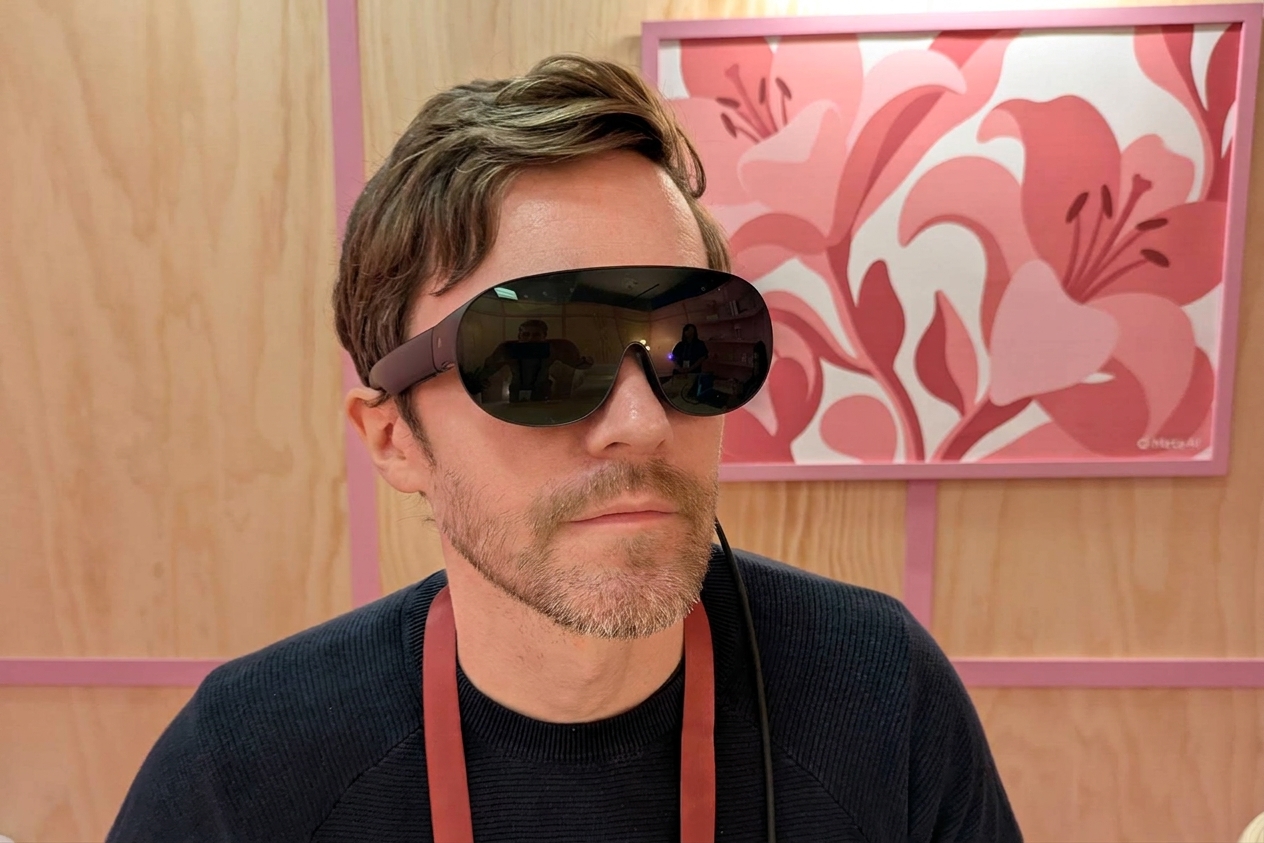
Meta VR Glasses go on sale in Spring 2027 at $1,300 with the densest display the company has shipped, a horizontal view 40 degrees narrower than Quest 3's, and no controllers included in the box.
The Product Desk · Product desk
What happened
- Meta showed Meta VR Glasses at its Connect developer conference, a compute puck-tethered headset previously known internally as Project Phoenix.
- The device goes on sale sometime in Spring 2027 at $1,300.
- The puck holds a battery rated for up to three hours and a Snapdragon Reality Elite (XR2 Gen 3) running up to 11% higher max GPU frequency than Quest 3's XR2+ Gen 2, cooled through a mesh grill.
- Controllers are not included, though the headset works with the Touch Plus units from Quest 3 and 3S and plays the existing Horizon store catalogue with them.
Compiled by The Product DeskSomething wrong?How this is made
Why it matters
- cost Controller-dependent titles now ask the buyer for a second purchase after the $1,300 headset, so the addressable install base for those apps is smaller than the number of devices sold.
- decision Any team with a shipping Quest app has to choose between re-laying out its interface inside 70 degrees with hand input, or keeping Quest 3 as the primary target and treating VR Glasses as secondary.
- capability Passthrough this clean plus rendered film environments make seated media and world-as-backdrop overlays the use cases the hardware is specified to win, without asking for peripheral vision.
- constraint A three-hour puck battery and an actively cooled puck cap how long a training or enterprise session on this device can run before someone has to charge or swap.
The demo was not the Beat Saber anyone has played. Meta put Road to VR's reviewer into a new hand-tracked mode called Flux, which drops block-slashing in favour of punching flying bars and cutting them with an energy beam connected to both hands [7]. The reviewer had expected the game to be the clean comparison against Quest 3 and got a reimagining instead [8]. Meta rebuilt its flagship music title for the input that ships in the box.
Hand tracking is that input. VR Glasses work with the Touch Plus controllers from Quest 3 and 3S, and with those in hand the headset runs everything already on the Horizon store [6]. For a studio, that splits the install base. Anyone whose app needs a trigger and haptics is selling to the subset of owners who bought controllers as a second purchase on top of $1,300 [2].
The display is the sharpest Meta has sold and the narrowest it has sold. Per eye the micro-OLED panels run 2,412 x 2,288 at up to 120Hz, quoted at 37 pixels per degree [3], which is 5.5 million pixels an eye [15]. Horizontal field of view is 70 degrees against Quest 3's 110 [4]: 40 degrees less, about 64 percent of the sweep [16]. Spread 2,412 pixels across 70 degrees and the average is roughly 34 per degree, slightly under the quoted 37 [17].
A narrow view costs least when the content sits in a fixed frame in front of the user. The reviewer wrote that the colour passthrough is "the best I've seen on a standalone VR headset", with no noticeable stitch lines and no appreciable latency [9]. Select film content will play inside a rendered immersive theatre whose environment changes with what is happening on screen; the demo clip was from Avengers: Infinity War [10]. Meta will sell an optional light blocker accessory when the device goes on sale [13].
Fit has to be adjusted per wearer, and that costs deployment time. The pancake optics are clear, but the sweet spot is smaller than Quest 3's, so each wearer has to work through the supplied nose pads and pick between a Standard and a Large body [11]. IPD adjusts from 56 to 70 mm by sliding each lens independently, a first for a Meta headset, and asymmetric adjustment is harder to calibrate correctly than an external dial [12]. Shared-device deployments spend minutes on each head. The hands-on reports no weight for the glasses or the puck [20].
For a team that already ships on Quest, it comes down to whether the app depends on what the user catches at the edge of vision, and whether it depends on controller input. An app that lives in a forward panel and takes hands and gaze is what this hardware was specified for, and gaze plus hand gesture is the native UI [14]. An app that needs both peripheral awareness and controllers keeps Quest 3 as its primary target, with VR Glasses as a second device its users have to accessorise. Most teams sit in between, which means a UI pass that pulls interface elements inside 70 degrees and a hand-tracked control scheme, per app, before Spring 2027 [2]. Meta pitched the device as the bridge between experimental AR work such as Orion and the bulkier Quest gaming platform [18].
What to watch
- Meta's published weights for the glasses and the puck, and real-world sizing figures for the Standard and Large bodies.