Science1 publisher2 min readPublished
Venus's mystery cloud absorber must hit 1,278 cm-1 at 375 nm, modellers calculate
An international team converted a century of ultraviolet images of Venus into a laboratory quantity, the absorption coefficient of the liquid inside the cloud droplets, and the value it requires is high enough that only very strong absorbers or very high concentrations qualify.
The Scientist · Science desk
What happened
- A study in the journal Astrobiology, led by Jan Spacek of the Foundation for Applied Molecular Evolution, sets the first numerical limits on how strongly Venus's unidentified cloud absorber must absorb light.
- The team combined Venus observations with a radiative-transfer model of scattering and absorption in the clouds, then converted spacecraft and telescope brightness into an absorption coefficient for the droplet liquid.
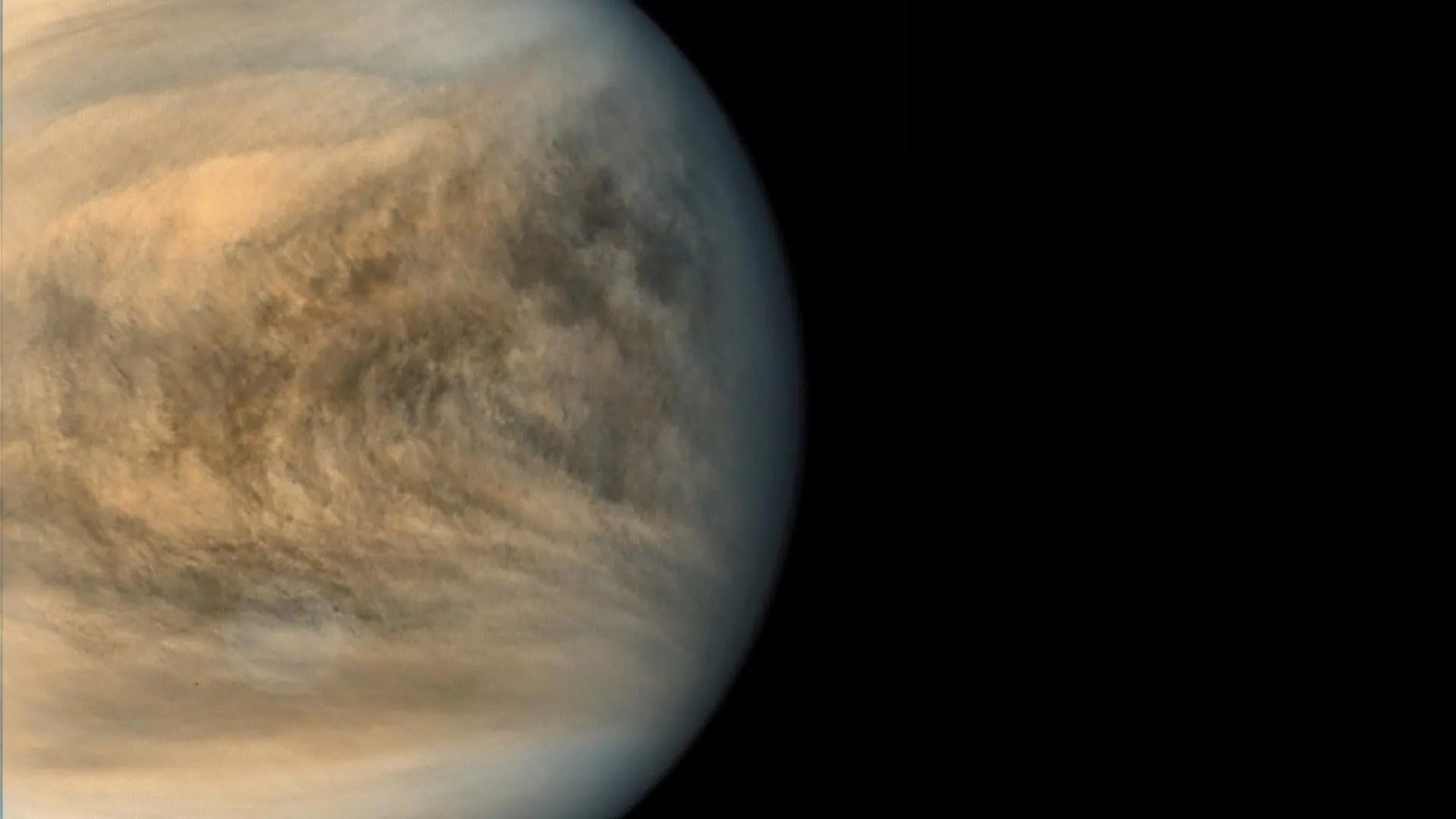
- Venus is pale yellow in visible light but shows dark and bright ultraviolet features in its sulfuric acid clouds, patterns observed for about a century without anyone identifying the material behind them.
- The release says the derived requirement leaves the absorber either extremely effective at absorbing light, present at very high concentration inside the droplets, or both at once.
Compiled by The ScientistSomething wrong?How this is made
Why it matters
- capability A candidate absorber can now be tested on a bench: dissolve it, measure the coefficient near 375 nm, and check whether it reaches the required level at a concentration the droplets could hold.
- constraint The coefficient describes the liquid inside the droplets as the model builds it, so a candidate carried as a separate solid grain rather than dissolved is not screened by this figure.
- decision Payload teams have a numeric target to design against if they want to settle whether the material is organic, inorganic or unexpected, which is the use the Institute for Basic Science proposes. The release does not identify a mission.
A cloud and the material it is made of do not look alike. Venus's droplets scatter sunlight so efficiently that the brightness a spacecraft records cannot be laid beside a bulk liquid spectrum from a bench instrument [9]. "The key is that Venus's cloud particles scatter sunlight very efficiently, so the brightness observed from space cannot be directly compared with the absorption of a bulk liquid measured in the laboratory," said Yeon Joo Lee of the Planetary Atmospheres Group at South Korea's Institute for Basic Science, who ran the radiative-transfer calculations [3][9]. "By accounting for the scattering and absorption by the cloud particles and atmosphere, the model allows us to estimate how strongly the liquid of cloud droplets itself must absorb light" [9].
Spacek chose the target quantity by imagining the sample in hand. "Our model effectively asks what would happen if we could collect that cloud material into a cuvette and put it into a laboratory spectrometer," he said. "This is important, as light absorption in a bulk liquid may be correlated with the concentration of light-absorbing material in the solution" [10].
The analogy in the paper is cigarette smoke, which looks white because its sub-micrometre particles scatter light extremely effectively, and which collects in a flask as a tar-like sludge of burned tobacco [11]. Venus's cloud particles have a comparable size distribution, so clouds that look pale yellow from a distance can be built from liquid that is dark once concentrated [12].
The requirement the model produces is a decadic coefficient, the same quantity a chemist reads off a spectrometer [6]. At its peak the implied path is very short: transmitted 375 nm light drops by a factor of ten every 7.8 micrometres of the liquid, since 1 divided by 1,278 cm-1 is 7.8 x 10⁻⁴ cm [7][16].
The number fixes a strength; it leaves the molecule open. Highly absorbing conjugated organic molecules are one class strong enough to reach it, and the release is explicit that organic here means carbon-based, with no implication that the material came from life [13]. The paper also works out the concentration that would be needed if the absorber had the absorption strength of an efficient porphyrinoid pigment [14]. And 1,278 cm-1 is the peak inside the modelled band, which runs from 365 to 455 nm, not a flat level across it [7].
What to watch
- Whether a laboratory group can reach the required coefficient at 375 nm with a candidate compound at a concentration the droplets could plausibly hold.
- Whether the concentration estimate for porphyrinoid-strength pigments in the Astrobiology paper survives independent modelling of the same observations.
- Whether any Venus payload in development can measure droplet-liquid absorption in place.