Science1 distinct publisher3 min readPublished
Instead of naming the century-old unknown absorber, a team writing in Astrobiology asked how dark the bulk liquid in Venus's cloud droplets has to be, turning a remote-sensing puzzle into a number a laboratory spectrometer can check.
The Scientist · Science desk

Compiled by The ScientistSomething wrong?How this is made
Take 1,278 cm-1 as a path-length problem [11]. A decadic coefficient becomes absorbance when you multiply it by the path, so a standard one-centimetre cell of this liquid would read an absorbance of 1,278 [1], which is a statement about opacity rather than a reading any instrument produces. To get the sample into the range where a UV-visible spectrometer is honest, absorbance near 1, the cell would have to be about 7.8 micrometres deep [2]. That is the sense in which the cuvette in Jan Spacek's framing is a thought experiment [5]. You would dilute hard, or build a very thin cell.
The same arithmetic dissolves the apparent conflict with a planet that looks pale yellow from outside [1]. If the droplets sit in the size range of cigarette smoke particles [6][7], a photon crossing one of them traverses on the order of a micrometre of liquid, where the absorbance is about 0.13 and roughly three-quarters of the light survives the crossing [3]. What leaves the cloud has mostly been scattered many times, not transmitted once, which is why the radiative-transfer calculations by Lee Yeon Joo of the Institute for Basic Science had to handle multiple scattering by droplets and molecules before any comparison with a benchtop number was legitimate [9][10].
Efficiency and concentration trade against each other inside that single number [12], and the ten-grams-per-litre figure is that trade priced at one particular efficiency, the efficiency of good porphyrinoid absorbers [14]. Assume a weaker chromophore and the required concentration climbs. The authors are explicit that the familiar pigments are units of comparison, not nominations [15], and Spacek's own wording keeps the step from bulk absorption to concentration as a correlation rather than an identity [8].
The spectral shape is the more selective of the two constraints. Darkness alone is easy to manufacture in concentrated sulfuric acid, since simple organics slide into complex tar-like mixtures, and those absorb broadly enough to look brown or black [16]. A steep fall across 365 to 455 nm asks for something that stays chemically defined in that acid instead of degrading into the usual sludge [17]. That is a stability requirement, and it is harder to satisfy than mere absorbance.
The thing this constraint does not tell you is where the absorber sits. The modelled quantity is the bulk liquid inside the cloud droplets [3], so a candidate riding along as a separate solid particle, or as a gas, is not addressed by 1,278 cm-1 at all. The published summary also does not give the droplet size distribution, the vertical cloud structure, or the specific observations fed into the retrieval, and that is precisely where the number's error bars live. A threshold with unstated uncertainty is still worth having, because it converts a century-old identification argument [2] into a measurement someone can attempt in a beaker.
Ranked by verification strength, evidence, and original report placement.
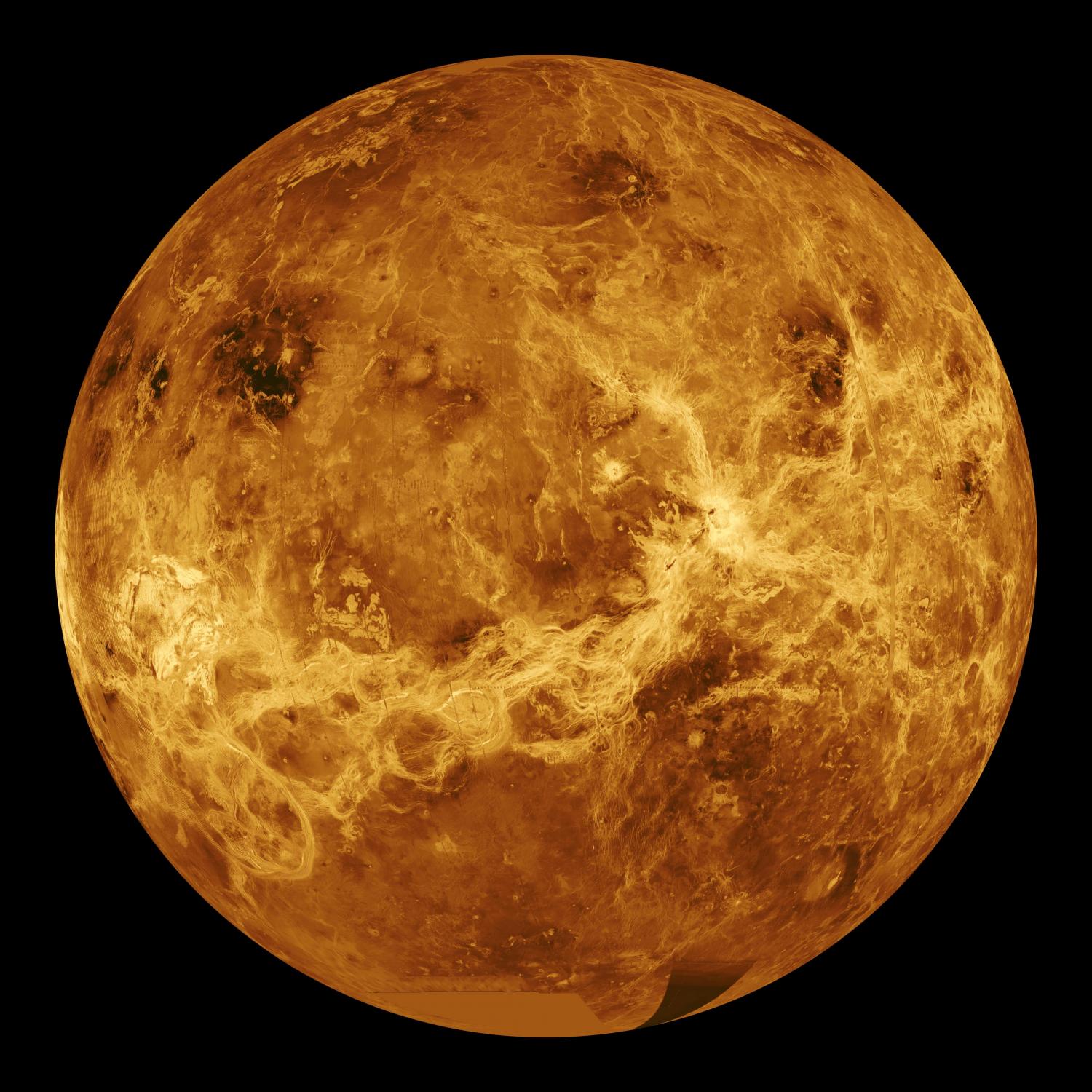
Venus appears pale yellow in visible light, but ultraviolet images reveal dramatic dark and bright patterns moving with the planet's upper sulfuric acid clouds.
Scientists have known about the ultraviolet markings on Venus for roughly a century, yet the chemical identity of the material responsible, the 'unknown absorber', remains unresolved.
An international research team combined observations of Venus with radiative-transfer modeling to estimate how strongly the liquid inside Venus's cloud droplets would need to absorb light to reproduce the planet's observed ultraviolet and blue reflectance.
Lead author Dr. Jan Spacek of the Foundation for Applied Molecular Evolution, U.S., posed the guiding question: 'If we were to collect Venus's cloud droplets into a spectrometric cuvette, how would the re-formed bulk liquid appear?'
Cigarette smoke appears white because its submicrometer particles scatter light very efficiently, yet the same particles collected in a flask form a dense, tar-like sludge of burned tobacco.
Distinct publishers with included, body-backed reporting in this cluster.
phys.org
1 article · August 27, 2026
Follow any of these and your For You feed starts watching them — no settings page required.
science
Sperm sequencing puts half of gene conversion before meiosis even starts1 distinct publisher
science
Viral RNA snippets triple linear mRNA half-life in cells, IBS team reports in Cell1 distinct publisher
science
A jazz model names the player 94% of the time, and says which part of the playing gave them away3 distinct publishers
leadership
The Arday case: a Cambridge hire made on a story nobody checked1 distinct publisher
Evidence-backed comparisons of source perspectives and observed adoption signals. Read the methodology
Which Builder, Operator, and Investor concerns the observed source mix emphasized—not a truth score.
Evidence, demonstrated adoption, hype gap, incentives, and confidence are assessed independently, each on its own current evidence. How these are measured.
One paper, one write-up, one falsifiable number
Every figure in circulation - the 1,278 cm-1 peak, the 365-455 nm window, the 10 g/L porphyrinoid comparison - traces to a single Astrobiology paper as relayed by phys.org, with all quotes from co-authors and no outside check. What keeps this above the level of an announcement is the form of the result: a cuvette absorbance is something a laboratory can go and contradict, which is more than most Venus absorber arguments have offered in a hundred years.
Nobody has filled the cuvette
The constraint exists on paper and nowhere else. No laboratory has yet reported screening a candidate against it, and the one piece of hardware in the story - the Autofluorescence Nephelometer bound for a Rocket Lab flight - hunts fluorescence rather than the bulk absorbance this model specifies. Real uptake would look like a spectrophotometer result, and phys.org has none to report.
Disciplined text, evocative frame
The prose is unusually careful - it says outright that nothing here shows life on Venus and that chlorophyll and heme are only yardsticks. The framing pulls the other way: an astrobiology journal, porphyrin pigments, and a headline about clouds that 'may hide' a strong absorber. The bigger stretch is scalar. A coefficient of 1,278 per centimetre sounds like ink, but the liquid only ever exists in micrometre droplets, where the same number lets about three quarters of the 375 nm light through.
Authors with a mission to fly
The people quoted are not disinterested. The Foundation for Applied Molecular Evolution and Janusz Petkowski are long associated with the case for Venusian cloud chemistry, the closing section advertises the Morning Star initiative and an instrument awaiting a Rocket Lab launch, and the Institute for Basic Science has an institutional interest in the modelling credit. A result that makes the absorber look chemically demanding and organic-compatible strengthens the argument for going there to look.
Internally tight, externally unchecked
The internal arithmetic is consistent and we can restate it independently, so we are confident about what the paper claims. We are much less confident it is right, because the number depends on a cloud model no second party has stress-tested in this reporting, and one science desk relaying one collaboration is a thin base for a century-old dispute.