Science1 distinct publisher3 min readPublished
A Nature study from the Sanger Institute and Cambridge read 9,525 recombination events straight out of sperm DNA and found a repair-like process running before the divisions that make sperm.
The Scientist · Science desk

Compiled by The ScientistSomething wrong?How this is made
Do the arithmetic before the biology. The 7,143 crossovers [4] and 2,382 non-crossover gene conversions [5] come to 9,525 events [1], roughly 635 per sample [2], with crossovers outnumbering conversions about three to one [3]. That density is what the method buys. Crossovers, the two-way exchange of large chromosome sections, were already tractable; the one-way copying of a short stretch from one chromosome to the other [14] has been the hard class to observe directly [16].
What the published summary does not give is the number that matters most to anyone modelling germline mutation: the share of those 2,382 conversions that arose before meiosis. The account calls it a substantial proportion [6] and leaves it there. Until that fraction is on the table, the premeiotic component can be acknowledged but not budgeted for.
The mechanism claim is narrower and more interesting than the headline. Cells that eventually make sperm run through many rounds of ordinary mitosis before they enter meiosis at all [2], and the events assigned to that earlier window carry molecular signatures that separate them from meiotic events and resemble DNA repair in normal body tissue [7]. A somatic-looking repair process is leaving its marks on the inherited record, which is why the authors describe recombination in sperm as happening in two stages rather than one [17].
A premeiotic component with a somatic signature invites an age question, because those maintenance divisions continue throughout life [6]. The donor panel spans 50 years, from 24 to 74 [3][4]. The account we have reports no comparison of conversion counts against donor age, which is the first thing to look for in the paper itself.
The clinical hook is where these tracts land. They often fall in regions of the genome that are naturally prone to breaking, and because those sites are unstable, the repair that follows can produce changes that cause inherited disease, according to the researchers [10][11]. One-way copying at a fragile locus replaces one parental sequence with the other [14], so it is not a neutral reshuffle at a position already predisposed to error.
Regev Schweiger, the first author, now at Tel Aviv University, put the finding as an absence of unity: gene conversion in sperm "does not appear to come from a single process", with a substantial component whose features are consistent with DNA repair before meiosis [12]. Richard Durbin at Cambridge, co-senior author, credits high-accuracy long reads with the power to study recombination within individuals rather than across families, and with revealing biology that earlier data could not resolve [13].
Thirteen donors is a thin panel on which to hang a two-stage model of human recombination [3], and the twin comparison sits inside that panel [8]. The load is carried by the signature analysis, not the head count [7], which also means the model stands or falls on how cleanly premeiotic and meiotic marks can be told apart.
Ranked by verification strength, evidence, and original report placement.
Researchers at the Wellcome Sanger Institute, the University of Cambridge and collaborators, publishing in Nature, found that non-crossover gene conversion happens before the cell divisions that produce sperm.
The findings suggest that genetic recombination events in sperm happen in two stages, both before and after cell division.
A substantial proportion of gene conversion appears to originate before meiosis begins, during the normal cell divisions that maintain the cells responsible for producing sperm throughout a person's life.
The cells that ultimately produce sperm first undergo many rounds of ordinary cell division (mitosis) before entering meiosis, the specialised division that generates reproductive cells.
The team analysed 15 sperm samples from 13 donors aged 24 to 74.
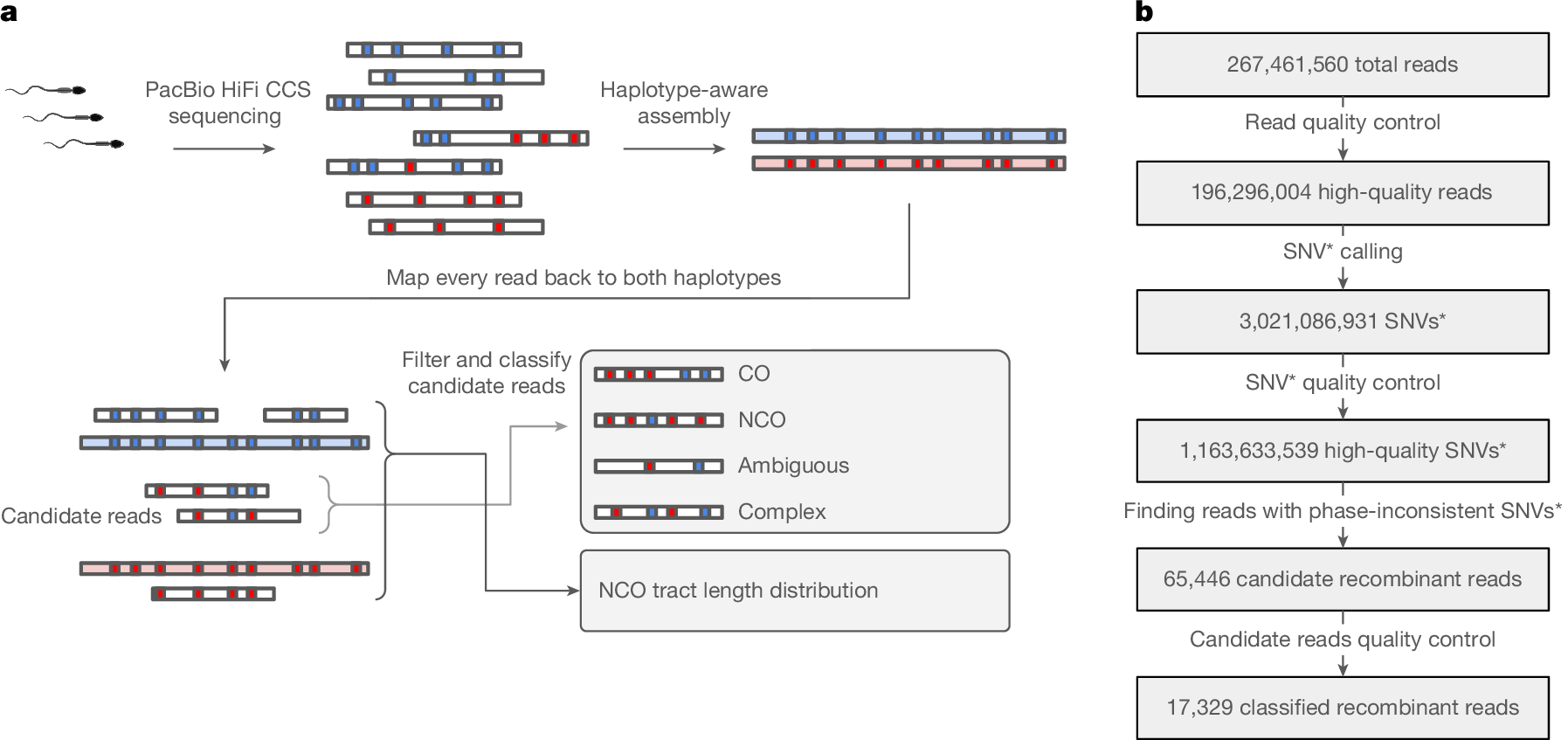
Using highly accurate long-read sequencing, the researchers identified 7,143 crossover events directly from sperm DNA.
Follow any of these and your For You feed starts watching them — no settings page required.
Evidence-backed comparisons of source perspectives and observed adoption signals. Read the methodology
Which Builder, Operator, and Investor concerns the observed source mix emphasized—not a truth score.
Evidence, demonstrated adoption, hype gap, incentives, and confidence are assessed independently, each on its own current evidence. How these are measured.
Peer-reviewed primary study, single press-release relay
The core finding rests on a named, DOI-identified Nature paper with concrete counts (7,143 crossovers, 2,382 non-crossover conversions from 15 sperm samples), an internal comparison against long-read blood data and prior published data, and signature-level discrimination of premeiotic events. Evidence is capped below high because the cluster contains one press-release relay with no methods detail, no premeiotic fraction, no error model, small cohort (13 donors), and no independent expert scrutiny or replication.
No uptake signal beyond publication
The supplied material documents only the publication and its press release. There is no replication, third-party dataset reuse, tool release, clinical deployment or usage disclosure to measure, so adoption cannot be scored without guessing.
Story framing outruns the sourced quantity
The finding itself is soberly reported by the source, which says only that 'a substantial proportion' of gene conversion appears premeiotic and that repair before meiosis contributes 'more than previously appreciated'. The story framing of 'half of gene conversion before meiosis' quantifies something the source never quantifies, and release language ('for the first time', 'challenge a long-standing view') plus an unvalidated inherited-disease hypothesis push the narrative modestly ahead of the evidence. The gap is small and positive rather than large because the underlying counts and peer-reviewed status are real.
Institutional release relayed without counterweight
Every fact in the cluster originates in a promotional release from the institutions that produced the work (Wellcome Sanger Institute, University of Cambridge, Tel Aviv University), quoting only its own authors, and is republished by an aggregator that adds no independent reporting. The authors have clear reputational incentive to stress novelty and the power of their sequencing approach; no competing or skeptical interest is represented.
Traceable but single-sourced
Confidence is moderate: the claims are internally consistent, specific and traceable to a peer-reviewed Nature paper with a DOI, which limits the chance of misreporting. It is held down by the absence of any second publisher, of the paper's own methods and limitations, of a quantified premeiotic share, and of any external replication or expert commentary in the supplied cluster.
science
Five years in a dish, four years of cortex: the organoid clock runs at human speed4 distinct publishers
science
A phage kinase with no target list: EMBL finds one enzyme that breaks several bacterial defences1 distinct publisher
science
HIPAA Covers Less Than You Think, And "Anonymized" Is Not A Legal Shield1 distinct publisher
product
LLNL closes a 20 percent gap in diamond melting, and stakes a fusion gain claim on it1 distinct publisher
Distinct publishers with included, body-backed reporting in this cluster.
phys.org
1 article · August 26, 2026