Invest1 publisher3 min readPublished
Caracas takes 916 exploration blocks to Houston. Two signed deals came back.
Venezuela's new petroleum minister pitched 916 exploration opportunities and 192 trillion cubic feet of gas. The names on paper so far are Hunt Oil and SLB.
The Investor · Invest desk
Drafted by a language model from the sources cited here and checked against its claim ledger before publication. How we use AISend a correction
What happened
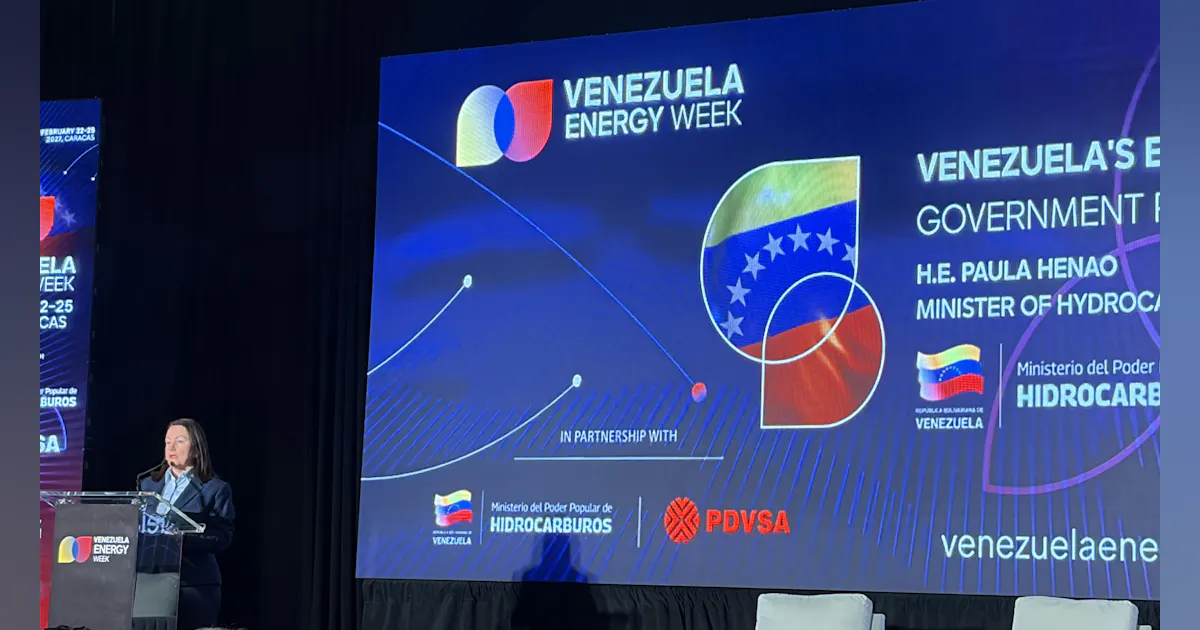
- Venezuela's new petroleum minister Paula Henao told an overflowing Houston energy audience on Wednesday that there are more than 916 exploration opportunities awaiting foreign investment, including natural gas and other untapped oil basins.
- Henao sees Venezuela as an emerging energy economy ripe for U.S. and foreign investment in new oil and gas exploration, both onshore and offshore.
- Paula Henao took over as Venezuela's hydrocarbons minister in March, after the forced U.S. removal of former leader Nicolas Maduro.
- Henao cited an estimated 192 trillion cubic feet of natural gas reserves in Venezuela.
- Henao cited Venezuela's world-leading proven oil reserves of more than 300 billion barrels.
Compiled by The InvestorSomething wrong?How this is made
Why it matters
Venezuela's new hydrocarbons minister, Paula Henao, told an overflowing Houston audience on Wednesday that her country holds more than 916 exploration opportunities awaiting foreign investment, onshore and offshore, including natural gas and untapped oil basins [1][2]. The pitch is inventory; the scarce thing is capital willing to sit in Venezuela for a decade, and on that count the week produced two signatures.
Henao, who took the ministry in March after what Fortune describes as the forced U.S. removal of Nicolas Maduro, cited an estimated 192 trillion cubic feet of gas reserves alongside proven oil reserves of more than 300 billion barrels, the largest in the world [3][4][5]. "It's an entire world waiting to be discovered, just waiting for us to reach these agreements so we can develop these new areas," she said in Spanish at the Post Oak Hotel [6]. PDVSA Vice President Jovanny Martinez was blunter: "Go to Venezuela to invest, go to Venezuela to develop businesses there" [7].
Set the reserve numbers against the production line and the marketing collapses into arithmetic. Venezuelan output has risen since last year from just under 1 million barrels per day to more than 1.2 million [8], an increase of more than 20 percent [9]. At that rate, 300 billion barrels of proven reserves represents roughly 685 years of production [10]. Reserves have never been the binding constraint here. Contract enforcement, the power grid and gas processing capacity are, and Crossover Energy's chief executive said as much: more work is needed on the grid, on infrastructure to move and process gas, and on further tweaks to the law for regulatory and contract certainty [11].
The revealed preference of the majors is instructive. President Donald Trump has repeatedly insisted U.S. oil companies will spend more than $100 billion rebuilding Venezuelan infrastructure [12], but apart from Chevron, which never left, large U.S. producers are mostly waiting, though Exxon has expressed optimism [13]. BP and Shell plan to invest in offshore Venezuelan gas near Trinidad and Tobago [14]. What actually got signed a day before the Houston event was with Dallas-based private producer Hunt Oil and the oilfield services firm SLB, which already works with PDVSA and Chevron in the country [15]. Hunt CEO Hunter Hunt said the company is "proud to be one of the first American companies to sign an agreement with PDVSA" [16].
That order of arrival is priced. Denver-based Crossover Energy, expected to sign next, sees more upside in Venezuelan mature and exploratory fields than in pricier U.S. shale acreage [17]. "Hopefully we can jump the line by taking a little more risk," CEO Eric McCrady told Fortune [18]. He said the risks are above-ground, in labor force, equipment availability and politics, rather than geological [19]. Crossover has bought a local operator to establish a workforce, expects productive participation contracts within days or weeks, and plans to start operating wells in January, delayed a few months by the fatal earthquakes that struck Venezuela in June [20][21].
The hesitancy has a history: the 2007 appropriation of assets from ExxonMobil, ConocoPhillips and others, after decades of cycling between reform and renationalization, and the hydrocarbon laws are being changed again [22][23].
Watch whether Crossover's contracts are executed on the stated timetable and whether January startup holds. Watch the text of the new hydrocarbons law for what it says about arbitration and expropriation. Venezuela Energy Week in Caracas in February is the next scheduled test of who shows up [24].