Product1 publisher3 min readPublished
Radiant puts a reactor on a trailer for 1,000 miles, then bets its licence on 150 unattended hours
The Kaleidos microreactor left El Segundo for Idaho National Laboratory on August 12, bound for a five-phase test campaign that ends with 150 hours of unattended full-power operation.
The Product Desk · Product desk
Drafted by a language model from the sources cited here and checked against its claim ledger before publication. How we use AISend a correction
What happened
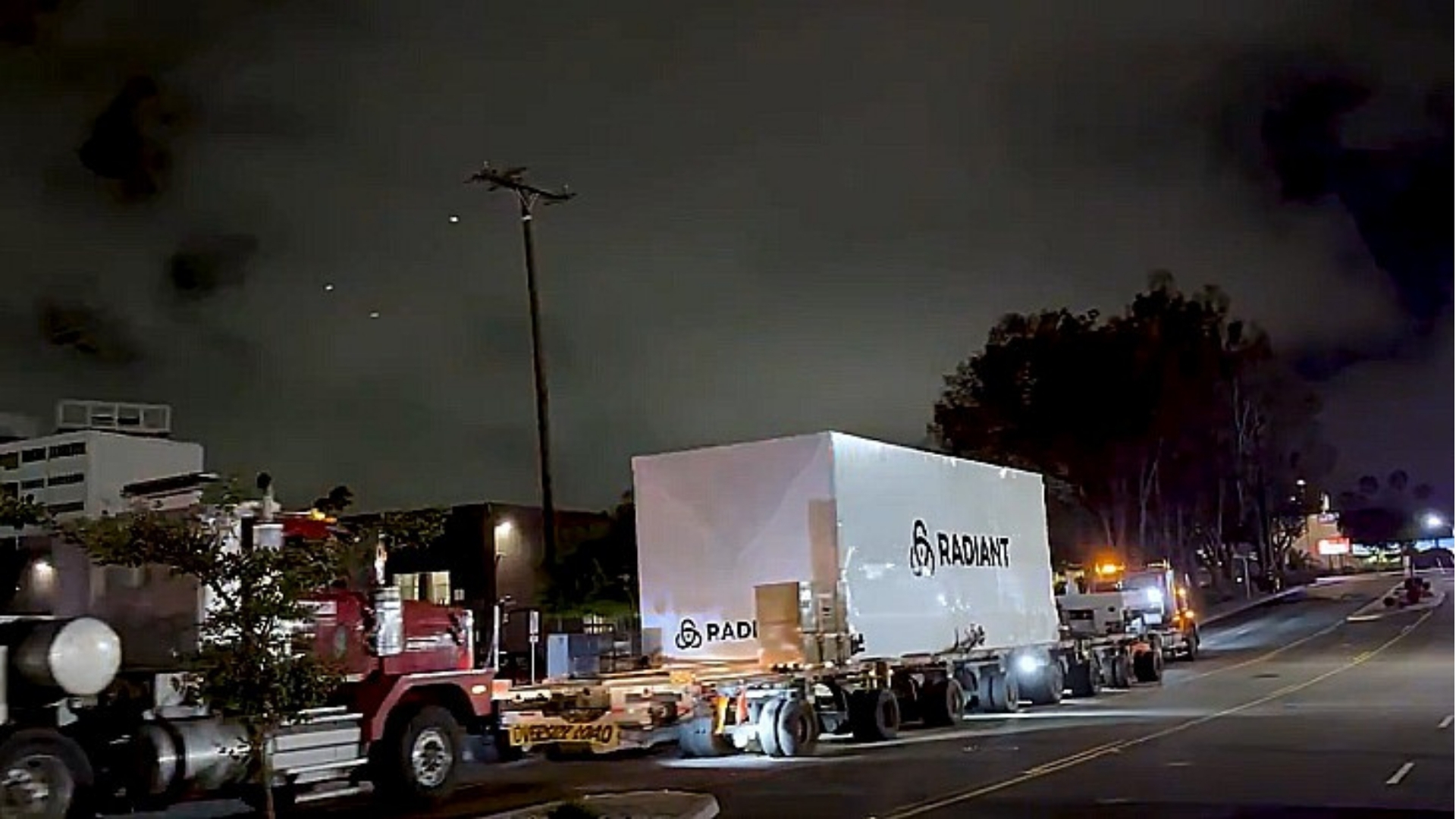
- Radiant's 1-MWe Kaleidos microreactor began traveling from El Segundo, California, to Idaho National Laboratory on August 12.
- The reactor is being transported more than 1,000 miles on a trailer bed.
- At Idaho National Laboratory, Kaleidos will be installed inside the Demonstration of Microreactor Experiments (DOME) test bed.
- Radiant's five-phase testing program begins with zero-power criticality and advances to heat and power generation, full-power operation, and a final 150-hour continuous run without operator intervention.
- The company will use data from the testing program for its US Nuclear Regulatory Commission license application.
Compiled by The Product DeskSomething wrong?How this is made
Why it matters
Radiant's 1-MWe Kaleidos microreactor began a journey of more than 1,000 miles from El Segundo, California, to Idaho National Laboratory on August 12, riding on a trailer bed [1][2]. The trip is not logistics in service of the product; the company is presenting it as evidence about the product, having promised a reactor transportable by land, sea and air and then pointing at the trailer as proof [7].
That framing only works if the thing on the trailer is the thing customers would buy. Radiant says it is: same design, same scale, same commercial fuel load as the units intended to come off the line at its proposed R-50 factory in Oak Ridge, Tennessee, and "not a simplified stand-in" [8][9]. Test articles in nuclear development are usually derated, partially fuelled, or otherwise trimmed, so building the demonstration unit to production configuration moves the regulatory and manufacturing risk earlier rather than deferring it. It also means a failure in Idaho is a failure of the shipping configuration, not of a prototype that can be quietly redesigned.
At Idaho the reactor goes inside DOME, the Demonstration of Microreactor Experiments test bed, which reuses the containment structure of a former experimental breeder reactor and exists so developers can run experimental designs and gather performance data [3][10]. Once installed, Kaleidos will be loaded with TRISO fuel under Department of Energy and Idaho National Laboratory oversight [11]. Standard Nuclear fabricated that fuel to Radiant's specifications earlier in 2026 [12].
Then comes the sequence that matters: zero-power criticality, heat and power generation, full-power operation, and a closing 150-hour continuous run with no operator intervention [4]. Radiant says every phase feeds data directly into its US Nuclear Regulatory Commission licence application and de-risks manufacturing and deployment at commercial scale [17][5]. The capstone is the interesting claim. An unattended 150-hour run is an assertion about staffing economics as much as about physics, and it is the kind of data a regulator can be shown rather than argued with. One wrinkle in the company's own language: the quoted description refers to "1 MWe thermal operation," mixing electrical and thermal units for a unit elsewhere described as 1 MWe [18].
The paperwork is running in parallel with the hardware. Radiant's Part 70 application for the R-50 production facility is already under NRC review, with the company targeting approval in the fourth quarter of 2026 [13]; it is targeting completion of the Idaho campaign in the third quarter of 2026 [6]. That leaves roughly one quarter between the last test data and the approval Radiant wants [19] - a tight coupling that assumes the campaign runs clean and on schedule. Beyond that sits an agreement with the US Air Force to deliver Radiant's first commercial microreactor to Buckley Space Force Base in 2028, which the company says the testing campaign will ensure [14][15]. That is about two years from the target end of testing to a delivered unit at a military site [20].
What to watch: whether zero-power criticality happens on the schedule implied by a third-quarter 2026 finish, since every later phase inherits any slip [6][4]; whether the 150-hour run is completed in one uninterrupted block or restarted; and whether the NRC's Part 70 review of the Oak Ridge factory moves independently of the Idaho results or waits on them [13]. Also worth noting for anyone dating this timeline precisely: the source gives August 12 as the departure without a year, while placing fuel fabrication earlier in 2026 [16].