Product1 publisher2 min readPublished
USA Rare Earth's quantum extractant hunt starts with thousands of automated experiments
USA Rare Earth, Pasqal and Riven Systems say they will find better rare-earth extractants using an autonomous lab and quantum machine learning. In the plan announced September 17, the quantum processor's first job is a benchmark.
The Product Desk · Product desk
What happened
- USA Rare Earth announced on September 17 a project with French quantum computing company Pasqal and industrial AI firm Riven Systems to identify molecules that bind more effectively to rare earths.
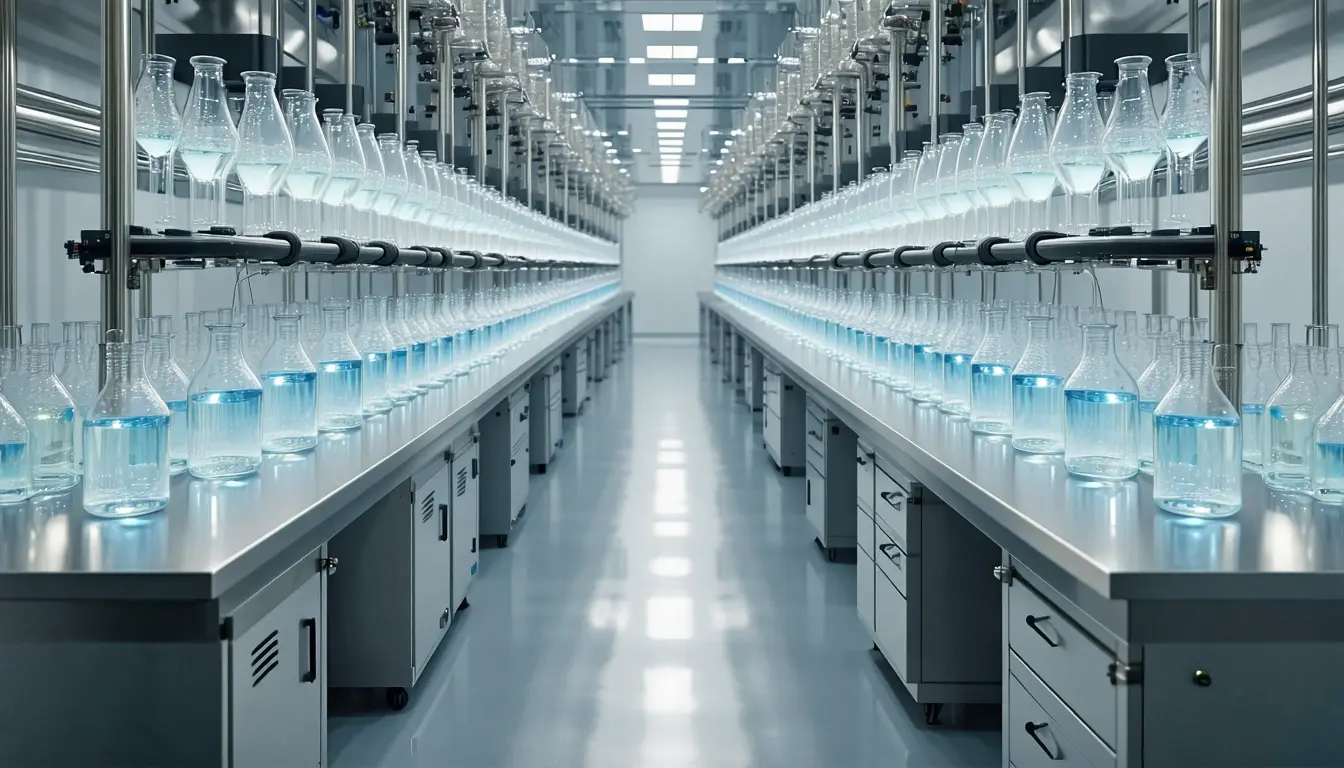
- Riven Systems will run thousands of automated experiments in its self-driving minerals-separation laboratory, producing the chemical data used to train models of extractant selectivity.
- Pasqal will run its neutral-atom quantum processing unit to benchmark quantum machine learning models against models running on classical computers.
- The experiments will use feedstock from the Round Top deposit in Sierra Blanca, Texas, third-party mixed rare earth carbonates, and recycled magnet-manufacturing cuttings known as swarf.
- A proposed later pipeline would send the strongest candidates to USA Rare Earth's research and development facility in Wheat Ridge, Colorado, before any move into processing flowsheets.
Compiled by The Product DeskSomething wrong?How this is made
Why it matters
- constraint The first phase does not depend on the quantum models winning: a loss on the benchmark costs USA Rare Earth a comparison, and the extractant shortlist survives it.
- cost The savings USA Rare Earth describes land in the capital and operating cost of plants it has not built, so no one running a separation circuit today banks anything from this.
- decision The scored comparison in phase one decides whether the quantum model gets promoted to picking molecules ahead of the lab.
- precedent A quantum vendor agreeing up front to be measured against classical models on an industrial task sets the expectation that the next pilot names its classical baseline too.
The person on the hook for this runs a separation circuit, and what they count is stages. Each stage is more equipment and more reagent, so a molecule that binds one element more selectively out of a mixed feed takes stages out of the flowsheet. USA Rare Earth said a more effective extractant could cut the number of processing stages, the equipment and the raw materials used, lowering capital and operating costs at facilities it has yet to build [8].
Alex Moyes, the company's senior vice president of upstream operations in the US, put the problem on the feed. "The key challenge the rare earth industry outside Asia faces is to separate the Mixed Rare Earth Carbonate (MREC) produced in upstream operations into individual, separated oxides," he said [5]. The work being replaced is lengthy trial-and-error testing [6]. China leads the separation step today, particularly for heavy rare earths such as dysprosium, terbium and yttrium [4].
Three pieces of work are described for the initial project, and the neutral-atom processor is in one of them, where its job is to be compared with classical models [18].
The deliverable exists without the quantum hardware. The autonomous lab still runs, the chemistry data still trains classical models that predict selectivity, and USA Rare Earth still ends up with candidate extractants to put into further testing [10][11]. The quantum layer only moves to the front of the line in a proposed later pipeline, where Pasqal's model would pick high-potential molecules before Riven tested them [14]. The second phase turns on that first comparison.
Pasqal chief executive Wasiq Bokhari said "Rare earth materials are essential, and improving how they are processed has implications far beyond a single industry" [16]. Riven's chief technology officer and co-founder, Orion Archer Cohen, said "AI and autonomous labs are the next frontier in critical mineral processing" [17]. None of the three executives quoted mentions quantum computing [19].
The report gives no budget, no schedule and no target number of candidate molecules, and "thousands of automated experiments" is the only quantity in it [20][9].
With the next pilot of this shape, I'd want to know whether the deliverable survives deleting the quantum hardware, as it does here, and whether a number from the comparison is ever published, and against which classical model. An unreported benchmark is a press line. In this project the models are scored on how selectively they predict extractant binding, and classical machine learning is the baseline to beat [11].
What to watch
- Whether Pasqal or USA Rare Earth publishes the benchmark result and names the classical model it was scored against.
- Whether the proposed second phase is funded, putting the quantum model upstream of Riven's autonomous lab.
- Whether any candidate extractant clears validation at Wheat Ridge and enters a USA Rare Earth flowsheet.