Product1 publisher2 min readPublished
Marine Corps orders 12 Rheinmetall logistics robots with amphibious kits for five of them
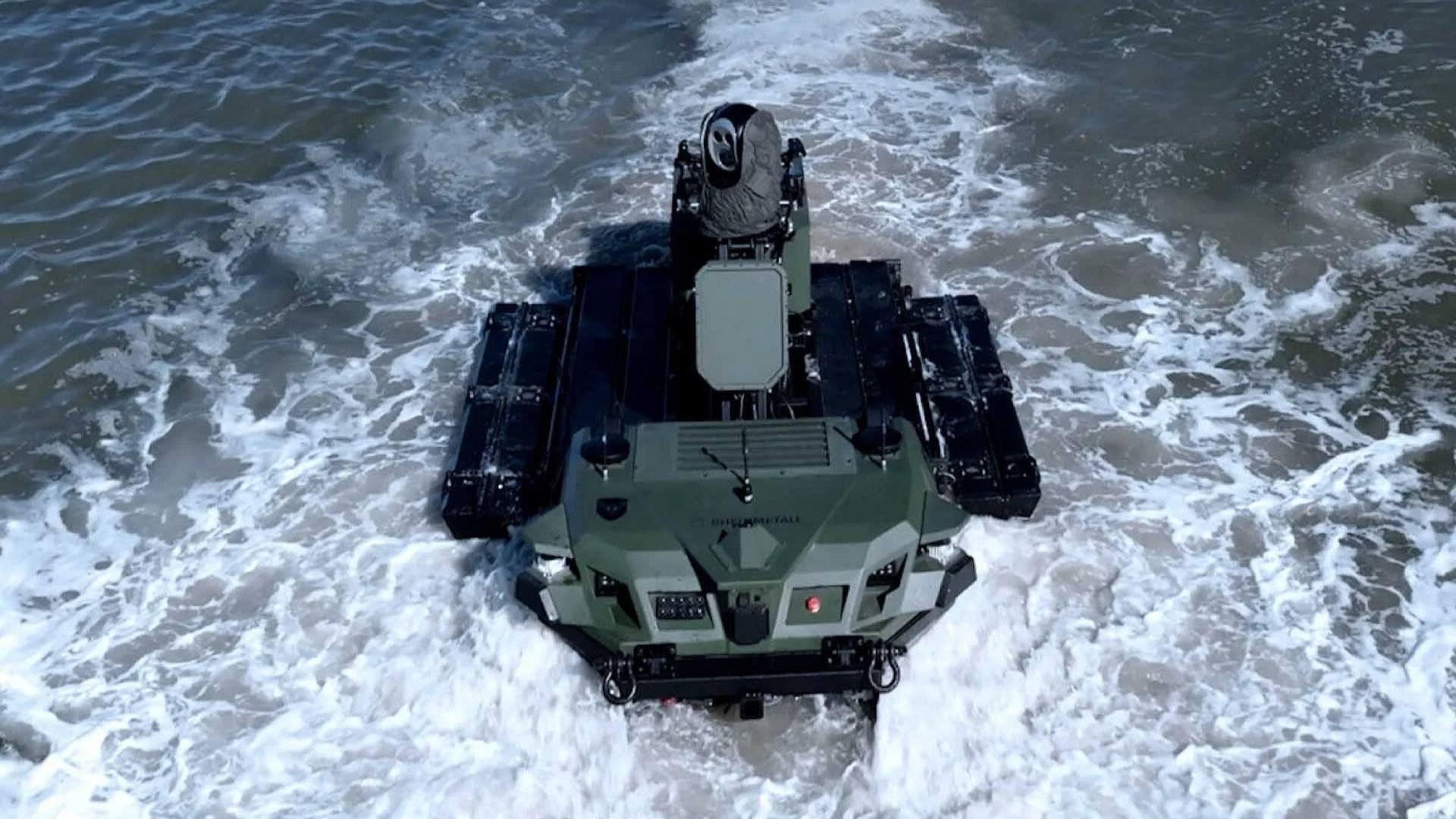
American Rheinmetall's $7.28 million award covers 12 Mission Master SP vehicles plus the training and engineering around them, all bound for a Marine Corps lab evaluation. Only five amphibious kits come with them.
The Product Desk · Product desk
What happened
- American Rheinmetall, the US arm of Germany's Rheinmetall, has won a $7.28 million contract to supply autonomous ground vehicles to the US Marine Corps.
- The order covers 12 Mission Master SP autonomous unmanned ground vehicles, five amphibious kits, associated Marine Kits and other supporting equipment.
- The Defense Logistics Agency is executing the procurement, with equipment supplier ADS Inc. as the prime contractor and Rheinmetall Canada as the original equipment manufacturer.
- Rheinmetall said the program could support its longer-term plan to expand autonomous vehicle manufacturing in the United States through a dedicated autonomous systems hub.
Compiled by The Product DeskSomething wrong?How this is made
Why it matters
- cost Training, program management, capability development and engineering sit inside the same $7.28 million as the hardware. Whoever writes the follow-on requirement has one bundled figure to work from.
- constraint A ship-to-shore rehearsal has to be designed around a mixed fleet in which most vehicles cannot cross water. The amphibious part of any such test is limited to five vehicles.
- decision The size and shape of any next order now rests on what the Warfighting Laboratory's experimentation measures.
- precedent A US autonomous systems production hub needs volume that a 12-vehicle evaluation buy does not supply, so Rheinmetall's factory plan waits on a follow-on order.
Somebody at the Marine Corps Warfighting Laboratory now has to write the trial plan: twelve unmanned vehicles, five of which can enter the water [2][8]. That puts 42 percent of the delivered fleet on the amphibious side of a littoral logistics test [2].
Divide the award by the vehicle count and it comes to $606,667 each [1]. Treat that as a ceiling. The same $7.28 million also covers the five amphibious kits, the associated Marine Kits, supporting equipment, program management, training, capability development and engineering services [2][9], and the announcement does not break out a hardware price.
Rheinmetall calls this the most advanced Mission Master configuration it has built, drawing on more than four years of work alongside Marines [5][6]. Both executives quoted reached for the same phrase. "This award represents a significant milestone in our long-standing partnership with the United States Marine Corps," said Matt Warnick, CEO of American Rheinmetall [13]. "The addition of an amphibious capability marks a significant milestone in ensuring that our system meets the evolving demands of littoral and expeditionary operations," said Pietro Mazzei, president and CEO of Rheinmetall Canada [15].
What the money buys is an evaluation. The equipment supports the Warfighting Laboratory's operational evaluations and capability development [4], and the vehicles will undergo further experimentation as the Corps explores how autonomous systems can assist distributed forces [11]. As announced, this is an evaluation and nothing else: no program of record, no down-select, no competing platform [3].
Each vehicle is built around Rheinmetall's PATH autonomy system, which the company says lets military vehicles perform tasks with reduced human involvement [7]. Reduced by how much is the question a twelve-vehicle trial can actually answer. One operator per vehicle and one operator per section of four cost different numbers of Marines, and the Corps has to move people, equipment and supplies between ships, beaches and inland positions [18].
An evaluation buy can settle a requirement when enough of the delivered units carry the capability under test and when the price shows what a production order would repeat. Five of twelve carry the amphibious kit here [2], and the $7.28 million covers hardware and services in one figure [9].
Rheinmetall's stated payoff for the Marines is logistics without exposing them to every hazardous part of a resupply run [17]. Getting there means every vehicle in a ship-to-shore serial can swim. If the follow-on order keeps this kit ratio, seven of the twelve cannot.
What to watch
- Whether a follow-on order buys amphibious kits for every vehicle or keeps the five-in-twelve ratio.
- Whether Rheinmetall attaches a site and a production volume to its planned US autonomous systems hub.
- What the Marine Corps Warfighting Laboratory publishes from the evaluations, including operators per vehicle.