Product1 publisher3 min readPublished
Army buys prototypes, not a blank sheet: Hanwha's wheeled K9 wins up to $262.9M for M777 successor
The Mobile Tactical Cannon solicitation asked for a mature wheeled 155mm gun and graded supply chains. Hanwha's answer is a Korean howitzer on a Tatra chassis, integrated in Alabama.
The Product Desk · Product desk
Drafted by a language model from the sources cited here and checked against its claim ledger before publication. How we use AISend a correction
What happened
- The U.S. Army selected Hanwha Defense USA's K9 Mobile Howitzer (K9MH) to build prototypes for its Mobile Tactical Cannon (MTC) program, the South Korean defense company's first major U.S. Army contract.
- Hanwha will initially deliver six prototype systems, with an option for another 12.
- As per reports, the agreement could be worth up to $262.9 million.
- The MTC program is intended to provide the Army with a more mobile alternative to its M777 155mm towed howitzers.
- The Army's prototype solicitation calls for a mature, wheeled 155mm system that can undergo testing and experimentation as a potential replacement for the M777 in some formations.
Compiled by The Product DeskSomething wrong?How this is made
Why it matters
The US Army has picked Hanwha Defense USA's K9 Mobile Howitzer to build prototypes for its Mobile Tactical Cannon program, the South Korean company's first major US Army contract [1]. The initial order is six systems with an option for 12 more, under an agreement reported to be worth up to $262.9 million [2][3].
The requirement matters more than the quantity. MTC is meant to give the Army a more mobile alternative to the M777 155mm towed howitzer [4], and the solicitation asked specifically for a mature wheeled 155mm system that could be tested as an M777 replacement in some formations [5]. "Mature" is the operative word: it rules out a design that still has to be invented, and it rewards whoever already has a line running.
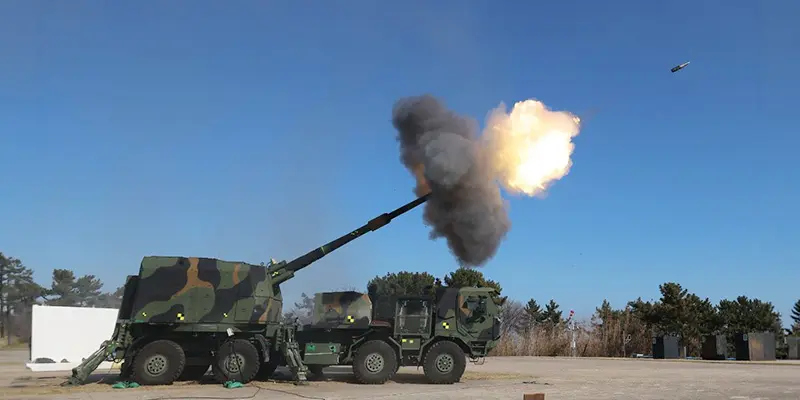
Hanwha's entry is the tracked K9 family adapted onto a wheeled Tatra Force 8x8 chassis [6]. The company says more than 2,500 K9 systems have been fielded globally, with Australia, Poland and Norway among the adopting allies [7][8]. Industry reporting puts the Army's eventual requirement at roughly 500 systems [15], which would be about a fifth of the K9 fleet Hanwha claims is already out there [17]. That is the whole argument for a foreign base: the gun's production and sustainment problems have mostly been found by somebody else.
The Army also wrote industrial policy into the scorecard. Proposals were assessed on US integration, delivery schedule, production cost, supply-chain health and plans for transitioning to domestic production [13], not on ballistics alone. Hanwha has been building toward that, leasing a facility in Opelika, Alabama, in April as its initial US integration and testing site for the K9MH family, with a first phase expected to create about 40 jobs [12]. Forty jobs is an integration shop, not an arsenal, which is the gap the company now has to close.
On the technical side the solicitation specifies a 155mm cannon in the 49 to 56 caliber range, and the Army is separately working on ammunition and propulsion technologies to extend future MTC range [10][9]. The mobility case is mechanical rather than rhetorical: a wheeled self-propelled howitzer moves under its own power instead of waiting for a prime mover, which can cut the time and crew needed to shift between firing positions [11].
The money frames the risk. This is a prototype contract, not full-rate production, and the Army will test before deciding what goes forward [14]. Army 2027 budget documents allocate more than $1.1 billion across MTC development and production over the budget period [16], so the $262.9 million ceiling is roughly a quarter of the programmed total [18]. Spread across all 18 possible prototypes, that ceiling works out to about $14.6 million per system [19], a number that will be read closely as a proxy for eventual unit cost even though prototype pricing rarely survives contact with production.
What to watch: whether the Army exercises the 12-system option, and how quickly; whether Opelika moves from integration and testing to actual manufacturing, and what share of the vehicle is US-built when it does; how the Tatra-based chassis performs in Army testing against a gun family that was designed to run on tracks; and whether the roughly 500-system figure survives the next budget cycle, since a 500-gun buy and a niche M777 supplement are very different industrial commitments.