Product1 publisher3 min readPublished
Energy Department lends $1.9bn to restart 615MW plant, most of which Google has booked for 25 years
Google has contracted about 92 percent of Duane Arnold's output for a quarter century, which is what made the restart financeable. The money itself is federal debt, and the Energy Department will not say what any of it does to Iowa household bills.
The Product Desk · Product desk
What happened
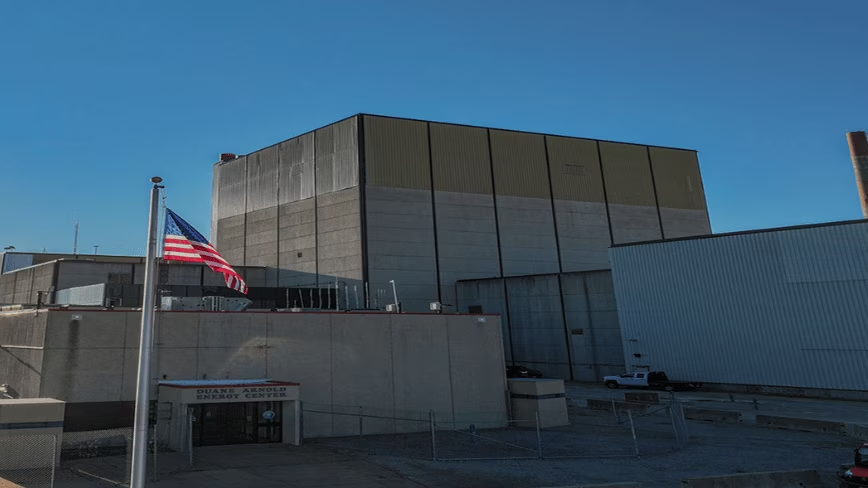
- The US Department of Energy has lent NextEra Energy up to $1.9bn to restart the Duane Arnold Energy Center in Iowa, with its Office of Energy Dominance Financing announcing the financial close on 8 September.
- The plant, which stopped running in 2020 after a storm damaged the site, will return at 615 megawatts, 14 more than before, and NextEra expects it online around the end of 2028 or early 2029.
- Google agreed in October 2025 to buy the plant's output for 25 years to supply its Iowa cloud and AI infrastructure, with minority owner Central Iowa Power Cooperative taking the remainder on the same terms.
- It is the third restart the financing office has funded, after Palisades in Michigan and the Crane Clean Energy Center, the former Three Mile Island, which received a $1bn loan last November.
- The Nuclear Regulatory Commission still has three licensing changes to issue, covering operating conditions, emergency preparedness and security, and said in April it would issue them all before January 2028.
Compiled by The Product DeskSomething wrong?How this is made
Why it matters
- exposure The pledge that Iowa customers pay nothing is scoped to the power Google buys, and with the department declining Utility Dive's question on household bills, no party has publicly claimed the downside on the loan itself.
- constraint By Utility Dive's count there are one or two revivable reactors left in the country, so the next compute buyer wanting firm clean power this decade is pushed onto new-build schedules instead.
- precedent A 25-year offtake covering about 92 percent of a plant, stacked on federal debt, is now a repeatable structure, and it settles the queue for the remaining shuttered reactors by who signs first.
- cost Restarts are sold as the cheap route to always-on clean power, yet the same office's new-build programme averages $1.75bn a reactor, close to what one 615MW restart is borrowing.
NextEra and Google, when they announced the offtake, said Iowa customers would not bear any costs for the power Google buys [18]. That promise attaches to a quantity of electricity. Google's contract takes the plant's output minus the 50 megawatts that NextEra chief executive John Ketchum told an earnings call would go to the Central Iowa Power Cooperative [19]. At 615 megawatts of restored capacity, that leaves 565 for Google, about 92 percent of the plant [1]. The Energy Department says the full output covers nearly 500,000 homes [8], which puts roughly 460,000 homes' worth of always-on supply behind one buyer's server racks [5]. Google has been looking at up to six data centres near the site, according to Data Center Dynamics [20].
Who holds what: Google holds a 25-year purchase obligation [16]. NextEra holds the asset, and is buying out the cooperatives' combined 30 percent stake to own all of it [17]. The department holds up to $1.9bn of credit risk [1]. The companies' own words are the accurate description: Google's agreement enables the investment and covers the cost of producing its power [18]. The contract is what made the loan bankable. A compute buyer at this scale is underwriting the revenue line, not writing the cheque for the plant, and that is who is exposed if the restart runs long.
James Danly, the deputy secretary of energy, said returning 615 megawatts of reliable baseload generation will drive down electricity costs [10]. TechCrunch noted he did not explain how [11], and Utility Dive reported the department declined to answer when asked how the loan squares with a pledge to protect residential customers from data centre infrastructure costs [12]. The arithmetic on hand does not fill the gap. The loan ceiling alone works out at about $3.1m per megawatt of restored capacity [2]. Constellation's Crane restart is about $1.6bn for 835 megawatts, or roughly $1.9m per megawatt of total project cost [14][3]. Those are not like for like, since $1.9bn is a lending limit rather than a published Duane Arnold budget, so read it as a floor on the capital per megawatt rather than a comparison. Even as a floor, it sits awkwardly against the pitch that shuttered reactors are the fast, cheap way to firm clean power [24].
Scarcity is what matters here. An earlier Utility Dive analysis found only one or two US restart candidates left after these three, closed for longer and needing more work [23]. The queue for the cheap-to-revive plants is short enough that it will be settled by who signs an offtake first, not by who needs the megawatts most.
Two questions sort a claim that a customer contract paid for a generation asset. Where does the capital come from, private or public balance sheets? And what did the buyer commit, revenue or equity? Duane Arnold is public capital plus buyer revenue, which is the quadrant to expect the next one to land in, and the quadrant where the cost promise has the narrowest scope. The promise here covers the power Google buys. It does not cover the loan, or whatever the restart costs above it. If a siting or procurement decision on your desk leans on somebody else's line that the customer funded the plant, the test is whether that contract sits in front of public debt or instead of it. In Iowa it sits in front.
What to watch
- The NRC's final environmental assessment and finding, following the August draft finding of no significant impact.
- Whether the three licence amendments arrive before the regulator's stated January 2028 target, which sits about a year ahead of NextEra's restart date.
- Whether the financing office names a fourth restart, and which of the remaining candidates it picks.