Product1 publisher3 min readPublished
A barge, a berth lease and a standards deal: how nuclear gets back into California
Bluecore Energy has leased Berth 48 at the Port of Long Beach for a floating small modular reactor, and the port has signed a standards agreement with MARAD. No licence application yet.
The Product Desk · Product desk
Drafted by a language model from the sources cited here and checked against its claim ledger before publication. How we use AISend a correction
What happened
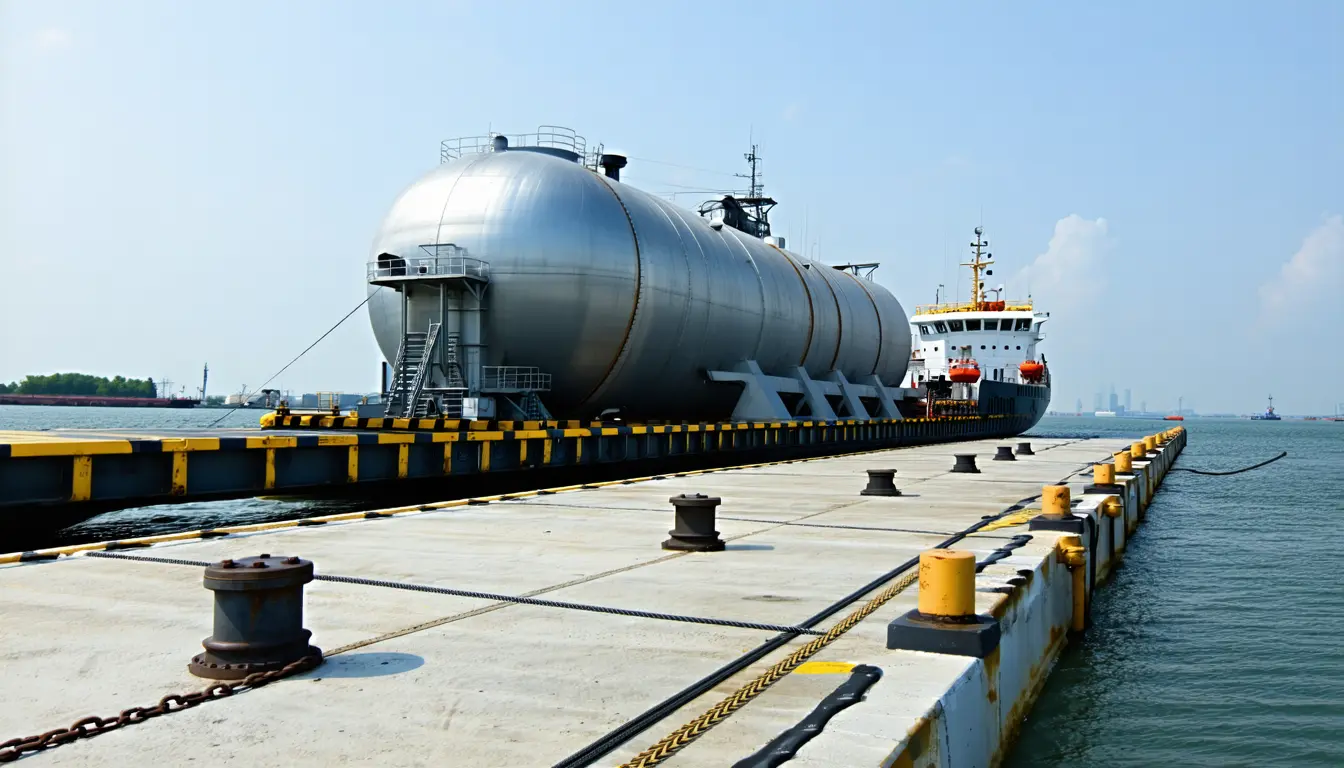
- Bluecore Energy, a startup developing small nuclear reactors designed to operate on floating barges, has leased space at Berth 48 at the Port of Long Beach, where it plans to develop and test its technology.
- The Port of Long Beach has signed a cooperation agreement with the U.S. Maritime Administration (MARAD) to help establish standards for maritime nuclear power.
- The Port of Long Beach is moving forward with plans to explore small modular reactors that could eventually provide electricity for port operations and ships, potentially bringing a new nuclear power project to California for the first time in five decades.
- California has maintained a moratorium on new nuclear fission reactor construction since 1976, with the policy tied to requirements concerning the long-term disposal of high-level radioactive waste.
- Bluecore founder and CEO Kofi Asante told CBS News that the company has taken nuclear reactor technology used in power generation and developed a smaller system designed to operate from a barge.
Compiled by The Product DeskSomething wrong?How this is made
Why it matters
Bluecore Energy has leased space at Berth 48 in the Port of Long Beach to develop and test a small modular reactor designed to operate from a floating barge, and the port has separately signed a cooperation agreement with the U.S. Maritime Administration to help establish standards for maritime nuclear power [1][2][3]. A real berth plus a federal standards track is what moves barge-mounted nuclear from concept into something terminal and shore-power planners have to price, in a state that has barred new fission reactor construction since 1976 [4].
The technical claim is narrow. Bluecore founder and CEO Kofi Asante told CBS News that the company took reactor technology used in power generation and built a smaller system designed to run from a barge [5]. The reactor is water-cooled and, like conventional plants, uses fission heat to produce electricity [6]. One unit could generate enough electricity to power about 15,000 homes, according to the company [7]. That is a residential-equivalent number: the source material does not say what share of the port's demand a single unit would cover, and homes are not the unit anyone uses to size cargo-handling equipment. The stated customers are port terminals, cargo-handling equipment, charging infrastructure and ships [8], with the company also citing data centres and other facilities located near water [9].
The regulatory work is the more portable asset. The NRC is working on how its existing framework could apply to maritime nuclear systems [10], and according to reports an NRC report identified questions about hazards specific to floating deployments, including sinking, capsizing and other environmental extremes [11]. The port and MARAD are working with the NRC, the U.S. Coast Guard and the Department of Energy on operational protocols, safety standards and inspection procedures [12]. MARAD began seeking industry input earlier this year on U.S.-built, scalable and commercially viable SMRs for the marine transportation system [13]. Naval vessels have run on reactors for decades and floating nuclear plants have been built internationally, but Bluecore's target is commercial power rather than military propulsion [14].
Two constraints define the schedule. California's moratorium on new fission reactor construction dates to 1976 and is tied to requirements on long-term disposal of high-level radioactive waste; according to reports it remains unclear how that restriction would apply to a floating reactor [4][15]. And Bluecore has not submitted a deployment application to the NRC [16]; it was scheduled to meet the commission on August 17 to introduce its design and regulatory plans, according to the Press-Telegram [17]. An introductory meeting is not a docketed application, so no federal review clock has started [18].
The port's motive is straightforward: it is pursuing zero-emission operations while handling large cargo volumes, which raises demand for reliable electricity [19], and port officials say nuclear could be one source of the clean, around-the-clock power needed as port infrastructure is electrified [20].
Watch for three things. Whether Bluecore files an actual NRC application, which converts this from planning to a reviewable design. Whether anyone in Sacramento states publicly how the 1976 moratorium applies to a reactor on a hull rather than a foundation [4]. And what MARAD's industry input process produces in the way of inspection and protocol drafts [13], because those documents are what any other port would reuse. Until then, the deliverable at Berth 48 is paperwork, not megawatts.