Product1 distinct publisher3 min readPublished
At Project Convergence-Capstone 6 the two firms swapped a payload rather than build a vehicle, which was the cheap part. The cost of keeping a forward robot running and getting it back is still unpublished.
The Product Desk · Product desk

Compiled by The Product DeskSomething wrong?How this is made
The crew that drives a GEREON to somewhere worth listening from and then has to get it back is the one whose week actually changes, not the commander watching bearings arrive on a map. Both quoted executives describe the payoff in the same terms, which is distance rather than detection: L3Harris's Nicky Tabram talks about extending passive sensing into forward or hazardous areas and reducing personnel exposure [6], and ARX's David Roberts about keeping operators at a safer distance [7] [15].
It is worth separating the pitch from the work. The pitch is a robot that takes counter-drone sensing closer to the fight. The work was a payload swap: an existing modular ground platform built to carry different mission payloads [8] carried an existing passive sensing and electronic warfare box at an Army experimentation event [10] [12], and both firms credit modular hardware and open architectures with reducing the integration barriers [9]. That is a useful finding about procurement plumbing, but not yet one about counter-drone performance.
The account goes quiet at that point. There is no detection range, no endurance figure, no crew size, no recovery time and no cost anywhere in it [14]. Those are the numbers that decide whether pushing the antenna forward reduces exposure or relocates it, because placement is the whole problem: small drones come in low, from several directions, across a wide area, so sensors have to sit where they can hear them, which tends to be where people should not be standing [13]. The measure that would settle it is hours of forward sensing produced per crew-hour spent driving and recovering the vehicle, alongside whether bearing quality held up at the distances the robot bought.
Two axes sort the decision for anyone thinking of copying this. Whether the payload has to transmit to do its job, and whether you can recover the platform under the conditions that made you send it forward. Passive and recoverable is the case the demonstration makes, and it is the strongest one. Passive and unrecoverable is an attrition budget, so price the vehicle as ammunition rather than as equipment. Transmitting and recoverable means constant repositioning, which is exactly the mobile alternative to fixed sensing locations being advertised [11], and it is paid for in crew hours nobody has counted in public. Transmitting and unrecoverable means you have bought a decoy with a sensor on it, which can be a sound buy as long as the requirement says so out loud.
The habit to carry into your own version of this: count the people a forward payload adds behind the line before you credit it with the people it removes from the front.
Ranked by verification strength, evidence, and original report placement.
Nicky Tabram, Managing Director of Global Spectrum Superiority UK at L3Harris, said that by mounting CORVUS-RAVEN on a remotely controlled uncrewed ground vehicle, "we explored how operators could extend passive sensing into forward or hazardous areas, enhance situational awareness and reduce personnel exposure."
David Roberts, CEO of ARX Robotics UK, said that integrating CORVUS-RAVEN with GEREON shows "how passive and active electronic warfare can be moved closer to the threat while keeping operators at a safer distance."
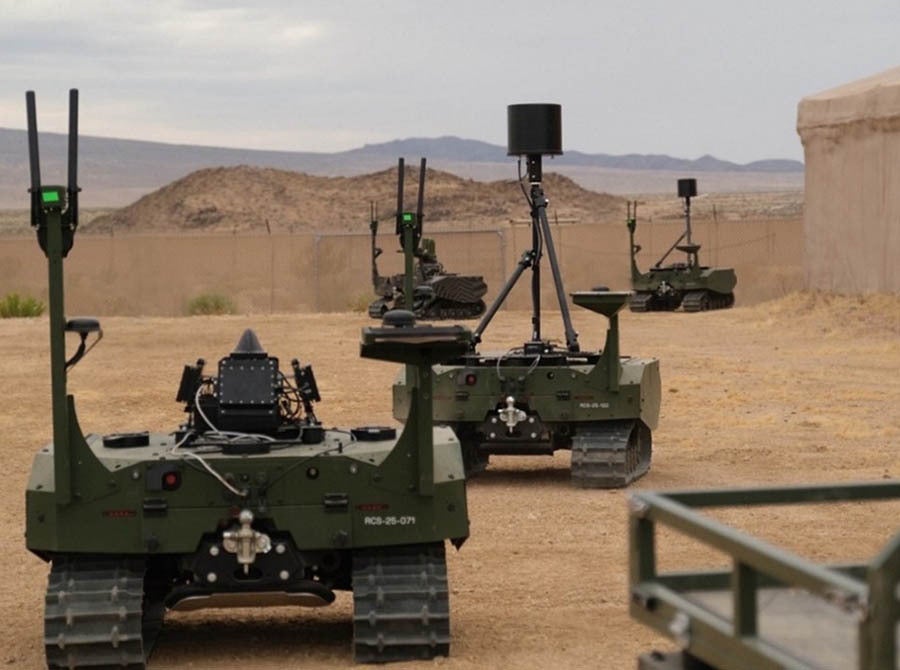
L3Harris Technologies and ARX Robotics demonstrated a robotic ground vehicle carrying a counter-drone sensing system during the US Army's Project Convergence-Capstone 6 experimentation campaign.
For the demonstration, L3Harris mounted its CORVUS-RAVEN counter-drone capability on ARX Robotics UK's GEREON uncrewed ground vehicle, exploring how mobile robotics could extend passive drone detection into forward or hazardous areas while operators remained elsewhere in the battlespace.
CORVUS-RAVEN passively detects signals associated with potential drone threats and provides bearing information to improve situational awareness.
CORVUS-RAVEN is designed around an open architecture and can generate TAK-compatible messages for integration with command-and-control and battle-management applications, so threat-bearing information can be added to a shared geospatial operating picture used by personnel elsewhere.
Distinct publishers with included, body-backed reporting in this cluster.
1 article · August 28, 2026
Follow any of these and your For You feed starts watching them — no settings page required.
product
CACI puts electronic warfare on a factory floor: 61,000 sq ft in Rochester for the Army's TLS Manpack1 distinct publisher
invest
A US brigade took counter-drone gear to Combined Resolve and was wiped out anyway1 distinct publisher
product
Army buys prototypes, not a blank sheet: Hanwha's wheeled K9 wins up to $262.9M for M777 successor1 distinct publisher
product
A $22.3m counter-drone contract that buys warning time, not shootdowns1 distinct publisher
Evidence-backed comparisons of source perspectives and observed adoption signals. Read the methodology
Which Builder, Operator, and Investor concerns the observed source mix emphasized—not a truth score.
Evidence, demonstrated adoption, hype gap, incentives, and confidence are assessed independently, each on its own current evidence. How these are measured.
One write-up, two vendor quotes
The entire record is one Interesting Engineering write-up assembled from a joint L3Harris/ARX announcement. The two people quoted work for the two companies selling the pairing; the US Army, whose exercise this was, says nothing. What is solidly established is that the integration happened and what the sensor is meant to do. Everything about how well it did it rests on the vendors' framing.
One sensor swap at one exercise
One integration, one appearance, at the venue the Army specifically maintains for trying things it has not bought. There is no unit using this, no repeat outing, no procurement decision and no second customer in the reporting. Demonstration credit at Project Convergence-Capstone 6 is a foot in the door, not traction.
Hedged language, unpriced logistics
The overstatement here is not in the adjectives — Interesting Engineering and both executives stick to 'explored' and 'could potentially', and neither company claims the robot detects anything better than a tripod would. The gap opens in what goes unmentioned. Moving the antenna forward is the cheap half of the idea; keeping a machine alive beyond friendly positions and getting it back is the expensive half, and no figure for it appears. A reader finishes the piece believing a soldier has been taken out of harm's way, without ever being told what replaces that soldier's walk home.
Both voices are selling the pairing
A defence prime and a robotics startup announce a joint demonstration, supply the quotes, choose which properties of their products to name, and get an Army exercise as backdrop. The framing benefits both: L3Harris shows its sensor travels, ARX shows its platform carries serious military kit. No counterweight appears in the reporting — no buyer, no evaluator, no competitor.
Sure what happened, blind to how it went
That CORVUS-RAVEN rode GEREON at Project Convergence-Capstone 6 is not in doubt; a joint announcement of a public exercise is unlikely to be wrong about that. Confidence falls away everywhere else, because a single vendor-sourced account with no measurements and no Army comment leaves no way to judge whether the arrangement is useful or merely photogenic.