Invest3 publishers3 min readPublished Updated
The USS George Washington is heading to the Middle East to relieve the USS Abraham Lincoln, leaving the western Pacific without a US carrier. The tradable Iran risk fell anyway.
The Investor · Invest desk

Compiled by The InvestorSomething wrong?How this is made
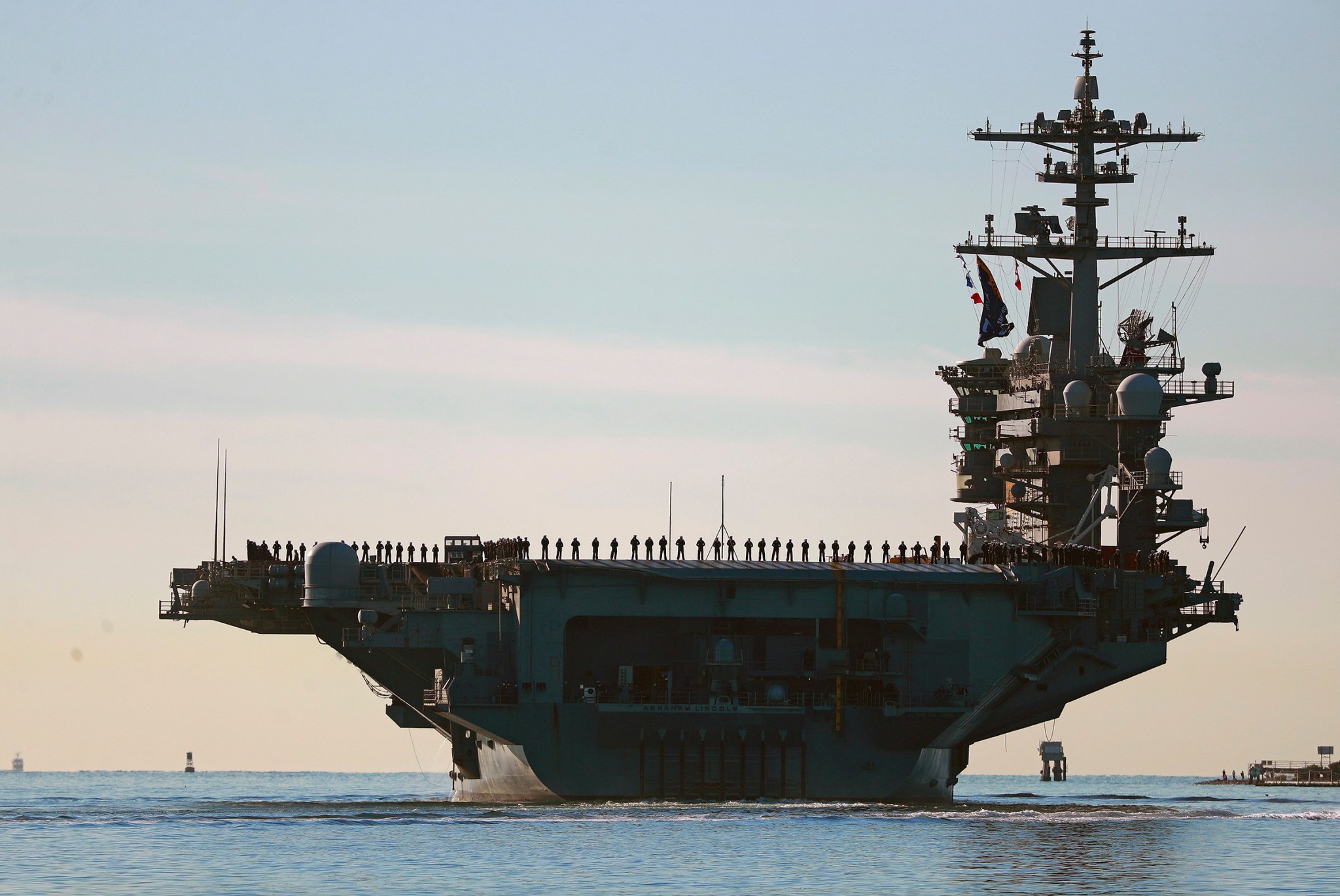
The USS George Washington is departing the Pacific and is expected to replace the USS Abraham Lincoln in the Middle East, which leaves the western Pacific without a US aircraft carrier [1]. If your bill of materials moves through the South China Sea, the Taiwan Strait or Japanese ports, that reallocation matters more to you this month than anything happening near Hormuz.
The mechanics are unglamorous and they are the whole story. The Lincoln's return was pushed out from an original May date to support operations against Iran [2], and it has now spent a record uninterrupted stretch at sea of more than 240 days [3], which on a mid-August dateline is roughly three months past the plan [4]. Before that, the USS Gerald R. Ford came home in mid-May from an 11-month deployment, the longest since the Vietnam War, covering both Iran and the capture of Venezuela's then-leader Nicolas Maduro [5]. The Ford suffered a laundry-space fire that sent it back to the Mediterranean for repairs and left hundreds of sailors without places to sleep [6]. Democratic lawmakers have called for investigations and more visibility into conditions aboard the Lincoln [7]. Open-ended commitments consume hulls, crews and maintenance cycles, and there is no spare set.
The Navy could close the Pacific gap within a couple of months by sending another carrier [8]. Until it does, the vacancy is doing work for Beijing. China ran naval exercises with Indonesia this week [9], conducted drills this month near Scarborough Shoal, claimed by both China and the Philippines [10], and last month sent a guided-missile destroyer to a live-fire exercise off Japan's southernmost island of Okinotori [11]. Bryan Clark of the Hudson Institute says the absence is being folded into a narrative aimed at the Philippines, Japan and Indonesia, that "the U.S. is not the big dog in the western Pacific anymore" [12]. Greg Poling of CSIS says the administration calls the Pacific its priority behind the Western Hemisphere while doing "the exact opposite" of its stated plan to pull out of the Middle East, and that Beijing "is quite happy with U.S. distraction" [13]. Evan Sankey of the Cato Institute frames carriers as psychological assurance, their absence adding to a sense that Washington is distracted [14]. Adm. Frank Bradley of US Special Operations Command was in Manila on Thursday offering expanded joint exercises, with Japan next [15]. Special forces exercises are not a carrier strike group, and allied procurement and basing decisions will register the difference. No analyst quoted expects China to invade Taiwan because a carrier sailed west [16].
Now the pricing. The same deployment is read in the Middle East as reinforcement of blockade enforcement and deterrence around the Strait of Hormuz [17], with talks through Oman and Qatar continuing without resolution [18]. Prediction-market odds on Iran imposing a full airspace closure by the end of August fell from 8% to 6.5% in 24 hours [19], a drop of 1.5 points or about 19% in relative terms [20]. So the one instrument in view moved in the direction of calm in the theatre where the ships are, while the exposure that actually changed sits several thousand miles east and has no equivalent quote attached to it. Operators hedging Iran are hedging the visible leg.
Watch whether a replacement carrier deploys inside the stated couple of months [8], what Bradley brings to Tokyo [15], the tempo of Chinese exercises near Scarborough Shoal and Japan [10][11], and statements from the Civil Aviation Organization of Iran on airspace [21].
Ranked by verification strength, evidence, and original report placement.
The USS George Washington is departing the Pacific and is expected to replace the USS Abraham Lincoln in the Middle East, leaving the western Pacific without a US aircraft carrier.
The USS Abraham Lincoln's time at sea was extended from its original May return date to support operations against Iran.
The Lincoln has spent a record uninterrupted time at sea of more than 240 days.
The USS Gerald R. Ford returned home in mid-May after an 11-month deployment, the longest since the Vietnam War, during which it supported the US fight against Iran and the capture of Venezuela's then-leader Nicolas Maduro.
The Ford experienced a fire in a laundry space that forced it to turn around and return to the Mediterranean Sea for repairs and left hundreds of sailors without places to sleep.
Democratic lawmakers have been calling for investigations and greater visibility into conditions aboard the Lincoln, amid concerns about mental health and supply issues on the long-deployed carrier.
Follow any of these and your For You feed starts watching them — no settings page required.
Evidence-backed comparisons of source perspectives and observed adoption signals. Read the methodology
Which Builder, Operator, and Investor concerns the observed source mix emphasized—not a truth score.
Evidence, demonstrated adoption, hype gap, incentives, and confidence are assessed independently, each on its own current evidence. How these are measured.
One reported account plus one unsourced market note
The core posture facts come from a single reported article with multiple named, on-record analysts (Hudson, CSIS, Cato, University of Kentucky) and specific dates and figures, which is credible but uncorroborated by any second outlet and unaccompanied by Navy or Pentagon confirmation. The second source adds a dated price observation but attributes its strategic framing to unnamed "recent reports," so claims like blockade enforcement and Oman/Qatar diplomacy remain unverified.
Real-world moves observed, downstream effects not
Concrete, dated real-world actions are documented: a hull relief that empties the western Pacific, a record-length deployment, the Ford's return, Chinese exercises in three locations, and a same-day move in traded Iran risk. What is not observed is any second-order uptake the story's framing implies, such as changes in shipping, insurance or Asia-exposed supply chains, and no Navy schedule confirms how long the gap lasts.
Framing outruns the priced and reported evidence
The cluster headline asserts that Iran operations are now repricing risk into Asia-exposed supply chains, but no source shows any supply-chain, freight or insurance repricing; the only tradable metric present fell. Cryptobriefing simultaneously calls the deployment escalatory while reporting easing odds, and the Fortune analysts explicitly discount an invasion scenario, so escalation language sits above the observed evidence.
Visible product promotion and institutional advocacy
Cryptobriefing's note closes with an explicit signup prompt for its own prediction-market analytics product, giving it a direct commercial interest in framing geopolitical news as tradable risk. The Fortune reporting leans on think-tank analysts from Hudson, CSIS, Cato and Quincy whose institutions hold declared positions on US posture in Asia and the Middle East, and cites Democratic lawmakers pressing for investigations, an inherently political incentive. Both sets of incentives are disclosed in the text rather than hidden.
Moderate: solid reporting, single-source pillars
Each pillar of the story rests on exactly one publisher, with no official confirmation of the carrier tasking and no independent corroboration of the market move. The reported specifics are internally consistent and same-day fresh, and the named-analyst sourcing is strong, which supports moderate rather than low confidence; the headline's supply-chain linkage is not evidenced at all.
invest
US strikes Iranian launchers on Larak Island days after declaring Hormuz mines cleared7 publishers
invest
A Sept. 15 cloture date, and a 24.5% price on the CFTC-SEC line ever being drawn1 publisher
invest
The Lincoln has been at sea 240 days, and that is the blockade's real clock3 publishers
invest
Importers Get No Vote on a Midnight Tariff: $20bn of Canadian Goods, 50%, Decided Overnight1 publisher
Publishers with included, body-backed reporting in this cluster.
2 articles · August 16, 2026
1 article · August 15, 2026
1 article · August 16, 2026