Build1 distinct publisher3 min readPublished
State money is arriving faster than autonomy, and inside the training centres the unit of production is still a human hour rather than a robot hour, which is what actually sets the price of the data.
The Engineer · Build desk

Compiled by The EngineerSomething wrong?How this is made
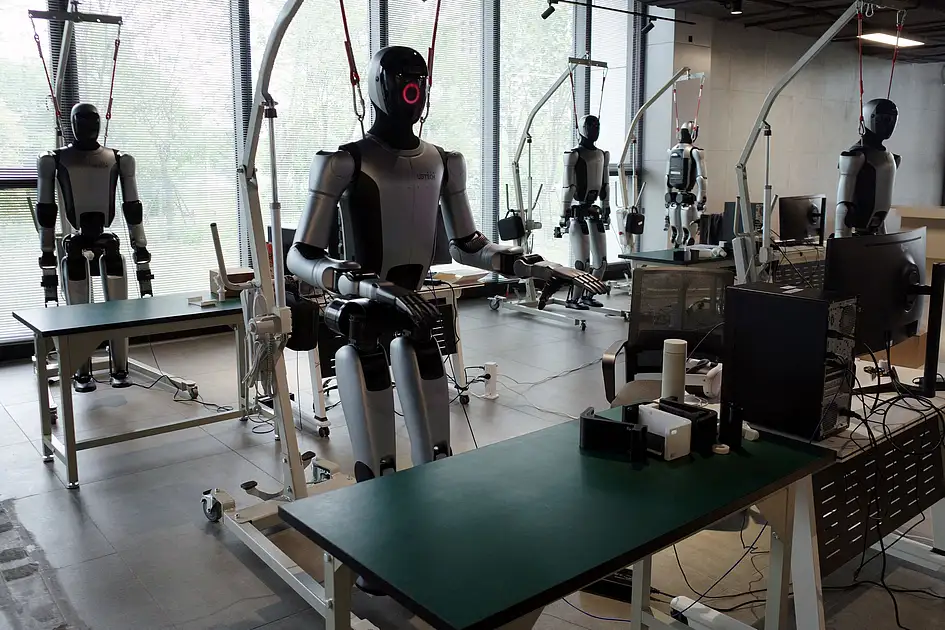
In Liuzhou, a usable motion is something a person performs first. The trainer wears a headset carrying the robot's camera feed, and controllers with sensors map the movement of his own hands onto the machine [5]. The robot is a recorder during that session. What the centre hopes to sell to factories is the recording, as data for embodied AI systems meant to perceive, decide and act physically [4] [6].
That fixes the unit of production at one human hour. A dozen trainers working a floor of more than a hundred robots is roughly eight machines per headset [1] [8]. Whether the other seven are producing anything depends on autonomous replay between sessions, and the account of the centre does not say that they do. Meanwhile the same task costs a beginner six times as many tries as a practised operator [2] [1]. The asset that appreciates fastest on that floor is the trainer.
You cannot price a dataset from attempts per motion alone. To turn 300 attempts into motions per shift you need the cycle time of an attempt, the reset time after a failure, and the rule that decides when a motion counts as usable. None of the three appears in the reporting. Until they do, the claim that this displaces labour is a forecast about hardware, and the demographic case, that these systems could one day offset a shrinking working-age population, sits in the same future tense [19].
The hardware side is cheap by comparison. UBTech's Guangxi contract was 18 million dollars for the robots plus other equipment delivered to the centre [3]. Divided across the hundred-plus machines, that is an 180,000 dollar per-unit ceiling, and since the contract also covered the rest of the kit, the true per-robot figure sits below it [6].
Scale is where the arithmetic gets interesting. The global industry shipped about 20,000 humanoids in 2025, roughly 19,000 of them from Chinese makers [10] [2]. In July 2026, an official at the Ministry of Industry and Information Technology, Gan Xiaobin, said China expects to produce more than 100,000 a year, about five times the whole 2025 global figure [11] [3]. Analysts put annual global shipments at 1.2 million by 2030, sixty times 2025 [12] [4].
For those units to do work rather than accumulate, one thing has to change. Industry people and researchers describe machines that fail where a task requires intuition or departs from its programmed sequence [9]. Tang Wenbin's version is shorter: the intelligence level is too low, and much of what is shown is dancing disguised as work [8]. That is the right test to apply to any demo video, including the boxing and kung fu routines the sector has been showing while investment outran capability [7].
Chinese manufacturers are building competitive hardware [9]. On the evidence available, though, Liuzhou is a subsidised data-supply operation with a robot line attached, and I would want the cycle times before pricing it as anything else.
Ranked by verification strength, evidence, and original report placement.
At a training centre in Liuzhou, southern China, more than 100 humanoid robots stand in rows while about a dozen trainers wearing headsets teach them simple tasks: sorting boxes, packing noodles and making coffee. Reported by Reuters.
A novice trainer can achieve roughly one usable motion per about 300 attempts, while an experienced trainer needs about 50 attempts.
UBTech received an 18 million dollar contract from the government of the Guangxi autonomous region in October 2025, under which it was to supply humanoid robots and other equipment to the centre.
The stated goal of the project is to collect data for so-called embodied artificial intelligence, capable of perceiving the surrounding world, making decisions and acting in a physical environment.
Trainers see the world through the robot's eyes via headsets, and transmit the movements of their own hands to the machine using controllers with sensors.
The Liuzhou centre plans to sell robot training data to factories but has no clear business model; staff acknowledge the project depends on state subsidies, its costs remain high, and data prices are low in a still young market.
Distinct publishers with included, body-backed reporting in this cluster.
mezha.net
1 article · September 4, 2026
Follow any of these and your For You feed starts watching them — no settings page required.
build
China is stamping out humanoids faster than trainers can teach them to move1 distinct publisher
invest
Unitree's 45% slide has unwound the abnormal half of a 460% pop, and none of the price3 distinct publishers
invest
State orders lift China's humanoid robot procurement from $6 million to $230 million in two years1 distinct publisher
invest
Unitree's debut prices 5,500 robots at $66 billion, or 262 times revenue9 distinct publishers
Evidence-backed comparisons of source perspectives and observed adoption signals. Read the methodology
Which Builder, Operator, and Investor concerns the observed source mix emphasized—not a truth score.
Evidence, demonstrated adoption, hype gap, incentives, and confidence are assessed independently, each on its own current evidence. How these are measured.
One outlet, one wire story, named agencies behind the numbers
The 300 attempts, the $230 million, the 95% share — all of it reaches readers through a single Ukrainian-language retelling of Reuters, with no tender, filing or dataset attached. What keeps it well above hearsay is that the attributions are checkable in principle: the planning commission's company count and its own warning, a named ministry official with a date, State Grid's April announcement, UBTech's Guangxi award. Nobody in our coverage has gone and checked them, and the piece stops mid-sentence before its final section.
Real machines, one dominant buyer
This is not vapour: robots are on a floor in Liuzhou, roughly 20,000 units shipped globally last year, a utility has a billion dollars earmarked and provinces have been told to open training sites. But trace the demand and it terminates in the state — $230 million of public procurement in six months against $6 million two years earlier — while the facility selling the resulting data cannot yet name a price for it. Deployment is broad and shallow: many buyers of one kind, few of any other.
Targets sit five to sixty times above the floor's output
The overstatement belongs to the sector, not to this reporting. A ministry expects 100,000 units a year against a world total of 20,000 last year, and unnamed analysts see 1.2 million by 2030 — while inside the training centre a skilled human still burns 50 attempts for one usable motion and the machines break whenever the script does. Mezha and Reuters are the deflating party here: they print "dancing disguised as work" and the planning commission's own warning that firms arrived before the business models did. Marked positive because the industry's projections outrun its demonstrated capability, not because the coverage inflates them.
Subsidised sellers selling to subsidising buyers
Follow the money and it is one circuit. UBTech is paid by a regional government; the Liuzhou centre survives on subsidies and hopes to sell data into a market the state is also building; 150-plus companies are chasing the same procurement; Unitree's fivefold post-listing run gives its holders a direct interest in bigger shipment numbers. The mitigating detail is that the sharpest scepticism in the story also comes from inside — Tang Wenbin on intelligence levels, Lizzi Li on waste being part of the search mechanism rather than an accident — and the agency issuing the warning is the one bankrolling the boom.
Convincing in texture, unverified in particulars
The operational detail has the grain of something observed: attempt counts, the three drilled tasks, one trainer to eight machines, a headset and sensor controllers. The policy facts arrive with dates and named agencies. What a single secondhand account cannot deliver is confirmation of the 2025 shipment estimate, an identity for the analysts behind the 2030 number, or the ending that got cut off. Directionally we would stand behind this; on any specific figure, treat it as one outlet's relay.