Invest1 publisher3 min readPublished Updated
Unitree's $905M Shanghai listing prices humanoids at 35x sales while profit halves
Retail investors bid more than 5,000 times the shares on offer. The prospectus underneath shows adjusted quarterly profit down 52.55% and robot hands that still cannot work a full shift.
The Investor · Invest desk
Drafted by a language model from the sources cited here and checked against its claim ledger before publication. How we use AISend a correction
What happened
- Unitree raised about 6.1 billion yuan ($905 million) in a Shanghai STAR Market IPO and is set to begin trading next week.
- Retail applications for the IPO came in at over 5,000 times the available shares, a record level of oversubscription for technology listings on Shanghai's STAR Market.
- Unitree priced its shares at 150.8 yuan ($22) and sold about 10% of its enlarged share capital, drawing a valuation of around $9 billion, according to CNBC.
- Unitree's first-quarter 2026 revenue growth slowed to 68.49% and adjusted net profit fell 52.55% to about 40.3 million yuan ($5.97 million) as research and marketing costs surged.
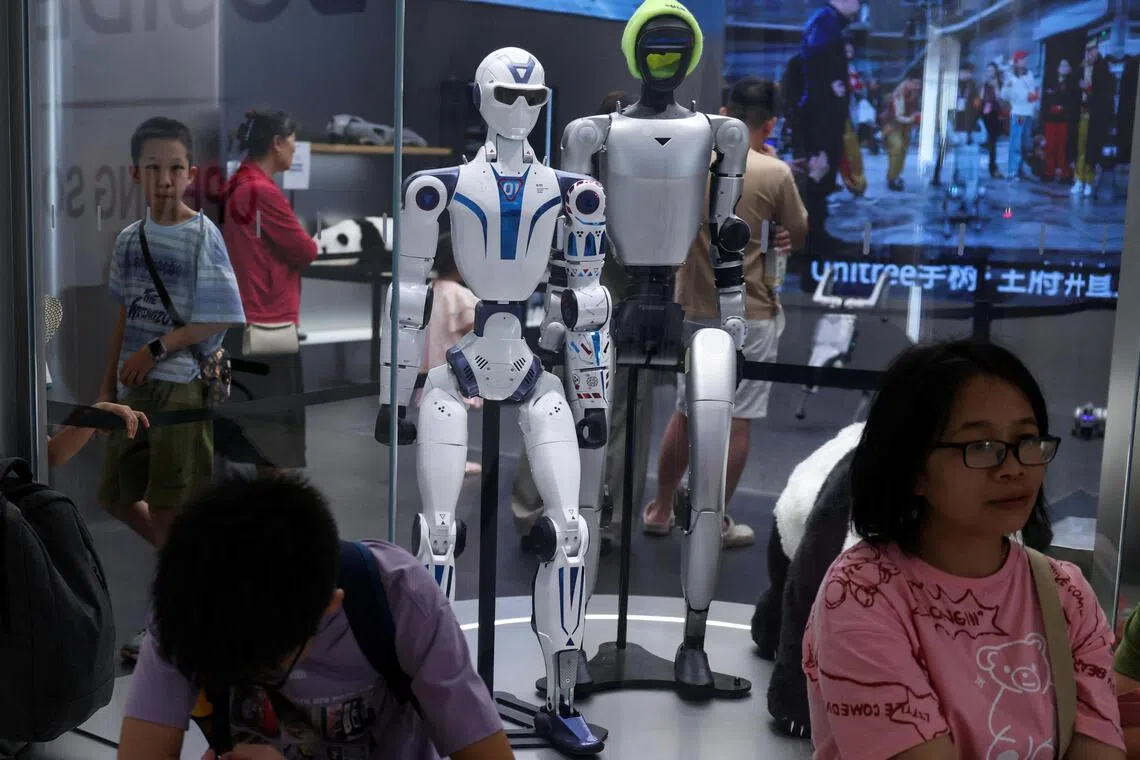
- Unitree's humanoid revenue reached 868 million yuan ($129 million) in 2025, more than half its main business income, Tech in Asia reported.
Compiled by The InvestorSomething wrong?How this is made
Why it matters
Unitree has raised 6.1 billion yuan ($905 million) on Shanghai's STAR Market, pricing at 150.8 yuan a share for roughly 10% of its enlarged share capital and a valuation of about $9 billion, according to CNBC [1][3]. Retail applications came in at more than 5,000 times the shares available, a record for technology listings on the exchange, which means the sector's first genuine public price is being set on a very thin slice of one company [2][3].
The filings are the useful part. In the first quarter of 2026, revenue growth slowed to 68.49% while adjusted net profit fell 52.55% to about 40.3 million yuan ($5.97 million), with research and marketing costs surging [5]. The raise is therefore roughly 152 times what the business earned on an adjusted basis in its most recent quarter [23]. Growth is real and it is being bought.
Scale is the other constraint. Humanoid revenue reached 868 million yuan ($129 million) in 2025, more than half of main business income, per Tech in Asia [6]. That caps trailing main business income at under about $258 million, so the IPO valuation is upwards of 35 times sales [7]. Unitree is nonetheless considered the world's largest humanoid maker by revenue, with rivals still spending toward commercial viability [10]. Its lead is narrow in units: more than 5,500 humanoids shipped last year against Shanghai rival Agibot's 5,168 [8], a gap of roughly 330 machines, or about 6% [9]. Research and education remain the largest market for those machines [19].
The grey market is where the enthusiasm shows, and it is less extreme than it looks. Hiive marked Unitree at about $62 on Friday morning, some 176% above the IPO price, with EquityZen and UpMarket also implying a near tripling, according to Reuters [11]. A contract tied to the stock on Trade.xyz traded around $90 on Hyperliquid, The Economic Times reported [12], roughly four times the offer price [13]. Chinese media report scalpers offering 410 yuan a share [14]. CoinEx chief analyst Jeff Ko says markets outside the regulated IPO process bake in "a substantial scarcity premium," and notes that Chinese IPOs in the first half of 2026 returned an average of 233% on day one [15][16]. Measured against that base rate, the off-exchange mark is about 57 points below what an average Chinese listing did this year [17]. Sentiment was also helped by chipmaker CXMT, whose Shanghai debut weeks earlier gained more than five times its offer price [22].
Unitree's own prospectus concedes that large-scale commercial adoption may arrive more slowly than expected and that robotic hands still lack the precision and durability for sustained operation, according to Robotics and Automation News [18]. Meanwhile the US Federal Communications Commission is banning imports of new foreign-made humanoid robots, closing off a market [20]. Founder Wang Xingxing attended a 2025 gathering of technology entrepreneurs hosted by President Xi Jinping, and Tencent, Alibaba and DeepSeek are among the investors [21]; domestic support is not in question, foreign demand is.
What to watch: whether the first-day print lands nearer the $62 private mark or the $90 derivatives print [11][12]; whether next quarter's margin stabilises or the 52.55% decline repeats [5]; and whether the share of humanoid revenue coming from research and education starts to fall [19]. That last number is the one that decides whether this is an industrial business or a very well-funded demonstration.