Science1 publisher3 min readPublished
The ocean is the coolant, and the coolant is warming
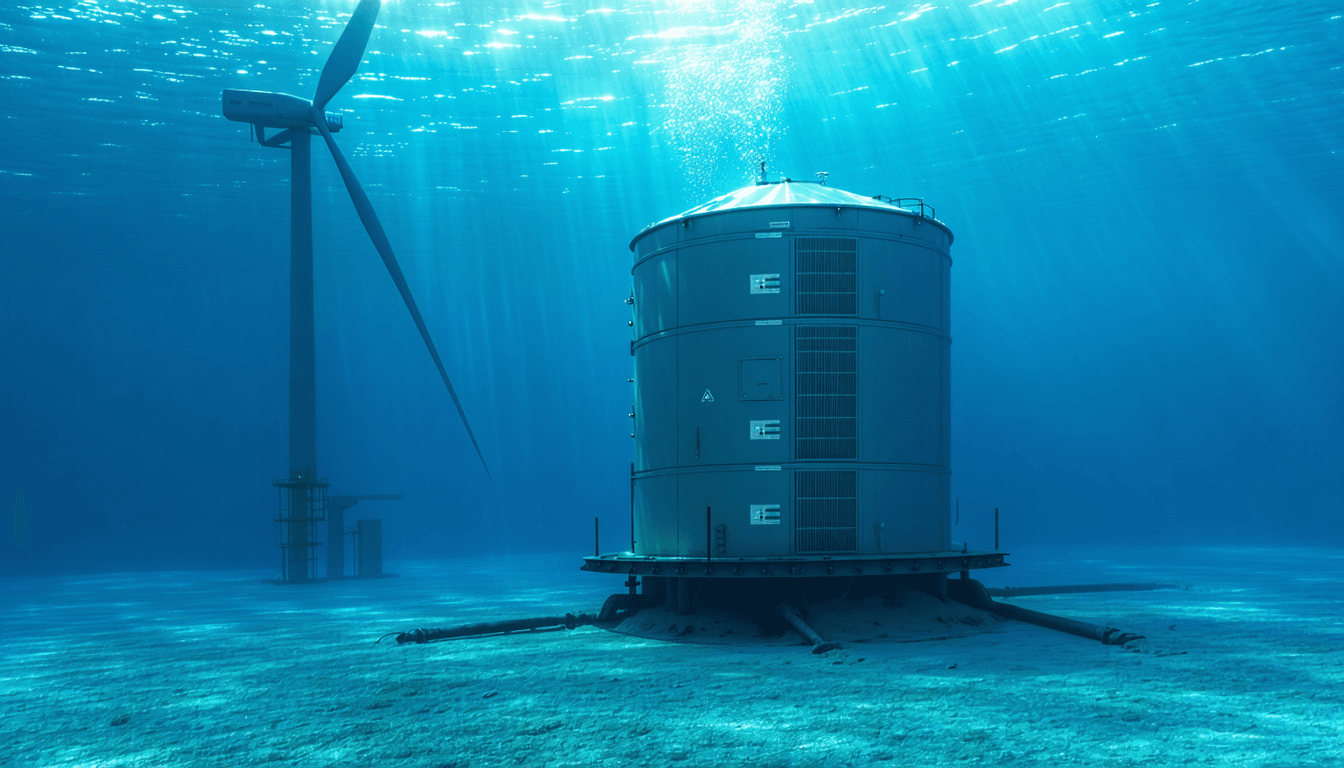
China has put a wind-powered data center in the East China Sea. The 66-degree water temperature threshold its cooling case rests on was already breached across the US East Coast in August.
The Scientist · Science desk
Drafted by a language model from the sources cited here and checked against its claim ledger before publication. How we use AISend a correction
What happened
- At the start of the 2026 summer, a new data center was announced in China, sited off the coast of Shanghai in the East China Sea rather than near a city or on a computing campus.
- The submerged Chinese center is wind-powered, and a government press release boasts that it is the world's first underwater wind-powered data center.
- The submerged Chinese data center is meant to be more environmentally friendly than land versions.
- Ocean temperatures have been steadily increasing since the 1950s, according to NASA, and rising ocean temperatures could reduce the cooling efficiency of underwater data centers.
- Data centers consume so much electricity and water that their energy demands already equal the airline industry, according to a study in The Journal of Strategic Information Systems.
Compiled by The ScientistSomething wrong?How this is made
Why it matters
At the start of summer 2026, China announced a submerged, wind-powered data center off the coast of Shanghai in the East China Sea, which a government press release called the world's first underwater wind-powered data center and pitched as friendlier than the land equivalent [1][2][3]. The environmental argument for putting servers in the sea depends on the sea being cold, and ocean temperatures have been rising steadily since the 1950s, according to NASA [4].
The demand pressure driving the idea is not in dispute. A study in The Journal of Strategic Information Systems puts data center energy demand already on par with the airline industry, and estimates the sector passes 20 percent of global energy demand by 2030 [5][6]. More than half the world's population lives near a coastline, which is why Microsoft engineers tried submersion in the mid-2010s, according to IEEE reporting [7][8]. They lowered a canister off Scotland in spring 2018 and raised it in autumn 2020, roughly two and a half years under, and called it a success: no dust on the servers, nobody knocking into a rack on the way to the break room [9][10][11]. Microsoft has announced no repeat in the six years since [12]. A successful pilot that its own owner did not scale is a data point.
The number operators should care about is a threshold. Ayodele Periola of Cape Peninsula University of Technology in Cape Town told Discover he considers water below 19 degrees Celsius, or 66 degrees Fahrenheit, suitable for what he calls warm cooling [13]. Above that, the design has to lean on a cold-water reservoir to hold efficiency [14], the mitigation he and colleagues proposed in a 2022 Scientific Reports paper to cover marine heat waves [15]. He also said that at higher temperatures cooling still works, but "the effectiveness reduces for servers with high utilization" [16]. High utilization is the entire financial premise of the asset.
In early August 2026, sensors run by NOAA's National Centers for Environmental Data put Nantucket at 78 degrees, Newport, Rhode Island at 74.5, and Portland, Maine at 68.7 [17]. That is 12, 8.5 and 2.7 degrees above the stated threshold [1][2][3]. Water reached the mid-80s off Virginia and the Carolinas and close to 90 in southern Florida, roughly 24 degrees clear of the threshold [18][19][4]. Lake Superior sat in the 50s while the other four Great Lakes were in the high 60s and low 70s, so four of five were above the line [20][5]. Coastal water is shallow water, and shallow water now spends weeks or months well above 66 degrees [21].
The reservoir does not remove the problem, it relocates it into capital and parasitic load, and none of the available material prices it. The same 2022 paper also found that submerged centers taking in warm water discharge it warmer still, with the effect on nearby marine life yet to be evaluated [22][23]. The waste heat lands in the fluid the yield depends on.
What to watch: whether the Shanghai operator publishes inlet water temperature and cooling performance across a full East China Sea summer rather than a commissioning week; whether any disclosure carries the cost of reservoir capacity; and whether Microsoft, holding the longest submerged dataset, says anything at all. The material available gives no site-specific warming rate and no efficiency-versus-temperature curve. An asset whose key input trends the wrong way for its whole life should not be financed without that curve.