Invest1 publisher2 min readPublished
LG Electronics is building its first chiller plant outside Korea in Virginia
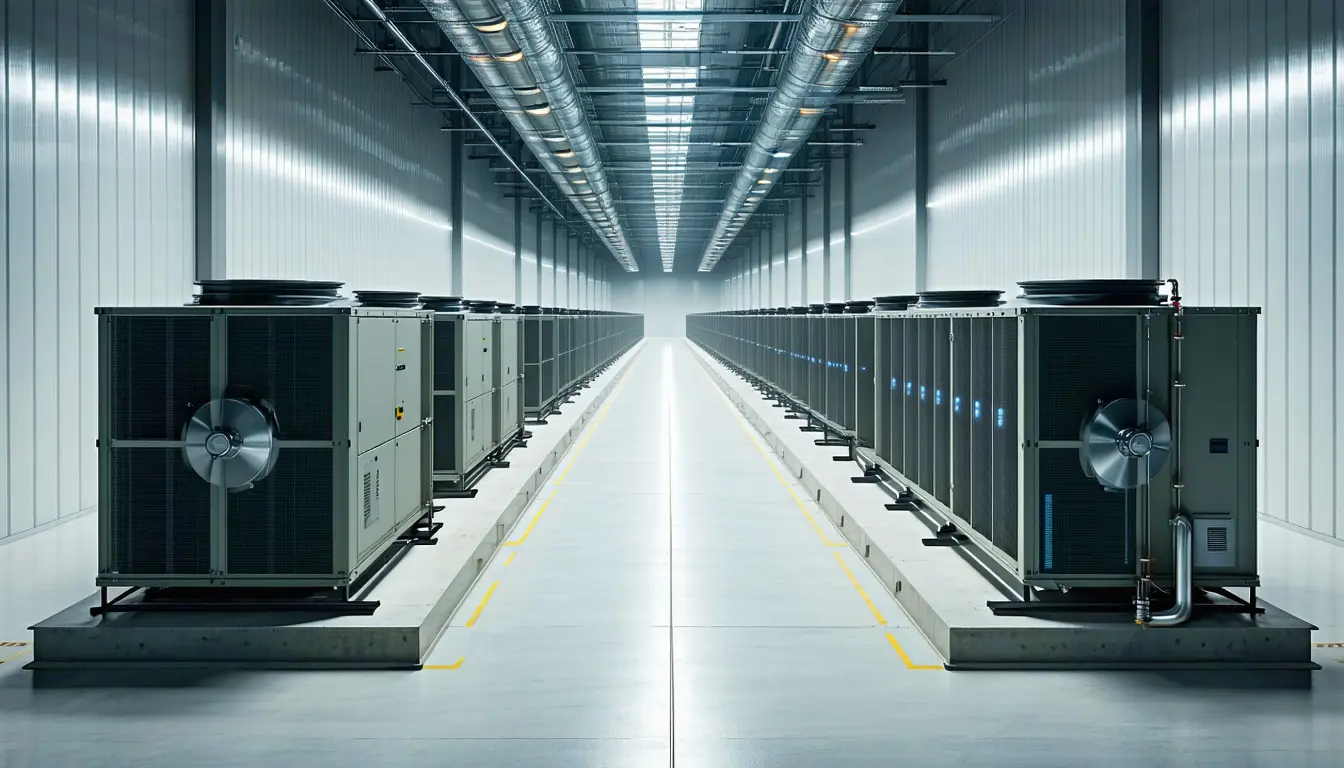
LG Electronics will make air-cooled chillers in Windsor, Virginia, under a 150 billion won program that also expands two Korean plants. It is a small, early stake in a data center market Omdia sees reaching 420 gigawatts by 2030, made before LG's Big Tech supply deals are signed.
The Investor · Invest desk
What happened
- The Windsor plant aims to start operating in the first half of next year, with 32,000 square meters of floor space on a 170,000-square-meter site.
- LG entered the chiller business in 2011 and has served global demand until now from a dedicated plant in Pyeongtaek, completed in 2017.
- Alongside chillers, LG has developed its own CDUs, which move coolant inside servers, and cold plates that sit directly on GPUs, and sells all three as Chip to Chiller.
Compiled by The InvestorSomething wrong?How this is made
Why it matters
- exposure LG is committing to a US plant before its Big Tech contracts are signed, so a stalled Microsoft negotiation would leave Windsor opening without the customers it was built to serve.
- decision Paying for Windsor out of the same 150 billion won as the Pyeongtaek and Changwon upgrades keeps Korea at the center of LG's chiller supply and limits how much it has put on US output.
- constraint Windsor will make only air-cooled chillers, so the CDU orders LG wants from North American hyperscalers will not benefit from the shorter delivery times that local production brings.
LG did not say how much of the 150 billion won goes to Windsor and how much goes to the new lines and equipment at Pyeongtaek and Changwon [11][10]. Even the full sum, roughly $105 million [11], is small next to the market Omdia describes, or rather next to its North American part. Omdia expects data center power capacity to rise from 226 gigawatts this year to 420 gigawatts in 2030 [7]. That adds 194 gigawatts [1], an increase of 86% [2]. If its 60% North American share [8] applies to the 2030 total, about 252 gigawatts would sit on the continent where Windsor is going up [3].
The building is also small relative to its own land. Its floor space is equal to about 19% of the site [2][4]. LG says it will keep expanding and automating its production bases [12], and I'd expect the next round of North American chiller capacity to go on that land first.
The report supports a narrower claim than a cooling shortage. It says heat from servers packed with GPUs is climbing sharply and demand for chillers and liquid cooling is rising rapidly [15], and LG describes Windsor as capacity built ahead of demand [9]. Building ahead of demand means building before the orders are in hand. LG's Big Tech contracts, Microsoft's among them, are still being negotiated, according to sources cited by the Seoul Economic Daily [5].
In my view Windsor is an early, low-cost position in what LG calls the biggest battleground for data center cooling [9]. The counter-thesis is that being early is the value. A plant in the state known as Data Center Valley shortens delivery times for the buyers clustered there [6], and that may be what closes the contracts. If LG signs enough Big Tech volume to fill Windsor before it starts operating in the first half of next year [2], the plant was sized behind demand and this view is wrong.
If the talks slip, Korea keeps supplying the US. The single-conveyor flow lines being added at Pyeongtaek and Changwon by the end of this year [10] raise output there, and Windsor runs below capacity. A third outcome depends on what the chiller connects to. Its chilled water can feed both air and liquid cooling [14]. LG also wants CDU orders from the same hyperscalers [16], so a chiller contract could open the door to that second sale.
What to watch
- Whether LG publishes Windsor's annual unit capacity and how the 150 billion won divides between Virginia and the Korean plants.
- Whether LG's 'One LG' approach of combining affiliates, so far aimed at Asia, extends to its North American data center push.
- Whether the energy-efficiency business that bundles LG cooling with software and power infrastructure wins data center orders alongside the chillers.