Science1 publisher2 min readPublished
Ultrathin silicon membranes let infrared nanospectroscopy work in water
A team at the BESSY II beamline measured proteins, DNA and amyloid fibrils through ultrathin silicon membranes in water, and found the near-field spectra track standard far-field references once a theoretical model accounts for the membrane.
The Scientist · Science desk
What happened
- The BESSY II infrared beamline now has a validated way to run nanoscale infrared spectroscopy on very small biological samples, and on individual biomolecules, under near-physiological conditions using ultrathin silicon-based membranes.
- Earlier in-liquid demonstrations were never benchmarked against established far-field infrared reference spectra. This study set out to close that gap.
- The international team reported that its high-resolution nano-infrared measurements in water reliably match the expected far-field spectra at a resolution of a few tens of nanometers.
- Test samples were bovine serum albumin, DNA molecules and fibrils of alpha-synuclein, the protein that plays a role in Parkinson's disease.
Compiled by The ScientistSomething wrong?How this is made
Why it matters
- capability A spectrum taken from a wet sample can now be read against the far-field reference literature, so chemical identification no longer depends on comparing one near-field measurement with another.
- constraint Every measurement in this geometry depends on the finite dipole description of membrane plus liquid, so the quality of a result is bounded by how well that model holds for a given cell.
- decision Groups building liquid cells have a systematic comparison across membrane materials and liquid conditions to choose from, instead of one working demonstration to copy.
- precedent Protein dynamics and in-situ catalysis are now the stated next targets for the method, and each of them needs a measurement that follows a process in time.
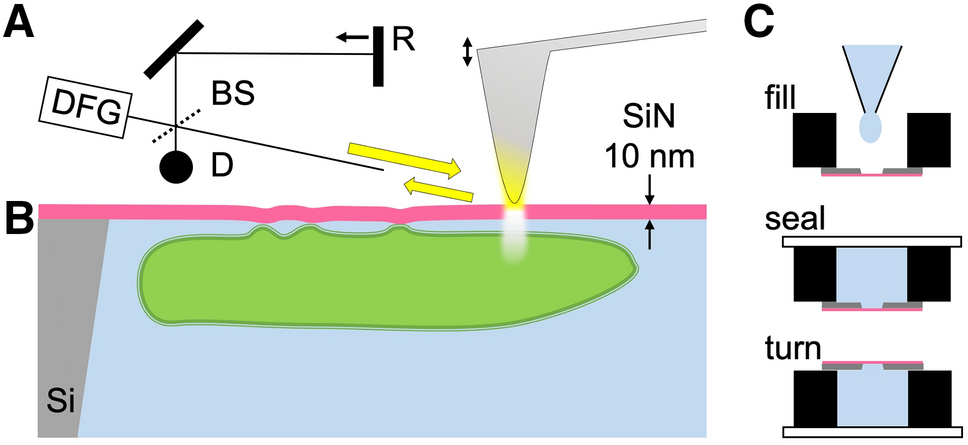
Biomolecules live in water, and water absorbs strongly across the mid-infrared, so s-SNOM has struggled with them [5]. Earlier proof-of-concept work found a way around that: put an ultrathin sheet of silicon nitride or silicon carbide between the microscope tip and the sample [6]. The sheet is transparent in the mid-infrared and acts as a protective film over the liquid [7].
The membrane and the liquid both sit inside the near-field interaction between tip and sample, and those local measurements had not been benchmarked against established far-field reference spectra [8]. Alexander Veber's group varied the membrane material and the liquid environment, then compared the results with theory [9][12]. "The finite dipole model proved to be the key to describing what actually happens at the nanoscale in the presence of the membrane and the liquid," said Maria Eleonora Temperini, the study's first author [13].
"We systematically tested various silicon membranes and examined the samples both in a dry state and in an aqueous environment," Temperini said [10]. The dry measurement is the control. It separates what the membrane and the water do to a spectrum from what the molecule does [9].
Conventional infrared spectroscopy needs a certain amount of material, so it supports only statistical conclusions about individual molecules [19]. s-SNOM in the general case reaches a resolution of up to 10 nanometers [4]; in the liquid cell, the validated figure is a few tens of nanometers, roughly two to five times coarser [18].
"We can now with confidence use s-SNOM to examine biological samples exactly as they occur in nature, in aqueous environments," Veber said [15]. He named protein dynamics and molecular interactions in catalytically active materials as the kind of process the method suits [16]. Both are prospects for now: the measurements reported are of proteins, DNA and fibrils examined dry and in water [20]. The paper, "Understanding In-Liquid Sample Environments for Infrared Nanospectroscopy of Soft Materials", is in Analytical Chemistry [17].
What to watch
- Whether an independent group reproduces the near-field to far-field match on different membrane materials and thicknesses at another beamline.
- A run that follows a process in time in the liquid cell. The protein dynamics and catalysis claims need one.
- Whether the finite dipole model still describes the signal for thicker water layers or for bands that overlap water's own absorption.