Science1 distinct publisher2 min readPublished
Enantiomer testing leans on linear circular dichroism, and a new Science Advances paper argues the sensitivity ceiling is a property of that linearity, which spiral gold structures get around by working at the second harmonic.
The Scientist · Science desk

Compiled by The ScientistSomething wrong?How this is made
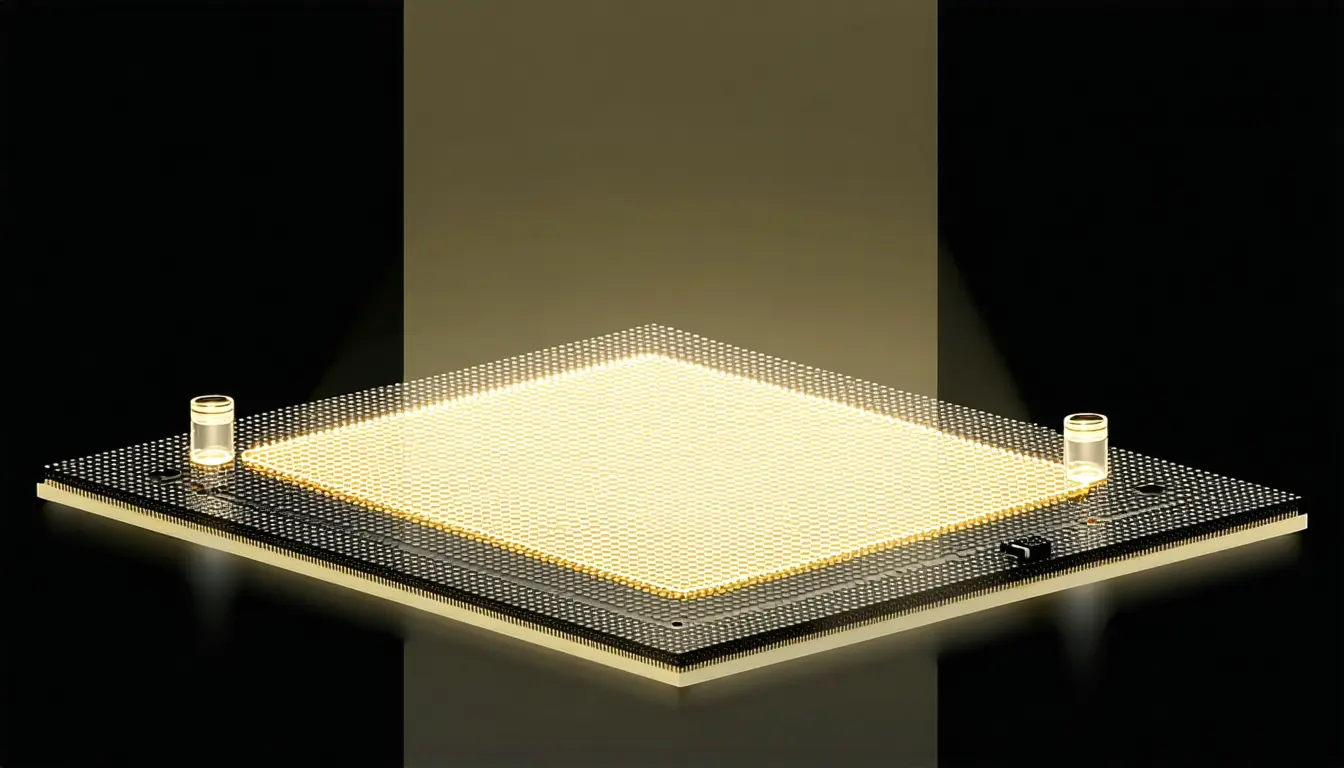
Divide the two scalings and the argument fits on one line. Linear chiroptical response grows roughly with the plasmonic enhancement factor P, while the nonlinear circular dichroism used here grows roughly with P squared, according to Govorov [6]; the ratio of the two is therefore P itself [13]. The advantage over a linear measurement tracks the field enhancement rather than sitting at some fixed multiple, and it does so only inside the small volume where the enhancement is real. That volume is what the spiral geometry is for: the structures amplify both the electric and the so-called superchiral near fields, and the signal appears as circularly polarized second-harmonic generation when chiral molecules interact with the metal surface [2].
The demonstrated sensitivity is about 11 picomolar for adsorbed bovine serum albumin [3], which is 1.1 x 10^-11 moles per litre [14], with a figure of merit reaching 3,260 per micromolar [4]. BSA is a convenient test protein. Whether a small chiral drug molecule behaves the same way on these spirals is the open question, and the account does not report a pharmaceutical substance run on the platform [15].
The source's own framing of the problem is worth keeping in view: conventional circular dichroism and optical rotatory dispersion are the established linear methods in research and industry [7], and their signals are often weak enough to make sensitive detection difficult [8]. The consequence of getting handedness wrong is the thalidomide case, where one enantiomer sedates and the other can cause birth defects [9]. For a quality control bench, though, the more interesting result is not the picomolar figure but the mirror-image pair of chips: left- and right-handed spirals respond preferentially to matching molecular forms, so enantiomer composition can be read out of a racemic mixture without a chromatographic step first [5].
The thing this does not tell you is how well that readout holds up. The writeup says composition can be quantified but gives no accuracy figure and no range of enantiomeric excess over which the response stays usable [12]. It also reports no same-sample comparison against a commercial CD or ORD instrument, no acquisition time, and nothing on chip-to-chip reproducibility [11]. A spiral array is a fabricated object, and a sensor whose response depends on how this week's array came out needs a calibration story before it competes with a column. I would take the scaling relationship as the durable result here, conditional on P staying large where the molecules actually bind; the path to a production instrument runs entirely through the numbers the account omits [11].
Ranked by verification strength, evidence, and original report placement.
Alexander Govorov, Ohio University Distinguished Professor in the Department of Physics and Astronomy and the Nanoscale and Quantum Phenomena Institute, co-authored a study in Science Advances titled "Ultrasensitive Chiral Detection by Nonlinear Chiroptics in Spiral Plasmonic Metastructures Surpasses Linear Limits" with collaborators at Wuhan University in China and the Istituto Italiano di Tecnologia in Italy.
The team developed engineered spiral gold plasmonic metastructures that amplify both electric and "superchiral" optical near fields, enhancing nonlinear optical processes, particularly circularly polarized second-harmonic generation, to create a sensitive signal when chiral molecules interact with their surfaces.
The platform achieved a detection limit of approximately 11 picomolar for adsorbed bovine serum albumin.
The platform reached a figure of merit as high as 3,260 per micromolar, which the account says places it among the highest-performing chiral plasmonic sensors reported.
Left- and right-handed spiral structures preferentially interact with corresponding molecular forms, allowing enantiomer composition to be quantified in a racemic mixture without first separating the molecules chromatographically.
Govorov says that in linear spectroscopy the enhanced optical response scales approximately as P, whereas in the nonlinear CD approach it scales approximately as P squared, where P is the plasmonic electromagnetic enhancement factor.
Distinct publishers with included, body-backed reporting in this cluster.
phys.org
1 article · September 2, 2026
Follow any of these and your For You feed starts watching them — no settings page required.
product
Penn State imaged 100 meters of subsurface using lightning and buried telecom fiber2 distinct publishers
science
Corals hosting heat-tolerant algae lost more tissue when infection followed the heat1 distinct publisher
invest
Shanghai installs a former finance vice-minister in line for mayor a year before the congress1 distinct publisher
science
Comparative brain data recasts evolution as a tug of war between two wiring styles1 distinct publisher
Evidence-backed comparisons of source perspectives and observed adoption signals. Read the methodology
Which Builder, Operator, and Investor concerns the observed source mix emphasized—not a truth score.
Evidence, demonstrated adoption, hype gap, incentives, and confidence are assessed independently, each on its own current evidence. How these are measured.
Peer-reviewed paper, single relayed voice
A Science Advances paper sits underneath this, which is more than a preprint or a demo video, and the two performance numbers are specific enough to be checked by someone with the same equipment. But everything a reader sees comes through Ohio University's own announcement, and the comparison that the title's word "surpasses" implies was never run: no circular dichroism instrument measured the same sample. The scaling argument is the evidence for the advantage.
Nothing outside the lab
The only observable event is a paper reporting its own bench numbers on a model protein. No device, no user, no partner outside the three collaborating institutions, and the on-chip detection that would constitute use is described in the future tense. There is no basis on which to score uptake.
Precise numbers, unpriced advantage
The overstatement is narrow but real, and it lives in the word "surpasses". A squared scaling law says the nonlinear route wins by a factor of P, so the size of the win depends entirely on the enhancement a given chip achieves — yet the account moves from that argument straight to pharmaceutical quality control and forensics without a drug molecule, an incumbent baseline, or a second chip. The physics is not inflated; the distance from it to the application list is.
The university announcing its own professor
This is a communications office writing about a Distinguished Professor at its own institution, and the interview questions are supportive by construction — one asks what the most important advance is, the other what the most promising applications are. The account also volunteers that the collaboration intends to keep publishing joint work and review articles in a "rapidly growing field", which is the interest being served. None of that makes the measurement wrong; it does explain why the caveats a competitor would raise are missing.
One publisher, one paper, one analyte
We can be fairly sure the paper says what the announcement says it says. Beyond that, confidence thins fast: a single publisher relaying a single interested institution, a single model analyte, and no independent replication or outside comment anywhere in our coverage.