Product1 publisher2 min readPublished
Brookhaven runs four X-ray tomography modes on one stage in about six hours
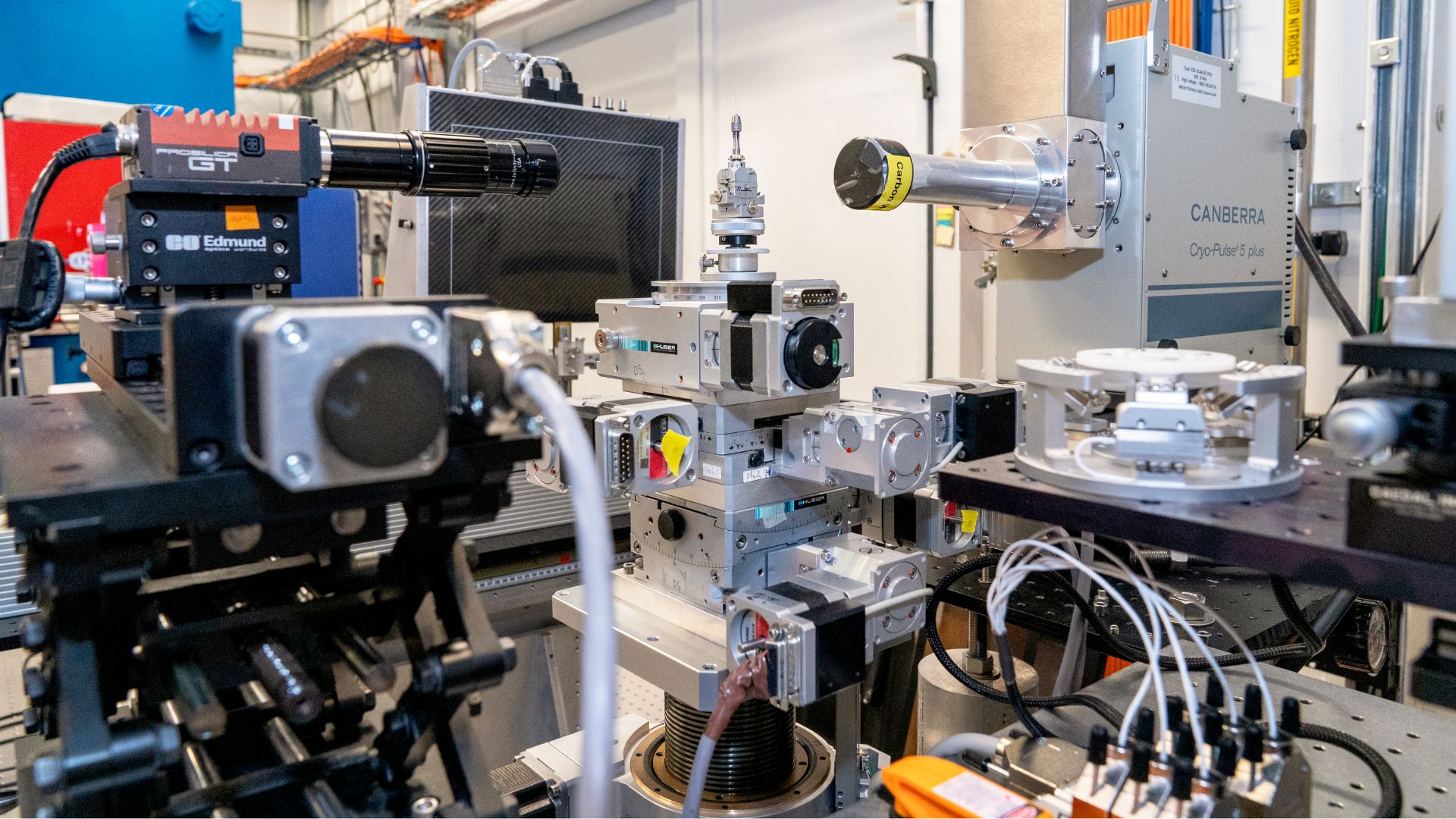
Brookhaven's new station at NSLS-II records density, elemental maps, crystal order and disordered structure from one intact specimen, so the four measurements line up on the same region of the same sample.
The Product Desk · Product desk
What happened
- Engineers at Brookhaven National Laboratory have put four computed tomography modes onto a single test stage at the X-ray Powder Diffraction beamline of the National Synchrotron Light Source II.
- Materials intended for next-generation reactors can now be evaluated in roughly six hours, where assembling the same analytical picture previously took multiple days.
- Hard X-rays give the station enough penetration to see inside structural reactor steels and radioactive actinide fuels such as uranium.
- The modes record physical form, elemental composition and atomic order at the same time, and none of it requires cutting into or degrading the sample.
- The group has also pointed the system at porous filtration media for water remediation and at internal battery changes during charge cycles.
Compiled by The Product DeskSomething wrong?How this is made
Why it matters
- capability Because nothing is sectioned, a coupon can go back under the beam after the next exposure step, so a degradation study becomes a time series on one specimen instead of a set of samples that were never quite identical.
- constraint The capability described sits on one stage at one beamline inside a national lab, so a vendor qualifying an alloy schedules around Brookhaven rather than buying an instrument for its own hall.
- decision At roughly six hours a specimen, program managers have to pick which samples earn a full four-mode pass and which get one cheap in-house measurement.
- precedent If the detector work reaches the sub-30-minute target, the measurement stops being the slow step in a qualification campaign and access to the stage becomes it.
An operator used to carry the same specimen from one instrument to the next, running each measurement separately. That stretched a single experiment across days, and it made inspecting the exact same region under different test conditions difficult [13].
Now the four modes run during one test cycle on one stage [1][7]. A void found by the absorption scan and an element mapped by the fluorescence scan sit at the same coordinates in a sample that was never opened [8][9][12]. At 15 microns, about a quarter of the thickness of a human hair, the beam is narrow enough to separate ordered crystalline sections from irregular zones inside one specimen [4][6].
Nuclear components have to stay intact for decades while radiation, mechanical strain, heat and corrosion work on fuel elements and containment vessels [14]. Brookhaven's account puts understanding those microstructural changes ahead of certifying a new reactor design [15]. The figures published in the Journal of Synchrotron Radiation cover scan time [2][3]; they do not include an estimate of how much sooner a design gets qualified [22].
Simerjeet Gill, deputy chair of Brookhaven's Nuclear Science and Security Department and a co-author of the paper, said: "By conducting these four techniques simultaneously, we can pinpoint exactly where those chemical changes occurred and connect them to how the material's strength and brittleness have changed." [16][17]
The team is building toward faster detectors, with a stated target of under 30 minutes a scan [18]. Six hours is 360 minutes, so meeting that target would be at least a twelvefold cut from the current run [19].
The demonstration itself was modest: an evaluation sample of powders combined with metal wires of varying diameters and compositions, scanned inside six hours to log atomic positions, elemental distributions and physical boundaries [20].
Two questions sort the work for anyone deciding what to send. Whether the answer depends on lining up several measurements on the same region of the same piece, and whether that piece has to survive for the next round of testing [12][13]. When both hold, the six hours and the trip to a national lab are worth it. If the answer is one bulk number from a single technique, the instrument in your own building is cheaper.
What to watch
- Whether the upgraded detectors deliver the stated sub-30-minute scan, and how many specimens a shift then fits.
- Whether the group publishes a four-mode scan of an actual irradiated fuel or cladding sample.
- Whether other light sources build the same four-mode stage, easing the queue at a single beamline.