Leadership1 publisher3 min readPublished
Iran plans exclusion zone near Hormuz requiring permission to transit
American strikes on five Revolutionary Guard tankers and Tehran's plan to stop unpermitted vessels have turned a current-quarter fuel line into a routing and compliance question, with Brent's seven-week high of $97 the part most plans already price.
The Board Room · Leadership desk
What happened
- Four of the tankers were struck in the Gulf of Oman and the fifth near the Persian Gulf island that is Iran's primary terminal for crude oil exports, according to CENTCOM.
- The head of Iran's Supreme National Security Council said Monday that Tehran will announce a maritime exclusion zone outside the Strait of Hormuz and stop vessels transiting without Iranian permission.
- Brent crude traded at a seven-week high of $97 a barrel on Tuesday afternoon, extending a rise that began at the end of August.
Compiled by The Board RoomSomething wrong?How this is made
Why it matters
- constraint A permission regime in the approaches rather than a closed channel turns route choice into a documentary and insurance matter, which no single military outcome settles for a charterer.
- exposure With tankers at Kuwaiti and Bahraini berths named as retaliation targets, cargo risk reaches loading ports and not only vessels in transit.
- decision Fuel cover and alternate loading capacity are cheaper to arrange before Tehran publishes its terms than afterwards, and that choice has to be made without knowing whether the zone will be enforced.
- contradiction Jordan's military supplies the only intercept and casualty count for the strike on its territory while CENTCOM declined to comment, so anyone reading escalation tempo off those numbers is working from one side's tally.
The word doing most of the work in Tehran's announcement is "outside". By its own description the zone the Supreme National Security Council has trailed sits outside the Strait of Hormuz, and the instrument is permission to transit rather than physical closure [4]. A closed chokepoint is one problem, and the answer is simple: the cargo does not move. A claimed right to stop and clear vessels in the approaches is a documentary problem instead, and it has several answers, each priced differently: who asks, who grants, what a refusal costs in waiting time and war-risk cover. That cost lands whether or not a shot follows the announcement.
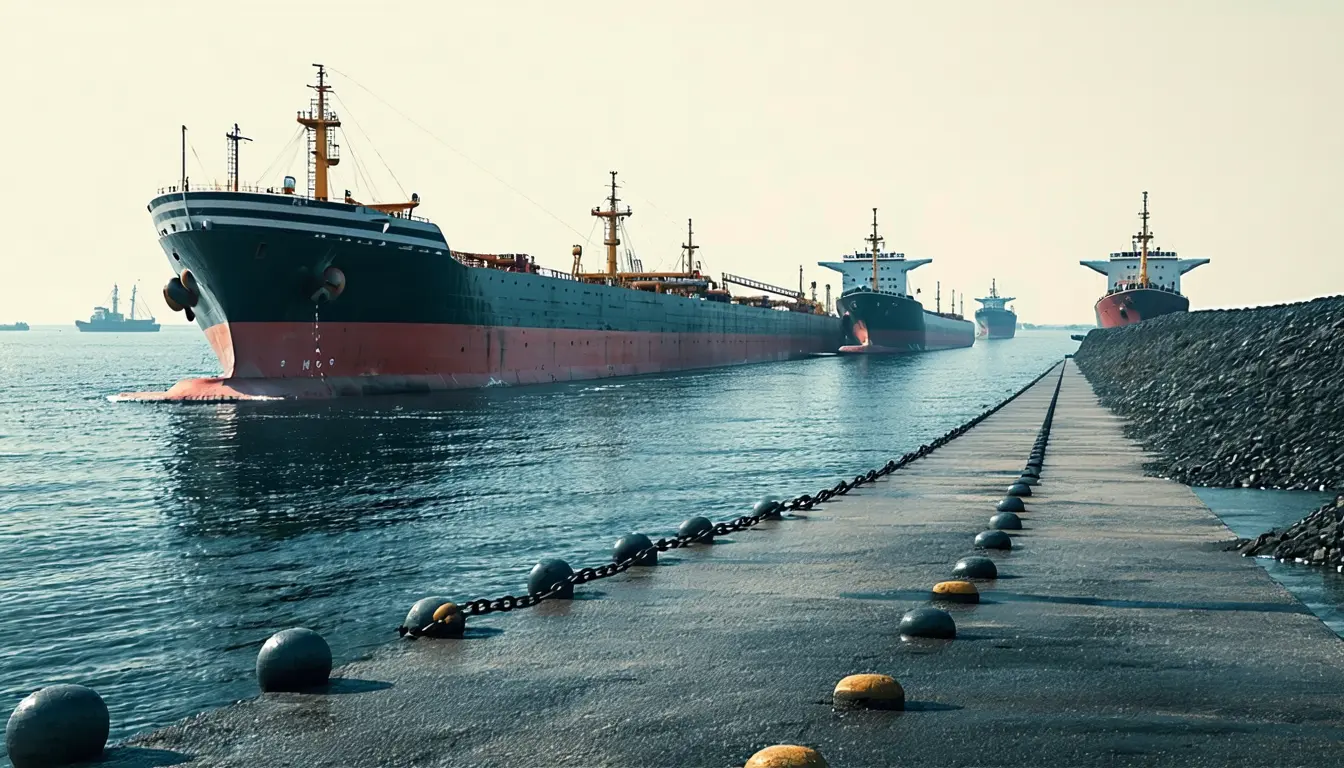
Both sides have now made tanker hulls the instrument of retaliation. US Central Command said it destroyed five tankers associated with the Revolutionary Guards, four in the Gulf of Oman and one near the island that is Iran's primary crude export terminal, after two unsuccessful Iranian missile attacks on a US warship [1][2]; it said crews were directed to abandon ship before the vessels were rendered inoperable [5]. The Guards' navy in turn warned crews of tankers near ports in Kuwait and Bahrain to leave their ships, saying the vessels could be targeted [6]. Exposure now sits at the loading berth as much as in the transit, which is not where a Hormuz-only contingency plan is looking.
On the price, $97 is not a crisis number. Brent's seven-week high on Tuesday afternoon is about 3.1 percent below the round hundred the coverage keeps circling [7][3], and the climb dates only to the end of August [7]. That is because the fuel line is the most easily hedged item in the plan and the least informative one. Neither CENTCOM's account nor the price reporting carries a war-risk premium or a charter rate [4], and that is where a permission regime shows up first.
Risk is also not concentrated in one waterway. The Houthis struck oil facilities in Saudi Arabia and the Saudis retaliated on Tuesday, the worst exchange since the two declared a truce four years ago [8], while Iranian state media said missiles were fired at US targets in Jordan [9]. On the Jordan strike the damage record comes from the defending party: Jordan's military says it intercepted 18 ballistic missiles and two more fell where nobody lives, with no casualties reported, while CENTCOM said it had no information to offer [10].
The casualty listings argue for duration rather than a spike. The Pentagon reported 26 more wounded in action on Tuesday without giving locations or dates [11], and its database shows 403 wounded in overseas operations between July 7 and Sept. 8 [12] alongside 417 from February to July under the earlier Operation Epic Fury label [13]. That is 820 across the two listings [1], and roughly 6.4 a day across the 63 days of the more recent one [2]. A rate that steady describes a campaign being sustained, not a single exchange being absorbed.
This quarter, charterers have to choose between paying now for optionality or paying later for information. Buying fuel cover and booking alternate loading capacity now costs real money against a scenario that may not arrive; waiting preserves the cash but means buying protection after Tehran publishes its terms, from counterparties who have read the same announcement. Iran's armed forces have vowed to target US bases in response to the tanker strikes, according to the semiofficial Tasnim and Mehr agencies [14], so those terms are likelier to arrive mid-exchange than after one. If the zone is declared and enforced even once, permission stops being an event to wait out and becomes a standing line in the cost of moving Gulf cargo.
What to watch
- Whether Tehran formally declares the exclusion zone, and what documentation it demands of transiting vessels.
- Whether the Saudi-Houthi exchange over oil facilities continues past Tuesday's retaliation, since that reaches export infrastructure rather than sea lanes.
- Whether the Pentagon's next casualty listing shows the July-September wounded rate holding or falling.