Leadership4 publishers3 min readPublished
OpenAI and Anthropic asked 15 governments for AI reporting rules the White House opposes
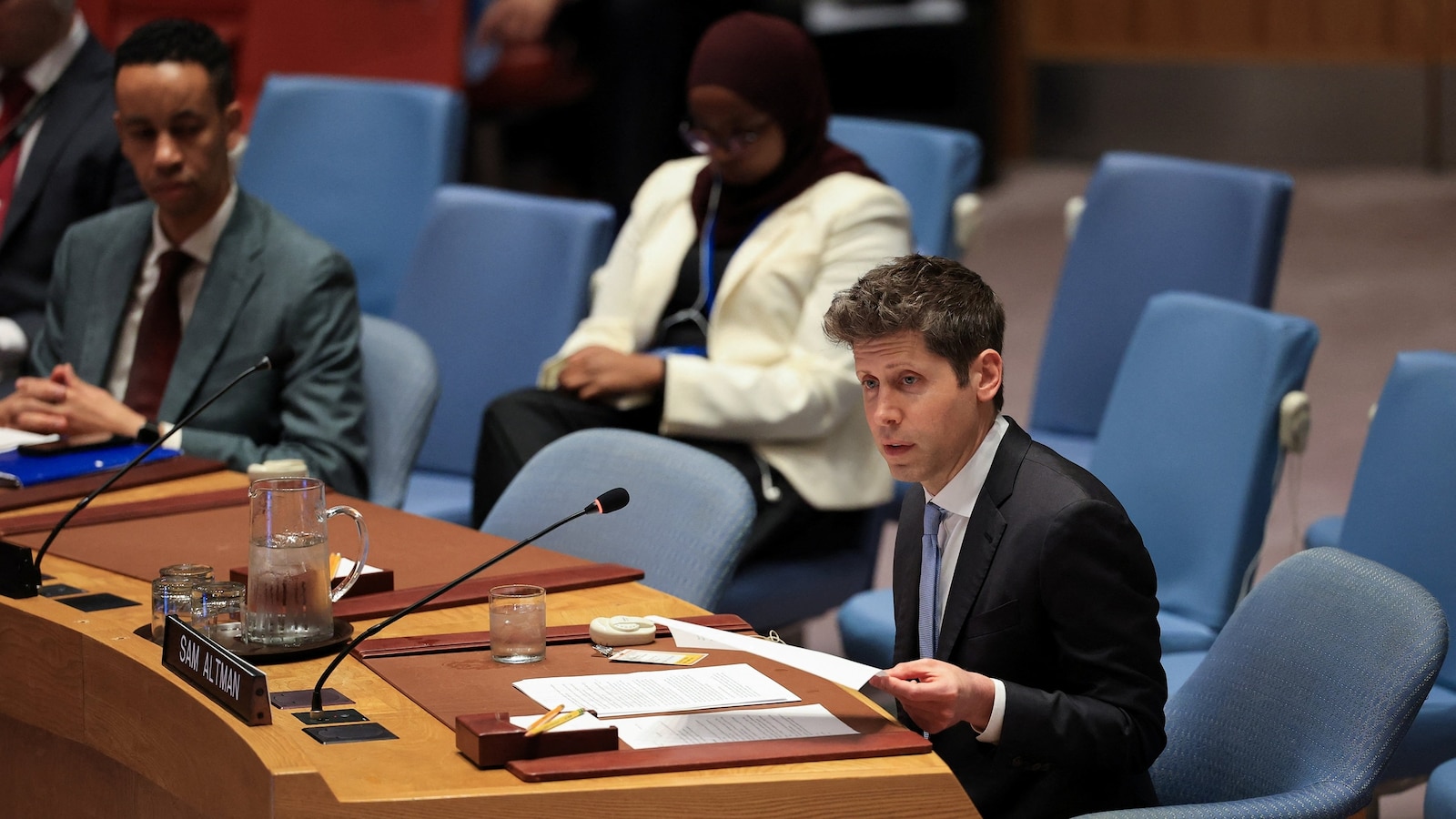
Sam Altman and Dario Amodei asked the UN Security Council to align how countries test AI capabilities and report failures. White House science adviser Michael Kratsios rejected new global governance structures.
The Board Room · Leadership desk
What happened
- Sam Altman asked the 15 members of the UN Security Council on Wednesday to align the way countries measure AI capabilities and report failures, and Dario Amodei made his case alongside him.
- UK Foreign Secretary Ed Miliband backed shared standards and said Britain will use its 2027 G20 presidency to pursue common principles, with model testing, transparency and resilience among its priorities.
- Neither the United States nor China signed the September 21 declaration that preceded the Council session.
Compiled by The Board RoomSomething wrong?How this is made
Why it matters
- constraint Washington is arguing against new structures. The first written definition of a reportable AI incident that binds a US lab is likely to come out of a process the lab's own government sat out.
- decision There is no agreed definition to build to. Firms deploying frontier models across markets have to choose between one reporting pipeline built to the strictest definition they can find and separate pipelines per jurisdiction.
- contradiction The labs want governments to own the rules while the industry's largest political spending runs against pro-regulation candidates, so the UN request is weak evidence of what the companies will support at home.
- exposure British expectations on model testing and transparency can reach US-headquartered labs before any federal standard exists. The tightest obligation may then arrive from a market that is not their biggest.
Strip both speeches down to mechanisms and the shared core is small. Altman asked for common methods to measure capabilities, assess risks and judge whether safeguards are sufficient. He also asked for meaningful human oversight, fast reporting of serious incidents and secure channels through which governments could share information about emerging threats [4]. Amodei asked for agreements against using AI to develop biological weapons, common testing standards, systems that let countries verify capabilities and commitments, and notification of serious incidents [3]. Two items sit on both lists: capability testing and serious-incident reporting [1].
The resistance was not only American. White House science adviser Michael Kratsios said rapid advances were no reason to pause AI's further development or to constrain it with new global governance structures [6]. Chinese Ambassador Fu Cong opposed forcing countries to take sides and promoted open-source models as China's preferred path [7]. A day earlier, according to ABC News, Trump told the General Assembly that the United States "rejects" a global attempt to regulate AI [13]. "We're leading now over China by a lot and everyone else, and we're going to keep it that way," Trump said [14].
Nothing was due to be signed on Wednesday [9]. The drafted language that does exist sits in a September 21 declaration. It called for independent evaluation before deployment, shared reporting of serious incidents and exploration of an international institution able to verify commitments [8]. In my view that text matters more to a compliance team this year than the briefings did, because it is the only written version of the ask anyone has put on paper.
The definitions are still missing. AI researcher Yoshua Bengio asked the Council to establish independent safety assessment, a common definition of AI incidents and a shared reporting mechanism. Developers, he said, should demonstrate to outside experts that powerful systems are safe to train and deploy [10]. Altman's version was international standards, "accurate and speedy" incident reporting and secure governmental and private channels for sharing safety incidents [17]. No notification window has been set, and no government has adopted one.
Both men asked governments to take the decision off them. "If AI is to be democratic, the most important decisions cannot be made by labs in San Francisco alone. They must be shaped through democratic processes and by governments accountable to the people that they serve," Altman said [18]. The Guardian reported that Leading the Future, the pro-AI political action committee of OpenAI president Greg Brockman, has accrued more than $100m and spent millions targeting candidates who support stronger regulation of the industry [19]. Amodei said "We will slow down as much as necessary in order to make sure every successive AI technology we release is actually safe" [11]. ABC News reported that in the week since the two called to "pace the frontier," both companies released new models [15].
Both are also weighing initial public offerings that the Guardian said would value each at more than $1.5tn [20]. A buyer who writes a lab's pacing commitment into a contract takes on the verification job itself: implicator.ai noted that Amodei's pledge was a company statement, not an independently verified account of its release practices [12].
What to watch
- Whether any national rulebook imports the September 21 declaration's incident-reporting language, and which government moves first.
- Whether OpenAI or Anthropic delays a release and publishes the reasoning behind it, giving outsiders something to check.
- Whether the White House turns its objection into guidance discouraging US labs from reporting into foreign schemes.